How Full Should Brake Fluid Be? Correct Level and Safety Tips
Brake fluid should sit between the MIN and MAX marks on the brake fluid reservoir, not above the MAX line or right up to the cap. If the fluid is anywhere within that marked range, it is normally at an acceptable level and does not need topping up. After a properly performed brake fluid service, the level may be set near MAX according to the vehicle’s instructions.
A gradual drop can occur as brake pads wear because more fluid stays in the brake calipers as the pistons extend. However, a reservoir at or below MIN, a sudden drop, or repeated need for fluid can indicate worn brakes or a hydraulic leak. Simply adding fluid can hide a problem that deserves an inspection.
Most cars have a translucent reservoir near the brake master cylinder, making the level easy to check without removing the cap. Some vehicles have special checking procedures or harder-to-access reservoirs.
In this article, I explain where the fluid level should be, how to read the markings, why the level changes, and what overfilling or low fluid can mean. I also cover safe top-up decisions, the correct DOT fluid, warning signs, and when professional brake service is essential.
How Full Should Brake Fluid Be? The Correct Reservoir Level
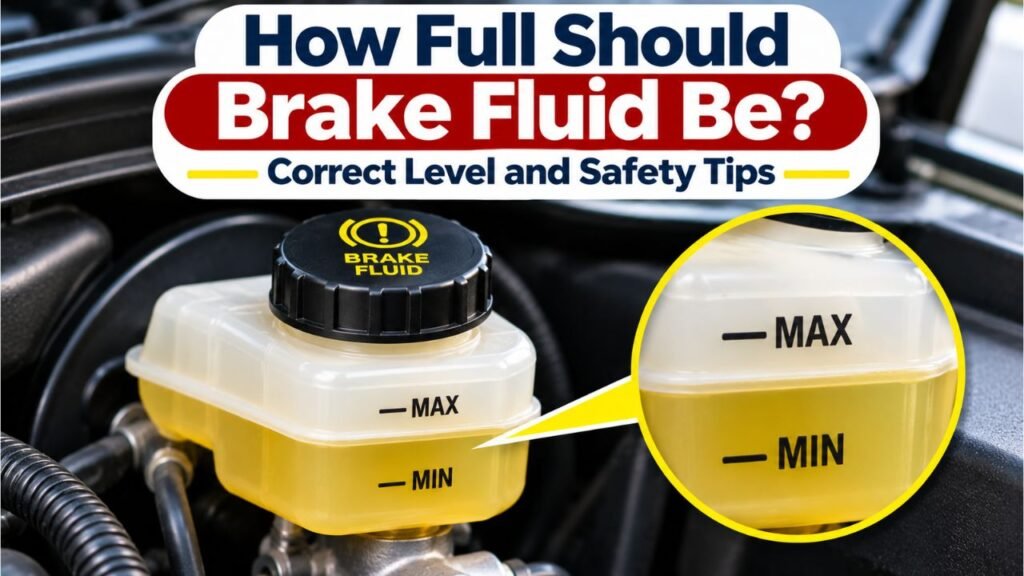
The correct brake fluid level is between the reservoir’s MIN and MAX lines. You do not need to fill the reservoir completely to maintain proper brake operation.
Most modern vehicles have a translucent plastic reservoir with two molded markings:
- MIN: The lower boundary of the specified fluid-level range.
- MAX: The upper boundary of the specified fluid-level range.
The brake fluid should remain inside these limits when checked using the vehicle manufacturer’s procedure.
Brake Fluid Level Chart
| Reservoir Level | What It Means | Recommended Action |
| At the MAX line | Upper limit of the specified range | Normally acceptable |
| Slightly below MAX | Within the normal operating range | No topping up needed |
| Halfway between MIN and MAX | Within the normal operating range | Usually no action needed |
| Slightly above MIN | Still within range, but worth monitoring | Check brake-pad condition and level history |
| At the MIN line | At the lower limit | Arrange a prompt brake inspection |
| Below MIN | Outside the specified range | Do not continue driving until the system is assessed |
| Above MAX | Overfilled or an abnormal reading | Have the level and system checked |
| Reservoir appears empty | Potential serious hydraulic problem | Do not drive; arrange professional assistance |
A level between MIN and MAX is not automatically a sign of missing fluid.
According to Ford’s official brake and clutch fluid checking instructions, fluid within this range is acceptable and does not require adding more. Ford also explains that the level can decrease gradually as brakes wear.
Should Brake Fluid Be at the MAX Line?
Not necessarily.
The MAX line identifies the upper limit, not a level that must always be maintained.
For example, if your brake fluid is halfway between MIN and MAX and the brakes operate normally, adding fluid just to reach MAX is usually unnecessary.
A level near MAX may be expected after certain maintenance procedures or with new brake pads, but the manufacturer’s procedure determines the correct final level.
Should Brake Fluid Be Half Full?
That depends on what you mean by half full.
If the fluid sits halfway between the MIN and MAX marks, it is generally within the normal range.
However, if the reservoir is physically half empty, that does not necessarily tell you whether the level is correct.
The MIN and MAX markings may cover only a portion of the container’s total height.
Use the markings rather than estimating percentages by looking at the reservoir.
Is It Normal for Brake Fluid to Be Below MAX?
Yes.
A level slightly below MAX is common and generally acceptable.
The important point is that it remains above MIN and does not decrease unexpectedly.
A gradual decline may be associated with brake-pad wear.
However, a sudden drop or repeated decrease needs investigation.
How to Check the Brake Fluid Level Correctly
Checking brake fluid is relatively simple on many cars.
Most vehicles have a translucent reservoir that allows you to inspect the fluid without opening the system.
Step 1: Park on a Level Surface
Park the vehicle on reasonably level ground.
An incline can make the fluid appear higher or lower against the reservoir markings.
Apply the parking brake and secure the vehicle according to the owner’s manual.
Step 2: Turn Off the Engine
For many conventional vehicles, a visual check is performed with the vehicle parked and the engine off.
However, some hybrid, electric, and electronically controlled hydraulic brake systems have special checking procedures.
Follow the manufacturer’s instructions if they differ.
Step 3: Locate the Brake Fluid Reservoir
Open the hood and find the brake master cylinder reservoir.
On many cars, it is located toward the rear of the engine compartment, near the firewall on the driver’s side.
The reservoir is often:
- Made of translucent plastic
- Fitted with a screw-on or locking cap
- Marked with MIN and MAX lines
- Labeled with a brake fluid specification
- Positioned above or near the brake master cylinder
Its appearance and exact location vary by vehicle.
Step 4: Identify the MIN and MAX Marks
Look carefully at the side of the reservoir.
The markings may be molded into the plastic rather than printed in a contrasting color.
If the reservoir is dusty, gently clean its exterior.
Do not open the cap unnecessarily.
Step 5: Read the Fluid Level
Look through the reservoir wall.
The boundary between the brake fluid and the empty space above it should indicate the level.
Check whether that boundary falls between MIN and MAX.
A flashlight aimed through the side of the reservoir may help when the plastic is difficult to see through.
Avoid shaking or tilting the reservoir.
Step 6: Evaluate the Reading
If the level is within the specified range, topping up is normally unnecessary.
If the fluid is at or below MIN, arrange a brake inspection.
If it is above MAX, do not ignore the reading, especially if brake work was recently performed.
Step 7: Check for Other Warning Signs
Inspect for symptoms such as:
- Brake warning lights
- Unusual brake pedal travel
- A soft or spongy pedal
- Visible fluid leaks
- Reduced braking effectiveness
- Repeated changes in reservoir level
These conditions require more attention than an ordinary fluid-level check.
Why Does Brake Fluid Level Drop Over Time?
Brake fluid may decrease in the reservoir for two main reasons:
- Normal brake-pad wear
- A leak or other hydraulic-system problem
Understanding the difference is important before adding fluid.
Normal Brake Pad Wear
Disc brakes use hydraulic pressure to push caliper pistons outward.
These pistons press the brake pads against the rotating brake discs.
As the brake pads wear thinner, the pistons gradually extend farther to maintain the proper working position.
More brake fluid then occupies the extended piston chambers.
This fluid comes from the reservoir.
As a result, the reservoir level can gradually decrease.
A small, gradual drop may be normal as brake pads wear, but it should never be used as the only method of determining pad condition.
Brake Fluid Leaks
Unlike normal pad wear, a hydraulic leak allows fluid to escape from the braking system.
Potential leak locations include:
- Brake hoses
- Steel brake lines
- Caliper seals
- Wheel cylinders
- Master cylinder components
- Hydraulic connections
A leak can cause a rapid drop or a continuing decline in the reservoir.
It may also introduce air into the hydraulic system.
This can seriously reduce braking performance.
Can Brake Fluid Evaporate?
Brake fluid is not normally consumed like gasoline or engine oil.
In a properly operating hydraulic brake system, it should not disappear through ordinary evaporation at a rate requiring routine refilling.
Many automotive brake fluids can absorb moisture from the air, which affects their condition over time.
However, moisture absorption is a different issue from a reservoir losing a substantial amount of fluid.
If the level keeps falling, investigate brake wear and possible leaks.
Is It Normal for Brake Fluid to Be Near MIN?
A level close to MIN can occur as brake pads wear, but it should not be ignored.
The difference between a gradual decline and an unexpected loss matters.
When the Level Drops Gradually
Suppose the reservoir was near MAX when new brake pads were installed.
After many miles, the level is closer to MIN.
If the brake pads are worn, their changing thickness may explain part of the decrease.
However, the pads and hydraulic system still need to be evaluated.
Do not assume normal wear is the cause without inspection.
When the Level Drops Suddenly
A sudden decrease is more concerning.
Possible causes include:
- A leaking brake hose
- A damaged brake line
- A leaking caliper
- A wheel-cylinder leak
- A master-cylinder problem
- A recent maintenance error
Even if the brake pedal still feels normal, a sudden loss of fluid requires immediate attention.
What if Brake Fluid Is Exactly at MIN?
Arrange a prompt brake-system inspection.
Do not assume that filling the reservoir will solve the underlying problem.
Hyundai’s brake safety and maintenance guidance advises having the brake system inspected when fluid reaches or falls below the minimum mark.
If the level is below MIN, a brake-system warning is active, or braking performance is abnormal, stop driving and arrange appropriate assistance.
Should You Top Off Brake Fluid?
You generally should not top off brake fluid merely because it is below MAX.
If the level remains inside the normal range, there is usually no need to add anything.
Topping up becomes a different decision when the level is genuinely low.
When Topping Up May Be Appropriate
Adding brake fluid may be part of a proper service procedure when:
- The vehicle manufacturer specifically instructs it.
- A technician has identified and corrected the reason for low fluid.
- The braking system has been serviced or flushed.
- The correct fluid specification is confirmed.
- The final level can be set according to the service procedure.
This does not mean adding fluid should replace diagnosis.
When You Should Not Simply Add Fluid
Avoid treating a top-up as the solution when:
- The reservoir is at or below MIN without an explained cause.
- Fluid is disappearing repeatedly.
- Brake warning lights are illuminated.
- The brake pedal feels unusually soft.
- There is a visible brake-fluid leak.
- The car has reduced braking effectiveness.
- You do not know the correct fluid specification.
These situations require inspection and may require repair.
Why Mechanics May Avoid Routine Top-Ups
If the reservoir level has decreased because the brake pads are wearing, filling it back to MAX can complicate later service.
When worn pads are replaced, the caliper pistons are usually pushed back to accommodate the thicker new pads.
This returns hydraulic fluid toward the reservoir.
If someone previously filled the reservoir too high, the returning fluid may cause overflow.
For that reason, the level should be managed as part of the complete brake-service procedure.
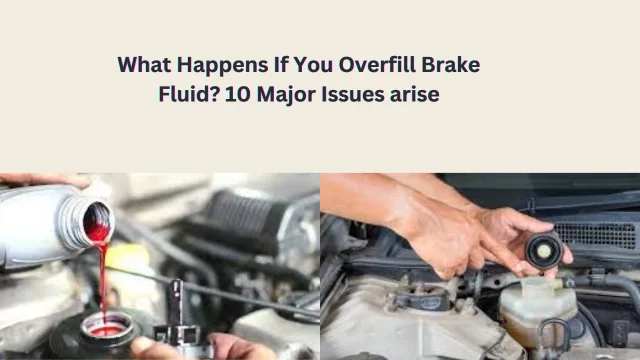
Can Too Much Brake Fluid Cause Problems?
Yes.
The reservoir should not be filled above the manufacturer’s MAX mark.
A brake fluid reservoir is designed to operate within a specified range.
Brake Fluid May Overflow
When caliper pistons are retracted during brake-pad replacement, fluid moves back toward the master cylinder reservoir.
If the reservoir has been overfilled, fluid can spill.
Brake Fluid Can Damage Paint
Many conventional glycol-based brake fluids can damage painted automotive surfaces.
Spilled fluid should be handled promptly according to the vehicle manufacturer’s cleaning instructions.
Avoid letting it remain on painted body panels.
Overfilling May Complicate Brake Service
A reservoir filled beyond its specified maximum leaves less available space for fluid returning during maintenance.
This may create a messy and potentially damaging situation.
Can Overfilled Brake Fluid Cause Brake Failure?
A reading above MAX is not automatically proof that the brakes have failed.
However, an incorrect reservoir level or improper service can create problems.
Ford advises having the system checked if the fluid level is outside its specified range.
Do not attempt to correct suspected overfilling by opening the system and removing fluid with dirty household tools.
A qualified technician can verify the reading and correct the level safely.
What Happens if Brake Fluid Falls Below MIN?
A level below MIN can indicate a condition that compromises the brake system.
The reservoir supplies hydraulic fluid to the master cylinder.
If fluid falls too low, air may enter the braking system.
Air is compressible, unlike the hydraulic fluid used in normal brake operation.
This can produce an abnormal pedal feel and reduce effective braking.
Possible Symptoms of Low Brake Fluid
| Symptom | Possible Explanation | What to Do |
| Brake warning light | Low level or another brake-system fault | Stop safely and investigate |
| Soft brake pedal | Air or another hydraulic problem | Do not continue driving |
| Pedal travels unusually far | Hydraulic or mechanical fault | Arrange professional inspection |
| Visible leak | Escaping brake fluid | Do not drive |
| Repeatedly dropping reservoir level | Leak or brake wear requiring attention | Have the system inspected |
| Reduced stopping ability | Potential serious braking problem | Stop safely and arrange towing |
These symptoms are not exclusive to low brake fluid.
A brake warning light may also indicate a parking-brake condition or another system fault.
An ABS warning light can have a different cause.
Follow the warning-light instructions in your vehicle’s manual.
Can You Drive With Brake Fluid Below MIN?
Do not continue driving with confirmed brake fluid below MIN or with abnormal braking performance.
The underlying cause may be a hydraulic leak or another serious fault.
Adding a small amount of fluid does not establish that the system is safe.
Have the car inspected and use roadside assistance or towing when necessary.
What if the Brake Pedal Goes to the Floor?
Treat this as an urgent brake-system problem.
Move to safety if possible and do not resume driving.
A professional inspection is necessary before the vehicle is returned to normal use.
How Much Brake Fluid Should You Add?
There is no universal number of ounces or milliliters that should be added to every reservoir.
Brake fluid reservoirs vary in:
- Capacity
- Shape
- MIN-to-MAX volume
- Internal chamber design
- Hydraulic-system configuration
- Manufacturer service procedures
For example, one reservoir may require a small quantity to move from MIN toward MAX, while another requires more.
A universal instruction such as adding 2 ounces or 100 mL would not be reliable.
Does the Reservoir Need to Be Completely Full?
No.
Filling it completely to the neck or cap would generally place the fluid above the specified MAX line.
The correct level is determined by the markings and the owner’s manual.
How Much Is Needed After a Brake Fluid Change?
A complete brake fluid flush uses more fluid than a small reservoir top-up because old fluid must be replaced throughout the hydraulic system.
The total quantity depends on the vehicle and the service procedure.
Do not confuse total brake-system fluid capacity with the amount visible in the reservoir.
How Much Fluid Is Between MIN and MAX?
It varies by reservoir.
The marks are level references, not a standardized measuring cup.
Avoid estimating the volume based solely on how tall the reservoir looks.
How to Add Brake Fluid Safely When Required
Adding fluid should only be done when the vehicle manufacturer’s procedure permits it and the reason for low fluid has been addressed.
Do not use topping up as a substitute for inspecting a suspected leak.
Step 1: Confirm the Required Fluid
Check the owner’s manual or the brake reservoir cap.
Identify the exact specification.
Do not rely on the color of the fluid.
Step 2: Prepare a Clean Work Area
Brake fluid is sensitive to contamination.
Clean dust and dirt from the outside of the reservoir and cap before opening it.
Keep tools and containers clean.
Step 3: Use Newly Opened Brake Fluid
Use fresh fluid from a sealed container that meets the required specification.
Do not use fluid from a container that may have absorbed moisture or become contaminated.
Step 4: Open the Reservoir Carefully
Follow the manufacturer’s procedure.
Some vehicles have special brake-system pressure, accumulator, or electronic service requirements.
If the procedure is unfamiliar, have a qualified technician perform it.
Step 5: Add Only the Necessary Amount
If topping up is specifically appropriate, add the correct fluid slowly while monitoring the level.
Do not exceed MAX.
Step 6: Reinstall the Cap
Secure the cap according to the manufacturer’s instructions.
Do not overtighten a cap with a specified tightening requirement.
Step 7: Inspect for Spills
Check the surrounding area.
Clean any spilled fluid promptly using the manufacturer’s recommended procedure.
Keep brake fluid away from painted surfaces.
Step 8: Confirm the Brake System Is Safe
If fluid was added because the reservoir had dropped unexpectedly, the car still requires diagnosis.
If the hydraulic system was opened, proper bleeding and other service steps may be necessary.
Do not assume that a normal-looking reservoir level proves the brakes are safe to use.
What Type of Brake Fluid Should You Use?
The correct type depends on the vehicle.
Common automotive brake fluid classifications include:
- DOT 3
- DOT 4
- DOT 5
- DOT 5.1
These are not interchangeable in every application.
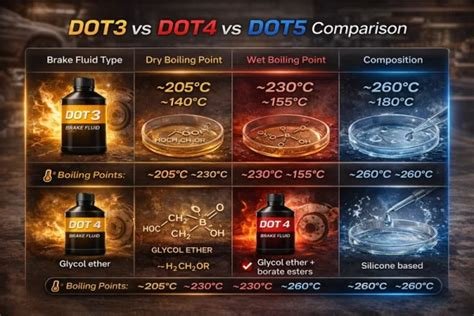
Brake Fluid Type Comparison
| Brake Fluid | General Chemistry | Important Note |
| DOT 3 | Glycol-based | Use when specified |
| DOT 4 | Glycol-based | Often specified for modern vehicles |
| DOT 5 | Silicone-based | Not interchangeable with conventional glycol brake fluids |
| DOT 5.1 | Glycol-based | Different from DOT 5 despite the similar name |
Is DOT 4 Better Than DOT 3?
DOT 4 generally has higher minimum specified boiling-point requirements than DOT 3.
However, that does not mean you should automatically replace DOT 3 with DOT 4.
Use the exact specification approved by the vehicle manufacturer.
Some vehicles permit more than one fluid classification, but others have specific requirements.
Can You Mix DOT 3 and DOT 4?
Both are generally glycol-based, but whether a particular replacement or mixture is permitted depends on the vehicle and fluid specifications.
Do not assume that chemical compatibility alone means manufacturer approval.
The safest approach is to use the specified fluid.
Can You Mix DOT 5 With DOT 3 or DOT 4?
No.
Silicone-based DOT 5 is fundamentally different from conventional DOT 3 and DOT 4 glycol-based fluids.
Mixing incompatible fluids can damage components or impair braking.
DOT 5.1 is not the same as DOT 5.
Why the Correct Fluid Matters
The AAA Car Maintenance Guide’s brake fluid section emphasizes following the vehicle’s specified brake fluid type and avoiding inappropriate fluid mixing.
AAA also warns that using an unsuitable fluid can damage braking components.
If you are unsure which fluid is already in the system, consult a qualified technician rather than guessing.
How Does Brake Pad Wear Affect Brake Fluid Level?
Brake-pad wear is one of the most important reasons a reservoir can show less fluid without an external leak.
How the Hydraulic System Compensates for Pad Wear
As disc brake pads become thinner, the caliper pistons remain farther outward during normal operation.
The extra space behind those pistons must be filled with brake fluid.
That fluid moves from the reservoir into the hydraulic circuit.
As a result, the visible reservoir level decreases.
Example: New Brake Pads vs. Worn Brake Pads
| Brake Condition | Caliper Piston Position | Possible Reservoir Level |
| New pads | More retracted | Often higher |
| Partially worn pads | Somewhat extended | May decrease gradually |
| Heavily worn pads | Farther extended | May be closer to MIN |
| New pads installed correctly | Pistons retracted during service | Fluid returns toward reservoir |
This is a simplified illustration.
Actual reservoir levels vary by vehicle, brake design, service history, and other conditions.
Does Low Brake Fluid Always Mean Worn Brake Pads?
No.
It may indicate pad wear, but it can also indicate a hydraulic leak.
The reservoir level alone cannot distinguish these causes.
Inspect brake pad thickness and the hydraulic system.
Should You Replace Brake Pads When Fluid Reaches MIN?
Not automatically, but the brakes need inspection.
Brake pad replacement should be based on the manufacturer’s wear limits and the actual condition of the braking system.
The fluid level is only one clue.
Why Is Brake Fluid Above MAX After Replacing Brake Pads?
During a brake-pad replacement, the caliper pistons are generally moved back into their bores.
This creates space for the thicker new pads.
As the pistons retract, fluid moves back through the brake lines toward the reservoir.
If the reservoir was previously topped up while the old pads were worn, its level can rise too high.
What Should Happen During Brake Service?
A technician should manage the fluid level throughout the service procedure.
The correct final level depends on the vehicle’s instructions.
The reservoir should not remain above the permitted maximum.
Should You Remove the Extra Fluid Yourself?
If the reservoir is overfilled after brake service, contact the repair shop or a qualified technician.
Avoid using an unclean syringe, funnel, or other household tool.
Contamination can damage a hydraulic brake system.
Can Brake Fluid Be Too Low Without a Warning Light?
Yes.
A brake fluid warning light does not necessarily illuminate the moment the reservoir drops below MAX.
Some vehicles use a level sensor that activates only at a low threshold.
Other vehicles may have different warning-system designs.
What if the Level Is Above MIN and No Light Is On?
That is generally within the acceptable fluid-level range.
However, if the level has dropped rapidly or repeatedly, inspection is still necessary.
A missing warning light does not rule out a brake problem.
What if the Warning Light Is On but the Level Is Normal?
The warning could relate to another condition.
Possible causes include:
- Parking brake engagement
- Brake fluid sensor problems
- Hydraulic-system faults
- Electronic brake-system faults
- Other manufacturer-specific warnings
Do not assume that adding fluid will resolve the warning.
Follow the owner’s manual and arrange diagnosis.
Can an ABS Light Mean Low Brake Fluid?
An ABS warning light generally indicates a problem detected by the anti-lock braking system.
Low brake fluid may be associated with certain brake-system warnings, but it is not the only possible cause.
ABS and red brake warning lights can indicate different problems.
Check the specific vehicle’s warning descriptions.
How Often Should You Check Brake Fluid Level?
Check the brake fluid level at the intervals recommended in your owner’s manual.
For vehicles with an accessible translucent reservoir, a quick visual inspection during routine maintenance is useful.
Practical Checking Schedule
| Situation | Suggested Action |
| Routine vehicle maintenance | Visually check the reservoir |
| Before a long trip | Check fluid level and braking condition |
| After brake service | Confirm the correct level as part of service |
| Brake warning light appears | Stop safely and investigate |
| Brake pedal feels abnormal | Do not continue driving |
| Fluid level drops unexpectedly | Arrange a prompt inspection |
| Fluid repeatedly needs adding | Investigate for leaks or wear |
A monthly visual check can be a reasonable routine for many vehicles, but the owner’s manual takes priority.
Should You Open the Reservoir Every Month?
No.
On a translucent reservoir, the level can usually be checked without removing the cap.
Unnecessary opening increases opportunities for moisture and contamination to enter.
Keep the cap securely installed unless a maintenance procedure requires access.
Does Brake Fluid Color Tell You if the Level Is Correct?
No.
Fluid color and fluid quantity are different characteristics.
A reservoir can contain the correct amount of fluid even when the fluid itself needs replacement.
Likewise, newly added clear fluid does not prove that the hydraulic system is safe.
Normal Brake Fluid Appearance
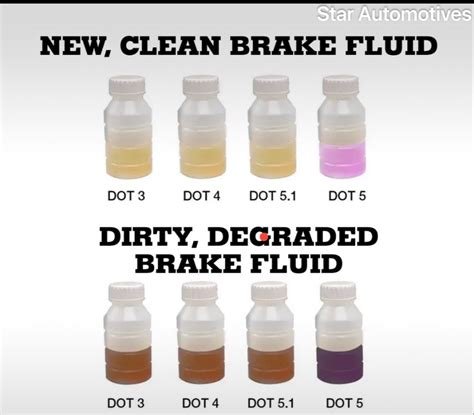
Many new DOT 3 and DOT 4 fluids have a clear to amber appearance.
However, appearance varies by formulation and age.
Dark Brake Fluid
Brake fluid may darken over time because of aging and contaminants.
Very dark or visibly contaminated fluid deserves inspection.
However, color alone is not a reliable measurement of water content or overall fluid condition.
Cloudy or Contaminated Fluid
Cloudiness, unusual particles, or other visible contamination can indicate a problem.
Do not add more fluid in an attempt to dilute contamination.
Have the system evaluated.
Can You Tell Moisture Content by Looking?
Not reliably.
Conventional glycol-based brake fluid absorbs moisture over time.
Moisture can reduce the fluid’s boiling point and affect braking performance under demanding conditions.
Professional testing and the manufacturer’s replacement schedule are more dependable than color alone.
Does the Brake Fluid Reservoir Need to Stay Full After a Flush?
After a brake fluid change or flush, the technician should set the reservoir to the level specified by the manufacturer.
That may be near MAX when the system has been serviced correctly.
However, it should never be filled beyond the maximum marking.
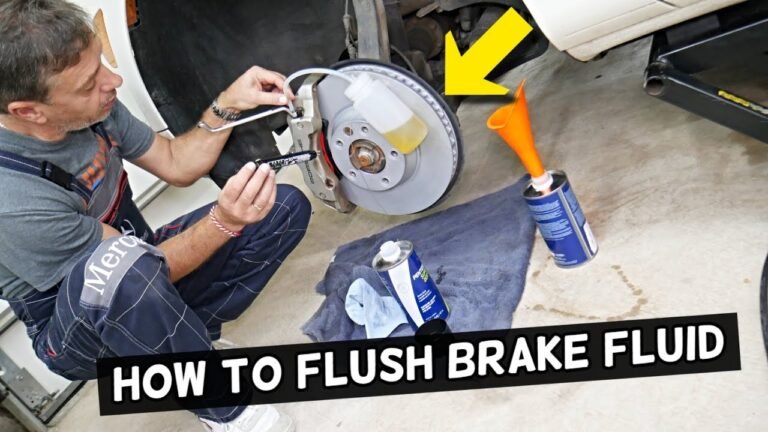
Why a Brake Fluid Flush Is Different From Topping Up
Topping up adds a small amount of fluid to the reservoir.
A flush or fluid replacement removes old fluid from the hydraulic system and replaces it with new fluid.
A proper service may also include bleeding and inspection.
Adding new fluid to the reservoir does not remove degraded fluid from the brake lines and calipers.
Can You Just Add New Fluid Instead of Replacing Old Fluid?
No, not as a substitute for scheduled fluid replacement.
Old brake fluid can remain in the hydraulic circuit even after new fluid is added to the reservoir.
Follow the vehicle’s brake fluid replacement schedule.
What Happens if the Reservoir Runs Dry During Bleeding?
Air may enter the hydraulic system.
This can complicate the bleeding procedure and require additional service steps.
Some vehicles with ABS or electronically controlled brake systems require specialized bleeding equipment or software.
If the reservoir has run dry during brake service, use the proper manufacturer procedure before returning the vehicle to the road.
Brake Fluid Levels in Different Vehicles
The MIN-to-MAX principle applies to many passenger vehicles, but some systems have specific requirements.
Gasoline-Powered Cars
Most conventional passenger cars use a brake master cylinder reservoir with clearly marked limits.
Read the fluid level according to the owner’s manual.
SUVs and Pickup Trucks
SUVs and trucks commonly use similar reservoirs.
However, the total fluid capacity and exact reservoir design differ by model.
Do not use a passenger car’s fluid quantity as a reference for a truck.
Hybrid Vehicles
Some hybrids have electronically controlled brake systems and hydraulic accumulators.
Reservoir readings may depend on the brake-system state.
Follow the exact manufacturer’s checking procedure rather than relying on general assumptions.
Electric Vehicles
Electric vehicles still have hydraulic braking systems, even when regenerative braking provides some of the deceleration.
Their brake fluid also requires appropriate maintenance.
Use the manufacturer’s specified inspection method.
Manual-Transmission Vehicles
Some manual-transmission vehicles use a shared fluid reservoir for the brakes and hydraulic clutch.
Other vehicles have separate clutch reservoirs.
Check the owner’s manual before identifying or servicing either system.
Common Mistakes When Checking or Filling Brake Fluid
Several mistakes can lead to unnecessary repairs or create safety risks.
Filling to the Top of the Reservoir
The correct level is not necessarily the neck of the container.
Do not exceed MAX.
Topping Up Every Time the Level Drops Slightly
A gradual decrease may occur with brake-pad wear.
If the fluid remains within the normal range, a top-up is generally unnecessary.
Ignoring a Level at or Below MIN
A low level can indicate worn brake components or a leak.
Arrange a brake inspection instead of assuming more fluid will solve the problem.
Using the Wrong Brake Fluid
The wrong fluid can damage seals or other braking components.
Use only the manufacturer’s approved specification.
Mixing DOT 5 With Conventional Brake Fluid
Silicone-based DOT 5 is not interchangeable with common glycol-based brake fluids.
Do not mix incompatible types.
Opening the Reservoir Unnecessarily
Brake fluid can absorb moisture, and dirt can contaminate the system.
Inspect the level through the reservoir wall when possible.
Using an Old or Unsealed Bottle
Brake fluid stored in an opened container may have absorbed moisture.
Use fresh, properly stored fluid as specified by the manufacturer.
Overlooking Brake Pad Wear
Fluid levels can drop as brake pads wear.
Inspecting the brake pads is important before assuming that a top-up is appropriate.
Ignoring an Abnormal Brake Pedal
A soft, sinking, or unusually long-travel pedal can indicate a serious problem.
Do not treat it as a simple reservoir-level issue.
Assuming Correct Level Means Safe Brakes
A reservoir between MIN and MAX does not guarantee the whole braking system is healthy.
Brake pads, rotors, calipers, hydraulic lines, electronic controls, and fluid condition all matter.
What to Do Based on Your Brake Fluid Level
The following guide summarizes the safest practical response.
| What You Find | Recommended Next Step |
| Fluid near MAX | Leave it alone if within specification |
| Fluid halfway between marks | Usually no fluid needed |
| Fluid slightly above MIN | Monitor and check pad wear and service history |
| Fluid at MIN | Arrange prompt brake inspection |
| Fluid below MIN | Do not drive until professionally assessed |
| Fluid above MAX | Have the overfill or abnormal condition corrected |
| Fluid drops soon after top-up | Investigate a possible leak immediately |
| Brake warning plus abnormal pedal | Stop safely and arrange assistance |
| Fluid looks contaminated | Have fluid condition and system checked |
| Correct fluid level but poor braking | Seek diagnosis; the problem may be elsewhere |
The most important distinction is between an acceptable level within the marks and an unexplained fluid loss.
Conclusion
So, how full should brake fluid be? The reservoir should contain enough fluid to keep the level between the MIN and MAX markings when checked according to the vehicle manufacturer’s instructions.
You do not need to fill the reservoir completely.
A level halfway between the marks is generally acceptable, and topping up simply because the fluid is below MAX is usually unnecessary.
Brake fluid can gradually move from the reservoir into the calipers as brake pads wear. However, a level at or below MIN, a sudden decrease, or repeated fluid loss needs professional attention.
I recommend checking the reservoir visually during routine maintenance, following the manufacturer’s specifications, and avoiding unnecessary opening or topping up.
If brake fluid must be added as part of an approved maintenance procedure, use only the correct fresh fluid and do not exceed the maximum mark.
Most importantly, never assume that adding brake fluid will repair a hydraulic leak or restore a failing brake system.
The safest brake fluid level is within the specified MIN-to-MAX range, with no unexplained loss and a properly functioning braking system.
FAQs About How Full Brake Fluid Should Be
Should Brake Fluid Be at the MAX Line?
Not always. The fluid should be between the MIN and MAX marks. A level below MAX but above MIN is generally acceptable and does not require topping up. MAX is the upper limit, not a target that must be maintained after every inspection.
Is It OK for Brake Fluid to Be Halfway Between MIN and MAX?
Yes. Halfway between the marks is normally within the specified operating range. However, a rapid decrease to that level or repeated fluid loss still deserves inspection, even if the fluid remains above MIN.
Can You Drive With Brake Fluid at the MIN Line?
A reservoir at MIN requires prompt brake-system inspection. If the fluid is below MIN, a brake warning is active, or braking performance is abnormal, do not continue driving. Arrange professional assistance rather than simply adding fluid.
How Much Brake Fluid Should You Add When It Is Low?
There is no universal amount because reservoir sizes and hydraulic systems differ. Only add fluid when the manufacturer’s procedure or a qualified inspection indicates it is appropriate. Use the specified fluid and never exceed MAX. Unexplained low fluid requires diagnosis first.
Will Brake Fluid Rise After Replacing Brake Pads?
Yes, it often does. When caliper pistons are retracted to accommodate thicker new brake pads, fluid moves back toward the reservoir. If the reservoir was previously overfilled, it may overflow during service. The final level should be set according to the manufacturer’s procedure.
What Happens if You Overfill Brake Fluid?
Excess fluid can overflow when hydraulic components are serviced, potentially damaging paint and contaminating surrounding surfaces. A level above MAX is outside the specified range and should be checked and corrected appropriately.
Is It Normal to Lose Brake Fluid Over Time?
A gradual reservoir-level decrease can happen as brake pads wear, but brake fluid should not routinely disappear from a healthy hydraulic system. A sudden drop or repeated need for fluid can indicate a leak or another problem requiring inspection.
Does Brake Fluid Need to Be Full After Bleeding Brakes?
After bleeding or replacing brake fluid, the reservoir must be set to the manufacturer’s specified level. It should not be filled beyond MAX. If air entered the hydraulic system during service, proper bleeding and any required specialized procedures must be completed before driving.