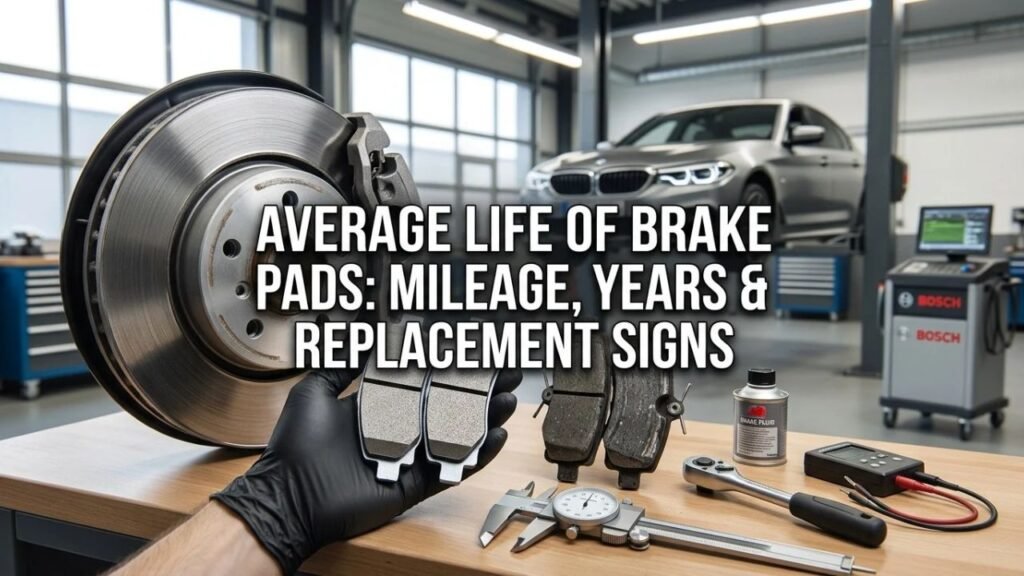
Average Life of Brake Pads: Mileage, Years & Replacement Signs
Most passenger-vehicle brake pads last roughly 30,000 to 70,000 miles, though some wear out closer to 20,000 miles while others can exceed 80,000 miles. Driving style, traffic, vehicle weight, terrain, pad compound, brake condition, and front-to-rear brake balance all have a major influence on actual service life.
AAA currently gives a broad brake-pad lifespan of about 30,000 to 80,000 miles, while Firestone places many pads around 30,000 to 70,000 miles. These wide ranges show why mileage is better treated as an inspection guide than an automatic replacement interval.
The average life of brake pads for a typical daily-driven car can reasonably be thought of as somewhere around 30,000 to 70,000 miles, but the physical thickness of the friction material tells you far more about remaining life than the odometer alone.
Brembo states that new automotive pads are commonly around 10–12 mm thick and recommends replacement once friction material drops below about 3 mm. Firestone similarly describes roughly 3–4 mm as a common replacement range.
There is also no universal number of years after which brake pads expire. A car driven 25,000 city miles a year can consume a set much faster than a car driven 5,000 highway miles. Low-mileage vehicles can have another issue: corrosion, sticking calipers, or uneven brake operation may require service even though plenty of friction material remains.
The sections below explain typical mileage, front and rear wear, material differences, driving factors, inspection thickness, and the warning signs that tell you replacement should not be delayed.
Average Life of Brake Pads in Miles
For most gasoline and hybrid passenger vehicles, a practical lifespan range is:
| Driving situation | Approximate brake-pad life |
| Severe city or mountain use | 20,000–30,000 miles may occur |
| Typical mixed driving | 30,000–70,000 miles |
| Light highway-focused use | 60,000–80,000+ miles can occur |
| EV or hybrid with heavy regenerative braking | Friction pads may last much longer, but still need inspection |
These are planning ranges rather than service specifications.
AAA gives 30,000–80,000 miles as a general range, and Firestone has published ranges from roughly 25,000 to 70,000 miles depending on the vehicle, pad, road conditions, and driver.
Your owner’s manual, pad thickness, brake inspection results, and any wear-warning system should take priority over an average mileage figure.
How Many Years Do Brake Pads Last?
Brake pads do not have a universal age-based replacement interval like some fluids or rubber components.
A set could last:
- Two years on a high-mileage urban vehicle
- Four or five years on a moderate-mileage commuter
- Much longer on a low-mileage car or EV
Mileage alone is not the whole story either.
A vehicle that sits for long periods can develop:
- Rotor rust
- Corroded pad hardware
- Sticking slide pins
- Caliper problems
- Uneven inner and outer pad wear
- Pads binding in the bracket
For a lightly driven vehicle, regular inspection is more useful than assuming the pads are safe because they are only a few years old.
AAA recommends regular brake-system inspections, while Brembo advises checking pad condition at least yearly or during scheduled service.
How Thick Are New Brake Pads?
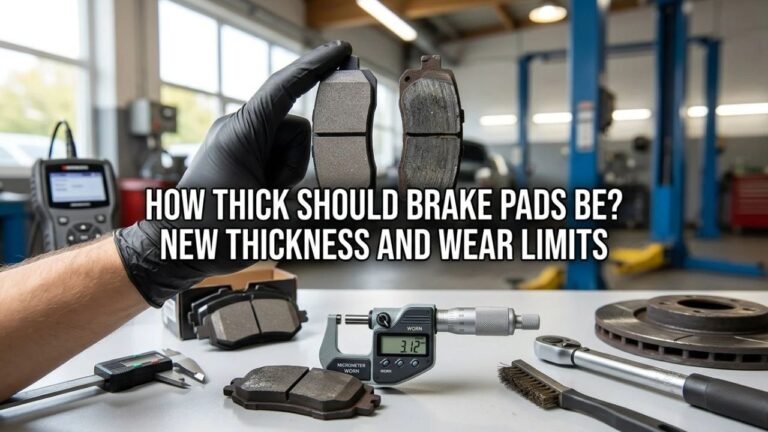
Many new passenger-vehicle brake pads have around 10–12 mm of friction material.
Brembo uses that range as a general reference and identifies less than about 3 mm as replacement territory.
Pad thickness varies by:
- Vehicle
- Axle
- Pad design
- Friction compound
- OE specification
Do not assume that every new pad starts at exactly 12 mm.
The metal backing plate is not included when checking usable friction-material thickness.
At What Thickness Should Brake Pads Be Replaced?
A common practical guideline looks like this:
| Friction material | General interpretation |
| 8–12 mm | Plenty of material on many designs |
| 6–7 mm | Moderate wear |
| 4–5 mm | Start watching more closely |
| 3–4 mm | Replacement planning/service range |
| Around 2 mm | Very near wear indicator on many pads |
| Metal-to-metal | Pad is exhausted; rotor damage likely |
Brembo recommends changing pads below about 3 mm, while Firestone cites roughly 3–4 mm as a common replacement point.
Firestone also notes that many mechanical wear indicators begin producing a warning as the friction material approaches roughly 2 mm.
Do not deliberately drive a pad down to zero thickness.
Once the friction layer is gone, the steel backing plate can grind against the rotor, greatly increasing repair cost.
Do Front Brake Pads Wear Faster Than Rear Brake Pads?
Often, yes.
During braking, vehicle weight transfers toward the front axle. Front brakes commonly handle a larger share of braking force, which can make the front pads wear faster.
AAA states that front pads commonly take much of the braking load and gives roughly 30,000–70,000 miles as a typical front-pad replacement range.
That does not mean rear pads always last longer.
Modern vehicles may use the rear brakes aggressively for:
- Stability control
- Traction control
- Electronic brake-force distribution
- Adaptive cruise control
- Parking-brake functions
A sticking rear caliper can also destroy a rear pad much earlier than expected.
The safest approach is to inspect all four corners rather than predicting rear-pad life from the front pads.
What Makes Brake Pads Wear Out Faster?
Brake pads disappear through friction, so anything that increases braking frequency, force, temperature, or drag can shorten their life.
Stop-and-Go Traffic
City driving is hard on brake pads.
A highway car may travel dozens of miles with only a few brake applications.
A city commuter might brake repeatedly every few hundred feet.
AAA directly identifies urban stop-and-go driving as a factor that shortens brake-pad life.
Hard Braking
Late, aggressive braking converts more vehicle energy into heat at the pads and rotors.
Repeated high-temperature stops accelerate friction-material wear.
Firestone lists frequent hard braking among the common causes of early brake wear.
Mountain and Hilly Driving
Long descents can keep the brakes loaded for extended periods.
AAA notes that hilly driving can shorten brake and rotor life because the brake system is used much more frequently.
Using an appropriate lower transmission gear on long descents can reduce continuous brake application where the vehicle manufacturer recommends it.
Vehicle Weight and Towing
A heavier vehicle contains more kinetic energy at a given speed.
Towing a trailer adds even more mass.
Stopping that combined weight places greater demand on the braking system, especially during repeated stops.
Riding the Brake Pedal
Keeping slight pressure on the brake pedal while driving can create constant friction and heat.
AAA advises against riding the brakes as a way to reduce premature wear.
Mechanical Brake Problems
A pad can wear quickly even with gentle driving if the brake is dragging.
Possible causes include:
- Seized caliper piston
- Sticking slide pin
- Corroded pad hardware
- Collapsed brake hose
- Parking brake not fully releasing
One pad being dramatically thinner than its partner is a reason to inspect the system rather than simply install new pads.
Key Takeaway: Heavy traffic, aggressive stops, hills, towing, excess weight, brake riding, and dragging calipers can reduce pad life far below the normal mileage range.
How Brake Pad Material Affects Lifespan
Brake-pad material changes noise, dust, heat behavior, rotor interaction, pedal feel, and wear.
Organic Brake Pads
Organic pads are made from non-metallic fibers and binders.
They can offer:
- Quiet operation
- Smooth engagement
- Lower initial cost
They may wear faster under demanding driving than some ceramic or semi-metallic compounds.
Semi-Metallic Brake Pads
Semi-metallic pads contain a substantial amount of metal in the friction compound.
They often provide:
- Strong heat tolerance
- Good braking under demanding conditions
- Durability for heavier vehicles or workloads
They can produce more noise and brake dust and may be harder on rotors than some ceramic formulations.
Ceramic Brake Pads
Ceramic pads are common on modern passenger cars.
AAA notes that ceramic products tend to offer long service life, low noise, and low dust in daily driving, though exact performance varies by formulation and vehicle.
Akebono, a major OE brake supplier, markets its vehicle-specific ceramic ProACT line around reduced pad and rotor wear and states that certain applications can last up to 40% longer than comparison formulations in its testing.
Do not select pads from material name alone. Use the compound recommended for the vehicle and its operating conditions.
Key Takeaway: Organic, semi-metallic, and ceramic compounds can wear at different rates, but vehicle-specific formulation and operating conditions matter more than assuming one material always lasts longest.
Do Ceramic Brake Pads Last Longer?
Often, but not universally.
A quality ceramic pad can have a long lifespan in normal passenger-car use because the friction material is designed for stable wear, lower dust, and controlled noise.
AAA states that ceramic pads tend to last longer under normal daily driving than basic organic options.
Still, a ceramic pad on a heavy vehicle driven aggressively through mountain roads might wear faster than a well-matched semi-metallic pad on a highway commuter.
Pad quality and vehicle engineering matter more than the word “ceramic” printed on the box.
Do EV Brake Pads Last Longer?
They often can.
Electric vehicles and many hybrids use regenerative braking, where the drive motor slows the vehicle and returns some energy to the battery.
That reduces how often the friction brakes need to do all of the stopping work.
Brembo notes that regenerative braking leads to more intermittent use of conventional friction brakes on EVs. It also points out a side effect: reduced brake use can make corrosion a bigger concern.
An EV may therefore have plenty of pad thickness after high mileage yet still need brake service because of:
- Rotor corrosion
- Pad corrosion
- Sticking hardware
- Uneven contact
Long pad life does not remove the need for brake inspection.
Signs Your Brake Pads Are Near the End of Their Life
Do not wait for a mileage target if the vehicle is already giving warning signs.
Common symptoms include:
- Consistent squealing when braking
- Grinding
- Brake wear warning light
- Longer stopping distance
- Reduced pad thickness
- Steering or pedal vibration
- Pulling during braking
- Visible rotor scoring
Firestone identifies squealing, grinding, increased stopping distance, vibration, and brake-warning indicators among signs that brake service is needed.
Squealing
Some pads have a metal wear indicator that touches the rotor as the friction material gets low.
It creates a high-pitched warning sound.
Not every squeal means worn pads. Moisture, rust, dust, pad composition, and installation issues can also produce brake noise.
Grinding
Grinding is more serious.
It can mean the friction material is gone and the pad’s metal backing plate is contacting the rotor.
Driving in that condition can damage the rotor and reduce braking performance.
Dashboard Brake Wear Warning
Some vehicles use electronic sensors embedded in or attached to the pads.
Firestone explains that one-stage and two-stage electronic wear sensors can trigger dashboard warnings as the pad reaches its wear threshold.
Key Takeaway: Brake noise, warning lights, poor braking, vibration, and low measured thickness should override any estimated mileage remaining.
How Often Should Brake Pads Be Inspected?
A brake inspection does not need to wait until the car reaches 50,000 miles.
Brembo recommends inspecting pads at least yearly or at regular vehicle service intervals.
AAA also advises routine brake-system inspections and notes that more frequent checking may make sense for vehicles exposed to hard driving or stop-and-go traffic.
A convenient opportunity is during:
- Tire rotation
- Seasonal tire changes
- Oil service
- Suspension service
- Wheel removal
With the wheel off, a technician can inspect inner and outer pad thickness, rotor condition, caliper movement, and brake hardware.
Should All Brake Pads Be Replaced at the Same Time?
Pads should generally be replaced as an axle set.
That means both wheels on the front axle or both wheels on the rear axle receive matching new pads.
Firestone recommends replacing at least the complete axle set rather than replacing pads at only one wheel.
You do not automatically need rear pads just because the front pads have worn out.
Inspect the opposite axle and replace it when condition and thickness call for it.
If one pad on an axle has worn much faster than the others, diagnose the cause before installing new pads.
How to Make Brake Pads Last Longer
You cannot stop normal friction wear, but driving technique can reduce unnecessary wear.
Allow more space ahead so you can slow gradually instead of braking hard at the last moment.
Avoid carrying unnecessary weight.
Do not rest your foot on the brake pedal while cruising.
On long descents, use the transmission and engine braking in the way specified by the vehicle manufacturer rather than riding the brakes continuously.
Keep the brake system serviced so caliper pistons, slide pins, pads, and hardware move freely.
AAA recommends gradual braking and avoiding brake riding as ways to reduce wear.
Is Mileage or Pad Thickness More Reliable?
Pad thickness is more useful.
A driver could have:
- 25,000 miles and nearly worn-out pads
- 60,000 miles and substantial material remaining
Mileage provides context.
Thickness tells you what is physically left.
Firestone specifically states that measuring remaining friction material is a better way to decide if brake pads need replacement than relying on mileage alone.
That is why a technician may tell you something like:
- 8 mm remaining
- 6 mm remaining
- 4 mm remaining
- 2 mm remaining
rather than giving only a percentage estimate.
What Happens If You Wait Too Long to Replace Brake Pads?
Once friction material becomes extremely thin, heat control and braking consistency can deteriorate.
If it wears away completely, the steel backing plate can contact the rotor.
Possible consequences include:
- Damaged rotors
- Longer stopping distance
- Grinding
- Excess heat
- Caliper damage
- Higher repair cost
Firestone warns that delaying replacement after the wear indicator appears can damage rotors and other braking components.
A relatively routine pad replacement can then become a pads-and-rotors repair.
Conclusion
The average life of brake pads is roughly 30,000 to 70,000 miles for many passenger vehicles, with a broader real-world range extending from around 20,000 miles to 80,000 miles or more. AAA currently cites about 30,000–80,000 miles, while Firestone gives similar broad ranges.
Mileage should not be the sole replacement trigger. Pad thickness, driving conditions, braking behavior, vehicle weight, pad compound, and brake-system condition can move the service interval substantially in either direction.
Have the pads checked periodically and start planning replacement as friction material approaches roughly 3–4 mm unless the vehicle maker specifies another limit. Grinding, a wear warning, abnormal braking, or severe uneven wear calls for inspection sooner.
FAQs About Average Brake Pad Life
What is the average life of brake pads?
Many passenger-car brake pads last about 30,000 to 70,000 miles. AAA gives an even broader 30,000–80,000-mile range. Hard city driving can shorten that figure, while gentle highway use can extend it.
Can brake pads last 100,000 miles?
It is possible on some vehicles, especially hybrids and EVs that use regenerative braking heavily, but 100,000 miles should not be assumed. The pads and brake hardware still need inspection because low friction-brake use can contribute to corrosion.
Is 50,000 miles good for brake pads?
Yes. Reaching 50,000 miles falls well within common brake-pad lifespan ranges. Some vehicles will need pads earlier, while others will have substantial material remaining. Measure the pads rather than replacing them automatically at 50,000 miles.
How many mm should brake pads have?
Many new pads start around 10–12 mm. Brembo recommends replacement when friction material falls below about 3 mm, while Firestone describes roughly 3–4 mm as a common replacement point.
How long do front brake pads usually last?
Front pads commonly fall somewhere around 30,000–70,000 miles, but heavy city use, towing, hills, vehicle weight, and braking style can shorten that range. Front brakes often wear faster because they handle a large share of stopping force.
Do rear brake pads last longer than front pads?
They often do, but not on every vehicle. Modern stability-control systems, brake-force distribution, parking-brake designs, and mechanical faults can cause rear pads to wear quickly. Inspect both axles rather than assuming rear pads have twice the remaining life.
Should I replace brake pads at 4 mm?
At 4 mm, many shops begin recommending replacement soon, especially if your driving is demanding or your next inspection is far away. Around 3 mm is a common replacement threshold, but the vehicle manufacturer’s minimum specification should control the final decision.