Are Front and Rear Brake Pads the Same? Size, Fit, and Function
No. Front and rear brake pads are usually different parts, even when both use the same basic friction material. They often have different dimensions, backing-plate shapes, hardware, wear indicators, and heat requirements because the front and rear brakes handle different loads. Never swap them unless the exact vehicle parts catalog lists the same pad for both axles.
Ordering the wrong axle set can create an immediate fitment problem. A front pad may be too large for the rear caliper, the mounting ears may not line up, or the wear indicator and hardware may sit in the wrong location. Trying to modify a pad so it fits can interfere with normal caliper movement and braking balance.
Using the correct pads gives each axle the friction characteristics and physical fit intended for its brake system. It also reduces the chance of noise, uneven pad contact, premature wear, or damaged hardware after installation.
A real U.S.-market example shows the difference clearly. Subaru’s official parts catalog lists 26296XC02A as a front brake-pad kit for a 2022 Ascent, while the rear pad kit uses 26696XC00A. Those separate factory part numbers show that even pads made for the same vehicle can be axle-specific.
The answer to are front and rear brake pads the same is therefore “usually no,” but I found an interesting exception during research: some specific pad designs are cataloged for both axle positions on selected vehicles. That rare case is exactly why fitment should come from the vehicle catalog or OE part number rather than from appearance alone. Akebono, for example, lists one ProACT application as Front/Rear for selected heavy-duty vehicles.
The sections below explain why the pads differ, how front and rear braking loads change their design, which axle normally wears faster, when both sets need replacement, how to identify the correct pads, and the uncommon situations where the same pad design may serve both axle positions.
Are Front and Rear Brake Pads the Same on Most Cars?
Most Vehicles Use Separate Front and Rear Pad Designs
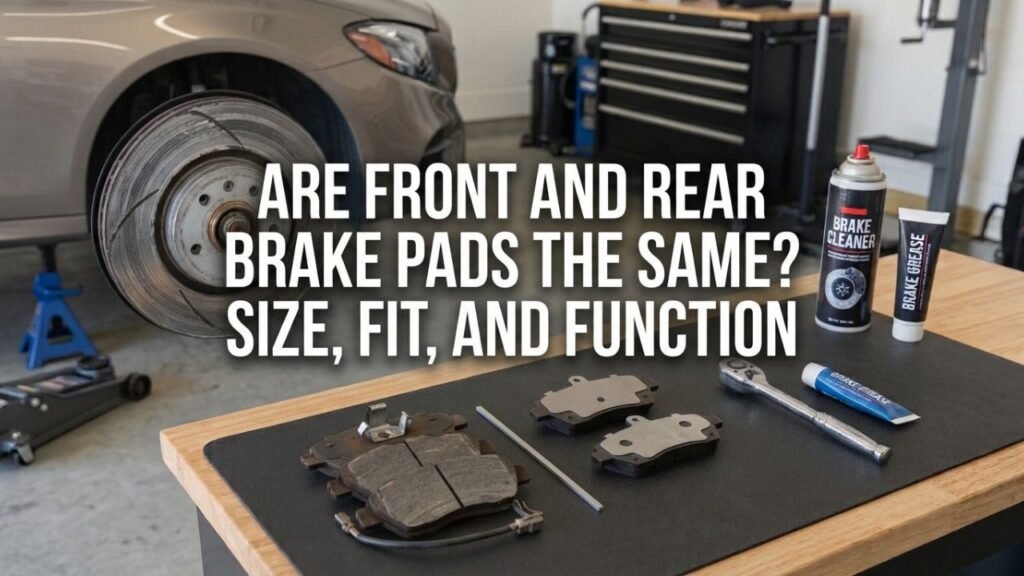
Most modern vehicles with four-wheel disc brakes use one pad design on the front axle and another on the rear.
Each pad has to match its caliper bracket, rotor dimensions, piston arrangement, clips, shims, and surrounding hardware. That usually results in visibly different front and rear pad shapes.
The parts catalog is a more dependable check than simply comparing the pads by eye. Two pads can look similar on a workbench while having slightly different mounting ears or dimensions.
The Friction Material May Also Differ
Front and rear pads may both be labeled ceramic or semi-metallic while still using different friction formulations.
Pad makers can adjust friction level, heat behavior, noise control, compressibility, and wear characteristics to suit the brake system. The compound needs to work with the rotor, caliper size, vehicle weight, brake bias, ABS, and stability-control calibration.
The same material category therefore does not make two pads interchangeable.
Rare Applications Can Use the Same Pad Design
There are exceptions.
A pad manufacturer may approve one pad shape for both front and rear positions on a specific vehicle or group of vehicles. Akebono’s published application information includes at least one ProACT pad listing marked Front/Rear, showing that axle sharing can exist in approved applications.
That does not create a general rule. Only use one pad set at both ends if the catalog for the exact vehicle explicitly approves it.
Key Takeaway: Most cars use different front and rear pads, but a small number of applications may share a pad design. Confirm axle position through the exact parts catalog.
Why Front and Rear Brake Pads Are Usually Different
Braking Transfers Load Toward the Front
When a vehicle slows, its weight distribution shifts toward the front axle.
The front tires gain vertical load while the rear becomes lighter. The braking system is designed around that change so the vehicle remains stable and can use available tire grip.
This is a major reason front brake assemblies are often larger. They may use larger rotors, larger pads, larger pistons, or multi-piston calipers to handle their share of braking energy.
Brembo’s brake package for the Chevrolet Corvette Grand Sport provides a clear design example: the standard system uses 370 mm front discs with six-piston front calipers and 365 mm rear discs with four-piston rear calipers. The difference shows how one vehicle can require separate hardware at each axle.
Front Pads Are Often Larger
A larger friction area can suit the higher thermal and mechanical demands placed on the front brake assembly.
That does not mean every front pad is larger than every rear pad. Vehicle architecture differs, especially on performance cars, trucks, electric vehicles, and models using unusual brake layouts.
The safest statement is that front pads are often larger, not always larger.
Rear Pads Work With a Different Brake Assembly
Rear brakes have their own rotor and caliper dimensions. They may also need to coexist with an electronic parking brake or a separate drum-in-hat parking-brake system.
On vehicles with an electronic parking brake integrated into the rear caliper, rear brake service can also require a maintenance or service mode before the piston is retracted.
A front pad set normally has no reason to accommodate those rear-caliper details.
Heat Requirements Can Differ
Braking converts vehicle motion into heat at the pads and rotors.
The axle doing more braking work can experience a different temperature range. Pad manufacturers select friction compounds to remain stable within the conditions expected at that wheel position.
That is another reason two pads carrying the same broad label, such as “ceramic,” may not use identical recipes.
Key Takeaway: Front and rear pads differ because each axle has its own braking load, rotor, caliper, heat range, hardware, and sometimes parking-brake requirements.
Front vs Rear Brake Pads: Quick Comparison
| Feature | Front brake pads | Rear brake pads |
| Typical size | Often larger | Often smaller |
| Braking workload | Usually higher during normal stops | Usually lower during normal stops |
| Heat generation | Often higher | Often lower |
| Caliper size | Often larger | Often smaller |
| Rotor size | Often larger | Often smaller |
| Wear rate | Often faster | Often slower |
| Parking-brake connection | Usually none | May be associated with rear parking-brake hardware |
| Part number | Usually front-specific | Usually rear-specific |
| Interchangeable? | Usually no | Usually no |
| Replacement | Replace both front sides as an axle set | Replace both rear sides as an axle set |
This table describes common passenger-vehicle layouts. Performance vehicles, EVs, hybrids, trucks, and specialty brake systems can differ.
Can You Put Front Brake Pads on the Rear?
Do not install front pads on the rear unless the parts manufacturer specifically lists that pad for both axle positions.
In most vehicles, a front pad will not correctly fit the rear caliper bracket. Its length, height, thickness, mounting ears, shim arrangement, and wear-indicator position may be different.
Even if a pad could physically be placed in the bracket, physical fit alone does not establish that it is approved for the brake system.
Brake friction is engineered as part of the front-to-rear braking balance. Installing an unapproved friction material or pad geometry can change braking behavior.
The same rule applies in reverse. Do not put rear pads on the front because they appear close enough in size.
Safety Tip: Never grind, cut, file, or otherwise modify a brake pad to make an incorrect part fit a caliper.
Do Front Brake Pads Wear Faster Than Rear Brake Pads?
Front Pads Often Wear First
On many conventional passenger vehicles, the front pads wear faster because the front brakes carry a larger share of the workload during deceleration.
That is why a vehicle may need its second set of front pads while the rear pads still have usable friction material.
This pattern is common enough that front and rear pads should not be expected to reach their wear limits at the same mileage.
Rear Pads Can Wear Faster on Some Vehicles
Rear pads are not guaranteed to last longer.
Electronic brake-force distribution, traction control, stability control, regenerative braking strategies, electronic parking-brake design, and vehicle calibration can change pad usage.
A sticking rear caliper can also wear one rear pad very rapidly.
For that reason, inspect all four corners instead of assuming the front axle is always the first to need service.
Driving Conditions Change Wear Rate
City traffic, hills, towing, vehicle weight, pad compound, brake temperature, and driver input all affect pad wear.
A generic mileage estimate is less useful than actual thickness measurements taken over time.
If the front pads measure 4 mm and the rears measure 7 mm, the numbers tell you far more about current condition than the vehicle’s odometer alone.
Key Takeaway: Front pads often wear faster, but brake-system calibration and mechanical problems can make rear pads wear just as fast or faster.
Are Front and Rear Brake Pads the Same Thickness?
Not always.
New front and rear pads can start with different friction-material thicknesses because they are separate designs.
Even their service specifications can differ on some vehicles. One current Ford brake specification, for example, lists a minimum application thickness of 2.8 mm for the front pads and 2.5 mm for the rear pads.
Other Ford applications specify the same limit for both ends, such as 1.5 mm or 3 mm.
This is why comparing a rear pad directly with a front pad can be misleading. Compare each measurement with the specification for that axle.
A thicker rear pad does not automatically mean it is healthier, and a thinner new rear pad does not automatically mean it has less expected service life.
Should Front and Rear Brake Pads Be Replaced Together?
Replace Pads as an Axle Set
If the front pads are worn, replace the pads on both front wheels.
If the rear pads are worn, replace the pads on both rear wheels.
Replacing pads on only the left or right side can create unequal friction characteristics across the axle. Brake-pad kits are generally sold and serviced as axle sets for this reason.
You Do Not Always Need All Four Wheels at Once
Front and rear pads do not have to be replaced together merely because one axle has reached its wear limit.
If the front pads measure 3 mm and the rear pads have 7 mm remaining with even wear and no damage, replacing only the front axle can be reasonable.
The reverse also applies.
Replace both axles at once if both are worn, damaged, near their limits, or the repair plan calls for full brake service. Firestone also describes front and rear sets as separate axle-service decisions while stressing paired replacement across each axle.
Check the Other Axle During Every Brake Job
Even when only one axle needs pads, inspect the other axle.
A brake job is a good opportunity to record remaining pad thickness, rotor condition, caliper movement, hose condition, and signs of uneven wear.
That gives a clearer idea of which axle is likely to need service next.
Key Takeaway: Replace pads in left-right axle pairs. Front and rear sets can be serviced at different times if the other axle remains within specification.
Can Front and Rear Pads Use the Same Material?
Yes. Both axle sets can be ceramic, semi-metallic, low-metallic, or another approved friction type.
Material category and pad fitment are separate issues.
For example, a manufacturer may offer ceramic pads for the front and ceramic pads for the rear. The two sets can still use different backing plates, dimensions, shims, slots, wear indicators, and friction formulations.
Do not shop for a rear pad simply by matching the material printed on the front-pad box.
Start with fitment, then choose among the approved compounds available for that axle.
How to Tell Front and Rear Brake Pads Apart
Check the Label and Part Number
Most pad boxes state Front, Rear, or an axle-position abbreviation.
Check the complete part number rather than relying on packaging color or brand.
If you are buying online, enter the exact year, make, model, engine, trim, and brake package. VIN-based lookup can reduce mistakes on vehicles with several brake options.
Compare the Pad Shape
Front and rear pads may differ in:
- Overall length
- Friction-material height
- Pad thickness
- Backing-plate shape
- Mounting ears
- Slots and chamfers
- Wear-indicator location
- Electronic sensor provision
- Shim design
These physical differences are often obvious when the sets are placed next to each other.
Verify the Brake Package
Some vehicles use different brakes based on trim level, engine, wheel size, towing package, performance package, production date, or drivetrain.
A single model year may therefore have several front pad options or several rear pad options.
The old pad’s shape is useful for comparison, but use catalog data or the OE part number as the primary fitment check.
Check Hardware and Sensors
Some pad kits include stainless clips, shims, wear indicators, or electronic sensor provisions.
The hardware may be position-specific even when the friction material looks similar.
Do not discard the fitment question just because both sets include four pads.
Key Takeaway: Identify pads by axle listing, exact part number, brake package, pad geometry, hardware, and sensor setup rather than appearance alone.
Why Rear Pads Sometimes Look Much Smaller
Small rear pads do not mean the rear brakes are unimportant.
The brake system is balanced so all four wheels contribute to deceleration while preserving stability. The rear axle simply has different grip and braking requirements under deceleration.
Larger rear brakes are also not automatically better. Brake-system sizing has to match tire grip, vehicle weight distribution, rotor capacity, ABS calibration, hydraulic pressure, and front brake capacity.
Changing rear pad size or friction level without an engineered brake-system change can upset that balance.
What If the Front and Rear Pads Look Identical?
Do not assume they are interchangeable.
First compare the part numbers. Then check dimensions, mounting ears, wear indicators, shims, and catalog axle position.
If the same manufacturer part number is explicitly approved for both front and rear, using it in both locations can be correct.
If the numbers differ, treat them as different components even if they look almost identical.
That small distinction is one of the reasons I prefer part-number verification over visual matching for brake components.
Conclusion
Are front and rear brake pads the same? In most vehicles, no. They are separate axle-specific parts designed around different calipers, rotors, dimensions, braking loads, hardware, and friction requirements.
Front pads are often larger and may wear faster because the front axle commonly handles more braking work during deceleration. Rear pads can be smaller, may interact with parking-brake hardware, and can use a different friction formulation. Some vehicle designs break these general patterns.
My recommendation is to buy brake pads by exact vehicle and axle fitment, not by size or material name alone. Replace left and right pads together on the serviced axle, inspect the opposite axle at the same time, and use the vehicle’s service specification to judge remaining thickness.
FAQs About Front and Rear Brake Pads
Are Front and Rear Brake Pads the Same Size?
Usually not. Front pads are often larger because the front brake assembly commonly handles more heat and braking load. Rear pads usually match smaller rear calipers and rotors. Exact dimensions vary by vehicle, so use the cataloged part number instead of assuming size from axle position.
Can Front Brake Pads Fit on the Rear?
Usually no. Front and rear pads commonly have different backing-plate dimensions, mounting ears, friction areas, and hardware. Do not force a front pad into a rear bracket. Use it only if the pad manufacturer explicitly lists the same part number for both axle positions.
Are Front and Rear Brake Pads Made From the Same Material?
They can use the same broad material category, such as ceramic or semi-metallic, but the exact friction formulation can still differ. A front ceramic pad and rear ceramic pad are not automatically identical parts.
Do Front Brake Pads Usually Wear Out First?
Yes, front pads often wear sooner on conventional vehicles because the front axle commonly handles more braking work. Rear pads can wear first on some vehicles due to brake-system calibration, stability-control activity, corrosion, parking-brake problems, or a sticking caliper.
Should I Replace All Four Brake Pads at the Same Time?
Not automatically. Replace both pads on the left and right sides of the worn axle. The other axle can remain in service if its pads are above specification, wearing evenly, and free from damage. Inspect all four wheels before making the decision.
Can I Use Different Brake Pad Brands Front and Rear?
Yes, provided each pad set is approved for the exact vehicle and axle. Matching brands can simplify compound selection, but proper fitment and suitable friction characteristics matter more than having the same logo on both sets.
Why Are My Rear Brake Pads Bigger Than the Front?
Some vehicles use brake layouts that do not follow the common pattern of larger front pads. Vehicle weight distribution, caliper design, rotor size, electronic brake control, performance goals, and parking-brake design can influence pad dimensions. Confirm the factory part numbers before assuming the pads were installed incorrectly.
Are There Cars That Use the Same Brake Pads Front and Rear?
Yes, rare applications can use a pad design approved for both axle positions. Published aftermarket catalogs include examples marked Front/Rear. Treat this as an application-specific exception rather than a general rule, and confirm the exact part number before installation.