Brake Pad MM Chart: Thickness, Wear Levels, and Replacement Tips
Most passenger-car brake pads start with roughly 8–12 mm of friction material, then move into a replacement-planning range near 3–4 mm. A 3 mm reading usually means the pads deserve near-term replacement, while 2 mm is very thin and may already equal the service limit on some vehicles. The exact factory specification still takes priority.
The problem with a single “safe” number is that brake systems do not share one universal wear limit. Ford U.S. specifications list 3 mm as the minimum front and rear pad thickness on one application, while another Ford application lists 1.5 mm. Mazda also publishes a 2 mm minimum for its brake pads.
That variation changes how a thickness reading should be used. A 3 mm pad may be at the stated limit on one car and still sit above the stated limit on another. Planning replacement before the final limit also reduces the chance that an unseen inner pad reaches the backing plate first.
For U.S. context, Virginia’s current vehicle-inspection rule rejects bonded, molded, or riveted disc pads worn below 2/32 inch, about 1.6 mm, at any point other than a manufactured slot. That state inspection threshold is not a universal replacement target for passenger cars, but it shows why legal inspection numbers and manufacturer service limits should not be treated as the same thing.
The most useful way to read a brake pad mm chart is as a planning tool rather than a promise of remaining mileage. What stood out to me while comparing service information was the spread in actual limits: 3 mm, 2 mm, and 1.5 mm can all appear in legitimate vehicle documentation.
The chart below explains what common readings from 12 mm down to 2 mm usually mean, how to convert them to inches, how to measure only the friction material, why inner and outer pads can tell different stories, and when a reading should trigger replacement rather than another mileage estimate.
Brake Pad MM Chart for Common Thickness Readings
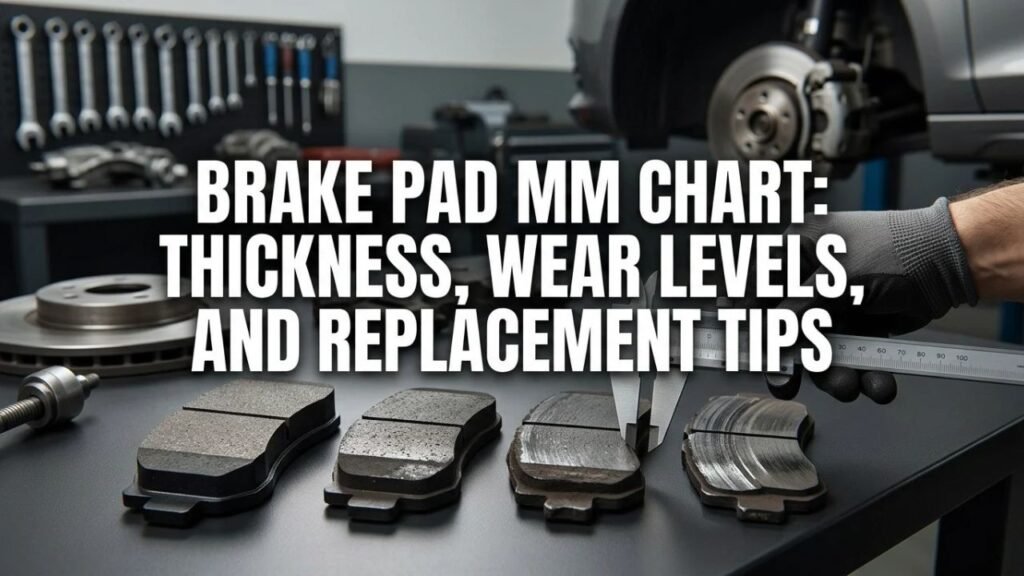
The table below is a practical passenger-vehicle reference. It does not override the service manual for the exact year, make, model, axle, and brake package.
| Pad thickness | Approx. inches | General condition | Practical action |
| 12 mm | 0.472 in | New or near-new on many applications | No thickness-based service needed |
| 11 mm | 0.433 in | Thick | Continue normal inspection |
| 10 mm | 0.394 in | Thick / often near-new | Continue normal inspection |
| 9 mm | 0.354 in | Good | Monitor during routine service |
| 8 mm | 0.315 in | Good | Monitor during routine service |
| 7 mm | 0.276 in | Moderate wear | Record the measurement |
| 6 mm | 0.236 in | Moderate wear | Recheck at normal service |
| 5 mm | 0.197 in | Worn but often serviceable | Start planning ahead |
| 4 mm | 0.157 in | Getting low | Inspect more often and plan replacement |
| 3 mm | 0.118 in | Common replacement point | Replace soon or follow the factory limit |
| 2 mm | 0.079 in | Very thin | Replace promptly unless factory data clearly says otherwise |
| Below specified limit | Varies | Out of specification | Replace the pads |
The chart intentionally does not call 6 mm “50% life” or 3 mm “25% life.” Brake-pad life is not a simple percentage of original thickness because the pad must be replaced before the friction material reaches zero, and wear rate changes with traffic, hills, towing, vehicle mass, caliper condition, and driving style.
A pad that began at 10 mm and has 5 mm left is not automatically halfway through its usable mileage. If its service limit is 2 mm, it has lost 5 mm out of an 8 mm usable range, not 5 mm out of 10 mm. Even that calculation does not predict mileage because wear does not stay constant.
What Each Brake Pad Thickness Usually Means
8–12 mm: Thick to Near-New
Many passenger-car pads fall somewhere around this range when new, though new thickness varies by application.
A reading near 10–12 mm usually leaves plenty of friction material. An 8 mm reading is also comfortably above common replacement ranges on many cars.
The best use of an early measurement is to create a baseline. If the pads measure 8 mm today and 6 mm at the next documented inspection, the two readings reveal the vehicle’s recent wear pattern more clearly than a generic mileage estimate.
6–7 mm: Moderate Wear
Six or seven millimeters normally means the pads still have usable material remaining.
This is a good stage to compare the inner pad with the outer pad and the left side with the right side. A major difference can matter more than the absolute number. One pad at 7 mm and its partner at 4 mm deserves investigation of caliper movement and hardware.
4–5 mm: Start Planning Replacement
At 4–5 mm, the pads are no longer near-new and the next service interval matters more.
A driver who covers little mileage and has even wear may simply schedule another inspection. A car facing a long road trip, mountain driving, towing, or a long gap before the next service may justify earlier replacement.
I would treat 4 mm as a planning number, not as a panic point. The key question is how quickly the pad has been wearing and how close it sits to the factory minimum.
3 mm: Common Replace-Soon Point
Three millimeters is a widely used replacement point because some vehicles list it as the actual minimum and many repair shops use it as a practical service threshold.
Ford documentation provides a clear example of a vehicle with a 3 mm minimum for both front and rear pads.
A 3 mm pad does not mean the brakes have stopped working. It means the friction material is thin enough that delaying service offers little margin, especially if the inner pad has not been measured.
2 mm: Very Thin
Two millimeters should be treated as replacement territory for normal passenger-car service.
Mazda publishes 2 mm as the minimum in its U.S. brake-replacement information. Other manufacturers may specify a different number.
At this stage, do not rely on a prediction such as “another 5,000 miles.” A dragging caliper, heavy city use, mountain descents, or uneven inner-pad wear can consume the remaining material much faster than expected.
Key Takeaway: 8–12 mm is generally a thick range, 4–5 mm is a planning range, 3 mm is a common replace-soon point, and 2 mm is very thin; the factory service limit decides the final cutoff.
Brake Pad Thickness in MM vs Inches
Brake-pad gauges often use millimeters, while U.S. service information or inspection rules may use inches. The conversions below cover the readings most drivers see.
| Millimeters | Inches | Common fraction reference |
| 12 mm | 0.472 in | Just under 1/2 in |
| 10 mm | 0.394 in | About 25/64 in |
| 8 mm | 0.315 in | About 5/16 in |
| 6 mm | 0.236 in | About 15/64 in |
| 5 mm | 0.197 in | About 13/64 in |
| 4 mm | 0.157 in | About 5/32 in |
| 3 mm | 0.118 in | About 1/8 in |
| 2 mm | 0.079 in | About 5/64 in |
| 1.6 mm | 0.063 in | About 2/32 in |
| 1.5 mm | 0.059 in | About 1/16 in |
Do not use a rounded fraction to overrule an exact metric specification. If the manual lists 3 mm, compare the measured friction material with 3 mm rather than assuming every “about 1/8 inch” reading is identical.
Why 3 mm Is Not a Universal Minimum
Vehicle Makers Set Different Service Limits
The factory limit depends on the brake design, pad shape, caliper, wear indicator, rotor, and intended vehicle duty.
That is why legitimate specifications can differ. Ford documentation shows both 3 mm and 1.5 mm minimums on different applications, while Mazda publishes a 2 mm value in its brake information.
A generic chart should therefore tell you when to pay attention, not pretend to replace model-specific service data.
Legal Inspection Limits Can Be Different
A state inspection rule answers a legal inspection question. A manufacturer service limit answers a vehicle-service question.
Virginia’s 2/32-inch inspection rule is about 1.6 mm. A vehicle whose maker specifies 3 mm should not be intentionally worn down to 1.6 mm just because that state rule exists.
Wear Indicators May Trigger Before Metal Contact
Some brake pads use a mechanical tab that begins touching the rotor as the pad gets thin. Other vehicles use an electronic wear sensor that triggers a dashboard message.
The warning point varies by design. A wear warning is a reason to inspect the brakes; it is not a substitute for measuring the thinnest pad.
Key Takeaway: The chart gives a useful wear range, but the exact vehicle specification, wear sensor design, and local inspection rules can use different numbers.
How to Measure Brake Pad Thickness Correctly
Measure Only the Friction Material
A brake pad has a steel backing plate with friction material attached to it. The thickness reading used for wear decisions normally refers to the friction material, not the steel plate.
Do not include a shim attached to the back of the pad. Do not measure across the full pad assembly and compare that figure with a friction-material specification.
A dedicated brake-pad gauge is useful because it fits into tight spaces and gives common thickness steps. A caliper or suitable depth-measuring tool can provide a more exact figure when access permits.
Check the Inner and Outer Pads
Looking through a wheel often reveals only the outer pad. That quick check can miss the thinner inner pad.
For a sound assessment, inspect both pads on the caliper. If one is far thinner, check for restricted slide pins, pad binding, piston trouble, corrosion, or another mechanical cause.
The same rule applies across the axle. One thick pad on the left does not prove the right-side brake is in the same condition.
Measure the Thinnest Usable Area
Pads can wear at an angle. A pad with 5 mm at one end and 3 mm at the other should not be recorded simply as “5 mm.”
Use the thinnest genuine wear area, while ignoring manufactured slots or grooves that are part of the pad design.
Inspect Condition Along With Thickness
A thick pad may still need replacement if the friction material is cracked, separating from the backing plate, contaminated with brake fluid or grease, badly glazed, or damaged by overheating.
Thickness is one part of a brake inspection, not the entire inspection.
Safety Tip: If wheel removal is needed, support the vehicle with properly rated equipment at the approved lifting points. Never work around a brake assembly with the vehicle supported only by a jack.
Key Takeaway: Measure friction material only, check inner and outer pads, use the thinnest real wear point, and inspect physical condition during the same check.
Front vs Rear Brake Pad MM Readings
Front and rear pads do not need to show the same thickness.
Many vehicles place more braking load on the front axle during a normal stop because weight transfers forward. That can make front pads wear sooner. Modern brake-force distribution, stability control, electronic parking brakes, vehicle design, and driving conditions can change that pattern.
A front reading of 4 mm and rear reading of 7 mm can be normal if wear is even and both remain above their service limits.
The concern is a large difference within the same axle or caliper. If the left front pads are much thinner than the right front pads, or the inner pad is much thinner than the outer pad, inspect the brake hardware rather than assuming the difference is ordinary.
Can You Estimate Remaining Miles From Brake Pad MM?
A thickness reading cannot give a dependable mileage number by itself.
Two cars with 4 mm pads can use that remaining material at very different rates. Stop-and-go traffic, hills, towing, vehicle weight, driving habits, pad compound, regenerative braking, rotor condition, and caliper drag all change wear.
Past measurements give a better estimate. If a pad dropped from 8 mm to 6 mm across 12,000 miles under similar driving, that history gives some context for the next interval. It still does not guarantee the same rate will continue.
I would use millimeters to decide inspection and replacement timing, not to chase a precise mileage forecast.
When Brake Pads Should Be Replaced Before Reaching 3 mm
A pad does not need to reach a specific thickness before replacement becomes justified.
Replace or investigate sooner if you find:
- Severe uneven wear
- Cracked or broken friction material
- Friction material separating from the backing plate
- Oil, grease, or brake-fluid contamination
- Deep rotor scoring
- Persistent grinding
- A seized or dragging caliper
- A manufacturer instruction calling for earlier replacement
- A wear sensor warning paired with confirmed pad wear
Grinding deserves prompt attention because the friction layer may be exhausted or another brake component may be contacting the rotor.
Common Brake Pad MM Chart Mistakes
Treating 3 mm as a Universal Law
Three millimeters is a useful planning point, but manufacturer examples show that actual minimums vary.
Use the chart to decide when closer inspection or replacement planning makes sense, then confirm the exact specification.
Counting the Backing Plate
Including the steel plate can add several millimeters and make a worn pad appear healthy.
The friction layer is the part that needs to be compared with a friction-material service limit.
Checking Only the Easy-to-See Pad
The visible outer pad may have more material than the inner pad.
A proper inspection checks both sides of the rotor and both wheels on the axle.
Turning Thickness Into an Exact Life Percentage
A 6 mm pad is not automatically “50% life.” New thickness varies, the service limit is above zero, and wear rate changes with use.
A percentage can look precise while giving the driver less useful information than the actual millimeter reading.
Key Takeaway: The biggest errors are using one universal cutoff, measuring the backing plate, checking only one pad, and converting thickness into a misleading life percentage.
Conclusion
A brake pad mm chart is most useful for sorting readings into practical wear stages: roughly 8–12 mm is a thick range on many passenger pads, 4–5 mm is a planning range, 3 mm is a common replacement point, and 2 mm is very thin.
Those numbers are not a substitute for the vehicle’s service data. Ford documentation alone shows different minimum values on different applications, and Mazda uses 2 mm in its published brake information. The lowest measured pad on the axle deserves the most attention.
My recommendation is simple: record actual millimeter readings, inspect inner and outer pads, and plan service before the pads reach the factory minimum. That approach is more useful than waiting for grinding or trying to calculate an exact percentage of pad life.
FAQs About Brake Pad Thickness in MM
Is 8 mm Good for Brake Pads?
Yes. Eight millimeters is generally a healthy amount of friction material on many passenger-car brake pads. New thickness varies, so 8 mm should not automatically be called a fixed percentage of remaining life. Record the measurement and compare it with later inspections.
Is 6 mm Good for Brake Pads?
Six millimeters is commonly a serviceable reading. It usually sits well above the common 3–4 mm planning range. Check for even inner-to-outer and side-to-side wear, then monitor the pads during routine service.
Should I Replace Brake Pads at 5 mm?
Five millimeters often leaves usable material, so replacement based on thickness alone may not be needed. Earlier replacement can make sense if wear is uneven, the next inspection is far away, a long trip is coming, or the manufacturer gives a higher service threshold.
Is 4 mm Low for Brake Pads?
Four millimeters is getting low enough to start planning replacement. It is commonly above the final service limit, but the remaining time can vary sharply with driving conditions. Check all pads on the axle because an unseen partner may already be thinner.
Should Brake Pads Be Replaced at 3 mm?
Three millimeters is a common replace-soon point and is the stated minimum on some vehicles. If a pad measures 3 mm, confirm the factory specification and schedule service rather than trying to stretch the pad to the smallest possible number.
Are 2 mm Brake Pads Too Thin?
Two millimeters is very thin and equals the published minimum for some vehicles. Other vehicles specify more material. Treat 2 mm as prompt-replacement territory and inspect the inner pad, rotor, caliper, and hardware before continued normal use.
What Does 1.5 mm Mean on a Brake Pad?
A 1.5 mm reading is at the published minimum for some specific vehicle applications, while it is below the limit for others. It leaves very little friction material. Confirm the exact specification and replace the pad if it is at or below that limit.
Do New Brake Pads Always Measure 12 mm?
No. New friction-material thickness varies by pad design and vehicle. Many passenger pads fall somewhere around 8–12 mm, while some applications start outside that range. Use the new-pad specification for the exact part if you need a precise baseline.