What Does Bad Brake Pads Look Like? 8 Clear Wear Signs to Check
Bad brake pads often look very thin, uneven, cracked, shiny, contaminated, or partly broken away from the metal backing plate. A severely worn pad may have almost no friction material left, leaving the backing plate close to or directly against the rotor. One bad pad can also look much thinner than the others.
Visible pad damage matters because appearance often points to the cause. A thin pad may simply be worn out, while a wedge-shaped pad can point to a sticking caliper. Oily material may signal contamination, and deep cracks or crumbling can appear after excessive heat or restricted pad movement.
Spotting the pattern early may save the rotor from deep scoring and reveal a caliper problem before another pad set is installed. It also gives a clearer answer than relying on squealing alone, since brake noise can come from several causes.
AAA guidance for U.S. drivers says brake pads at roughly 3 mm of remaining friction material are at the point where replacement should be planned. AAA also advises checking both inner and outer pads because they can wear differently.
The clearest answer to what does bad brake pads look like is not one single appearance. In my research, the strongest warning patterns were very low friction material, glazing, cracking, contamination, taper, edge crumbling, separation from the backing plate, and major differences between pads on the same axle.
The sections below show what each pattern looks like, what may cause it, how it differs from normal wear, what the rotor may reveal, and when a visual check should turn into a full brake inspection.
What Does Bad Brake Pads Look Like Up Close?
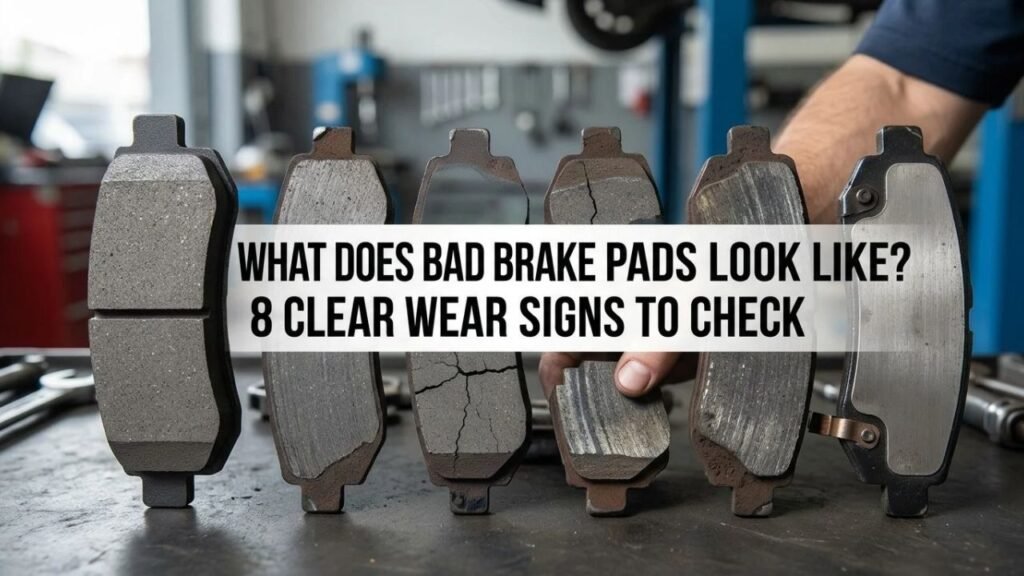
A healthy used pad normally has a flat friction surface, solid friction material attached firmly to the steel backing plate, and reasonably even thickness across the pad. Bad pads depart from that pattern in several recognizable ways.
Very Thin Friction Material
The most common visual sign is a friction layer that has become much thinner than it was when new.
Look at the material between the rotor and the steel backing plate. That dark friction block is the part that wears. Do not include the backing plate when estimating pad thickness.
Brembo states that new passenger-car pads are commonly around 10–12 mm thick and recommends replacement below 3 mm in its wear guidance. The exact service limit for the vehicle or installed pad should still control the decision.
A pad that is down near its backing plate may also have a wear-indicator tab touching the rotor. Some cars use an electronic pad-wear sensor instead.
Shiny or Glazed Friction Surface
A glazed pad looks unusually smooth and shiny rather than dull and textured. The surface may have a polished or glass-like appearance.
Ferodo identifies glazing as a brake-pad condition associated with high intermittent pad temperature or harsh braking during bedding. Heavy glazing can reduce braking response and may call for pad replacement along with a rotor check.
Do not confuse normal smooth contact marks with severe glazing. The concern is a hard, glossy surface paired with noise, heat history, or poor braking behavior.
Cracks Across the Pad Material
Cracked pads show visible splits through the friction block. Small surface marks are not always the same as structural cracking, so look at the depth, location, and condition of the surrounding material.
Ferodo links center cracking in some passenger-car pads with a sticking caliper that flexes the pad and backing plate. Heat damage can also make friction material brittle and more prone to cracks or chips.
A cracked pad should prompt inspection of the caliper rather than a pad-only replacement.
Chunks Missing or Crumbling Edges
Bad friction material may break away at the corners or edges. The pad can look chipped, ragged, or partly crumbled instead of having a solid edge.
Ferodo links edge crumbling with a pad sticking in the caliper and remaining against the rotor, which can raise temperature and damage the friction material.
A small manufacturing chamfer at the edge of a new pad is normal. Random missing chunks, broken corners, or fresh crumbling are different.
Wet, Greasy, or Dark Contaminated Areas
A contaminated pad may look wet, oily, greasy, or darker in patches. Brake fluid, grease, oil, or another substance on the friction face is a problem because the rotor needs a clean friction surface.
Ferodo advises replacing a contaminated pad set and finding the source of the contamination. A leaking caliper or misplaced lubricant can create this pattern.
Do not spray cleaner onto an installed pad and assume the friction material is restored. Some liquids can soak into porous friction material.
Tapered or Wedge-Shaped Wear
A tapered pad is visibly thicker at one end and thinner at the other. Viewed from the side, the friction material forms a wedge rather than a nearly even block.
This pattern often points toward a caliper movement problem. Ferodo lists sticking caliper slides, caliper distortion, or excessive clearance among possible causes, while noting that some pads are tapered by design.
Compare the pad with service information or a matching new pad before treating every angled edge as a fault.
One Pad Much Thinner Than Its Partner
On a disc brake, the inner and outer pads should be compared with each other. If one is close to worn out while the other still has much more material, the difference is a warning.
A sticking piston, seized guide pin, pad binding in the bracket, or another caliper fault can create this pattern. PowerStop also lists uneven pad wear as a possible sign of caliper trouble.
This is one reason a quick look through the wheel can be misleading. The visible outer pad may still look usable while the hidden inner pad is nearly gone.
Friction Material Separating From the Backing Plate
A serious pad problem is a visible gap between the friction block and the steel backing plate. Rust may be present around the separation, and the friction block can appear lifted, loose, or partly detached.
Ferodo describes corrosion between the friction material and backing plate as a condition that can progress to material separation. Once the friction block separates, the pad should be replaced and the caliper area inspected for corrosion and restricted movement.
This is very different from normal wear. The friction material should remain firmly attached to the backing plate throughout its service life.
Friction Material Completely Gone
The worst-looking worn pad may have little or no friction material remaining. What is left is the steel backing plate, often polished, scored, overheated, or damaged from rubbing against the rotor.
Ferodo describes a fully worn pad as one whose friction material has disappeared and warns of rotor damage and heavy brake noise.
At this stage, inspect the rotor and caliper instead of replacing pads alone.
Key Takeaway: A bad pad may be thin, glossy, cracked, chipped, oily, tapered, detached, or worn to bare metal. Uneven shape and damage often reveal a brake-system fault that needs attention with the pad replacement.
Bad Brake Pads vs. Normal Wear
Normal wear should look fairly even. The friction material gets gradually thinner while remaining firmly attached to the backing plate, and the contact face stays broadly flat.
The table below separates common normal findings from patterns that deserve attention.
| Appearance | Often Normal | Warning Sign |
| Evenly thinner friction material | Yes, if above the service limit | No material or near the limit |
| Flat, dull contact face | Usually | Deep cracks or severe glazing |
| Small designed chamfers or slots | Yes | Fresh chunks missing from random areas |
| Similar inner and outer thickness | Usually | One pad far thinner than the other |
| Light surface marks | Often | Deep grooves or broken material |
| Dry friction face | Yes | Oil, grease, or brake fluid |
| Friction block firmly bonded | Yes | Gap or separation from backing plate |
Color alone is a poor way to judge pad condition. Ceramic, semi-metallic, and organic compounds can look different even when new. Focus on thickness, shape, surface damage, contamination, attachment to the backing plate, and comparison with the other pads.
What Uneven Brake Pad Wear Looks Like
Uneven wear is useful because it may show where the brake assembly is not moving as intended.
Inner Pad Worn More Than the Outer Pad
The inner pad sits on the piston side of many floating-caliper systems. If it is far thinner than the outer pad, the piston may be sticking, the slides may not be releasing freely, or the pad may be binding in its bracket.
The inner pad can be hard to see through the wheel. A wheel-off inspection gives a better comparison.
If the inner pad has reached metal while the outer pad still has substantial material, inspect the rotor closely. Deep scoring may be present on the hidden side.
Outer Pad Worn More Than the Inner Pad
An outer pad that wears much faster can also point toward restricted caliper movement. The floating caliper body needs to slide so both pads clamp and release correctly.
Corrosion, dry or seized guide pins, damaged hardware, or a pad jammed in the bracket can disturb that movement.
Do not simply install a thicker new pad and leave the cause untouched. The new set may develop the same pattern.
Tapered Wear Across One Pad
Tapered wear looks like a slope across the friction material. One edge may have several millimeters more material than the opposite edge.
Ferodo associates abnormal taper with caliper or slide problems, though some applications use intentional pad taper. Compare both pads, inspect caliper movement, and check the vehicle’s brake design before deciding the taper is abnormal.
Key Takeaway: Uneven pad wear is not just a thickness issue. Large inner-to-outer differences or abnormal taper can point toward sticking slides, piston trouble, binding pads, or caliper alignment problems.
How to Check Bad Brake Pads on Your Car
You can spot some pad problems through the wheel, but removing the wheel provides a much clearer view of both pads and the rotor.
Check Through the Wheel
Park on a level surface, let the brakes cool, and use a flashlight through an open wheel spoke.
Find the rotor first, then locate the brake pad beside it. The friction material sits between the rotor and the pad’s metal backing plate.
A wheel-on check may reveal a very thin outer pad, heavy rotor grooves, or obvious damage. It usually does not give a full view of the inner pad.
Remove the Wheel for a Better Inspection
If you have the tools and experience to lift the vehicle safely, removing the wheel exposes the caliper and pad edges.
Use the manufacturer’s lifting points, support the vehicle correctly, and never work around a brake assembly while the vehicle is supported by a jack alone.
Compare the inner and outer pad on that wheel, then compare the same axle on the opposite side. Look at the thinnest point rather than the easiest point to see.
Measure Friction Material Only
Measure the friction block, not the total pad thickness.
AAA guidance says roughly 3 mm is the point where pad replacement should be planned. Brembo’s current wear guidance also uses below 3 mm as a replacement point. Vehicle-specific service information can set a different limit, so use that specification when available.
If one end measures much thinner than the other, record the lower measurement and investigate the wear pattern.
Key Takeaway: A flashlight check is useful for spotting obvious wear, but a wheel-off inspection gives a better view of the inner pad, taper, cracks, contamination, and side-to-side differences.
What the Rotor Can Tell You About Bad Pads
The rotor often shows evidence of what the pad has been doing. Pad and rotor findings should be considered together.
Deep Circular Grooves
Deep grooves or scoring on the rotor can appear after the pad friction material wears away and the backing plate contacts the rotor.
Scoring can also result from debris, abnormal pad contact, or a worn rotor surface. Ferodo links disc scoring with uneven pad contact and states that badly scored combinations may require both pads and rotors.
A fingernail-catching groove deserves more than a quick visual judgment. Rotor thickness and surface condition need to be checked against the manufacturer’s specifications.
Blue, Dark, or Heat-Marked Areas
Heat-damaged rotors may show blue or dark areas. These marks can appear after severe overheating, repeated hard braking, or a pad that drags because the caliper does not release.
Heat history also matters when a pad looks glazed, charred, cracked, or crumbly.
A hot wheel after ordinary driving can point toward a dragging brake, but do not touch a rotor or caliper to compare temperatures. Brake parts can cause serious burns.
Metal-on-Metal Damage
If the pad has no friction material left, the backing plate may grind directly on the rotor. The rotor can become deeply scored and the pad backing plate may look polished or ground down.
That condition means the rotor needs inspection, not just a fresh pad set.
Ferodo’s passenger-car troubleshooting material links completely worn pads with rotor damage and heavy brake noise.
Key Takeaway: Deep scoring, heat marks, or metal-on-metal rotor damage often confirm that pad wear has progressed beyond a simple visual concern. Check rotor thickness and the rest of the brake assembly before fitting new pads.
When Bad-Looking Brake Pads Need Replacement
Replace or professionally assess pads that have reached the vehicle or pad manufacturer’s wear limit, show heavy glazing, contain major cracks, have pieces breaking away, are contaminated with oil or brake fluid, or are separating from the backing plate.
A pad set also needs attention when one pad is worn far more than its partner. In that situation, the repair should include diagnosis of the caliper, slides, bracket contact points, and rotor.
Grinding is a late warning. Once friction material is gone, continued driving can damage the rotor and may change braking behavior.
A soft or sinking pedal, visible brake-fluid leak, sharply reduced braking force, or major pulling should not be diagnosed from pad appearance alone. Those symptoms can involve the hydraulic or caliper system and call for prompt brake inspection.
Safety Tip: If braking force has dropped sharply or the pedal sinks toward the floor, avoid normal driving and arrange qualified inspection or towing.
Conclusion
The visual answer to what does bad brake pads look like includes much more than thin friction material. Bad pads can appear glazed and shiny, cracked, contaminated, tapered, chipped, unevenly worn, detached from the backing plate, or completely worn down to metal.
Check the inner and outer pads, not just the easiest pad to see through the wheel. Compare both sides of the axle and pay attention to the rotor. A large difference between pads often points toward a caliper or hardware fault that should be corrected with the pad replacement.
My first concern would be bare metal, separation, deep cracks, contamination, or one pad wearing far faster than the others. Those patterns give more information than color alone and may show why the brake pad failed.
FAQs About What Bad Brake Pads Look Like
What Does a Worn Brake Pad Look Like?
A normally worn pad looks thinner than a new pad but should still have a flat friction surface and solid material attached to the backing plate. As it approaches its service limit, the friction block may look very thin compared with the steel plate behind it.
If the material disappears completely, bare backing-plate metal can contact the rotor.
What Does a Glazed Brake Pad Look Like?
A glazed pad often has a smooth, shiny, polished surface instead of a dull friction texture. Heavy glazing can appear after excessive heat and may be paired with squealing or reduced brake response.
A shiny appearance should be judged along with heat history, rotor condition, and braking behavior.
What Do Cracked Brake Pads Look Like?
Cracked pads show splits or fissures through the friction material. Damage may appear near the center, edges, or corners, and severe heat damage can make the material brittle or crumbly.
Cracks paired with uneven wear or one hot wheel may point toward a sticking caliper and call for more than a pad replacement.
What Do Brake Pads Look Like When They Are Completely Worn Out?
A completely worn pad has little or no friction material left. The steel backing plate may be exposed and may look shiny, scratched, or ground down after contacting the rotor.
The rotor can also show deep circular grooves. That condition calls for rotor and caliper inspection along with pad replacement.
Can Bad Brake Pads Still Look Thick?
Yes. A pad can have plenty of material left but still be damaged by contamination, severe glazing, cracking, edge crumbling, or separation from its backing plate.
Thickness is only one inspection point. Surface condition, attachment, wear pattern, and the condition of the matching pad matter too.
Why Does One Brake Pad Look Thinner Than the Other?
A large difference between inner and outer pads often points toward restricted caliper movement. Sticking guide pins, a piston that does not release correctly, pad binding, or hardware problems may cause one pad to do more work.
Find and repair the cause before fitting a new set, or the replacement pads may wear the same way.
Can I See Bad Brake Pads Without Removing the Wheel?
Sometimes. Open wheel spokes may let you see the outer pad and part of the rotor with a flashlight.
The inner pad is often harder to inspect, and it can wear at a different rate. Remove the wheel safely or have the brakes inspected if the visible outer pad is the only pad you can check.