Are Wagner Brake Pads Good? Quality, Pros, Cons, and Best Uses
Wagner brake pads are generally a solid aftermarket choice for normal street use, towing, trucks, and heavier-duty applications when you select the correct Wagner line for the vehicle. The brand offers budget, standard replacement, premium, and severe-duty pads rather than relying on one friction formula for every driver.
The biggest mistake is judging the entire brand by one set of pads. Wagner ES, QS, OEX, and SD pads target different driving conditions, so price, hardware, noise control, heat handling, and intended use vary across the range.
Buying the correct line gives you a better chance of getting the braking feel, noise level, and service life you expect. A basic commuter does not need the same pad design as a loaded pickup that tows through steep grades.
There is also a current U.S. material standard worth mentioning. California’s brake friction law limits copper to 0.5% by weight under its Level N requirement from January 1, 2025. Wagner states that its current ES, QS, OEX, and SD lines use its OE25 zero-copper formulation.
What stood out to me while researching are Wagner brake pads good was the amount of application-specific design across the current lineup. Wagner does not present one pad as the answer for every vehicle; ES targets light-duty use, QS covers everyday driving with occasional heavier use, OEX targets higher-demand applications, and SD is aimed at severe service.
That makes the brand easier to recommend than a brake-pad range built around one generic compound. It also means a disappointing result can come from picking the wrong Wagner series rather than from Wagner pads as a whole.
The sections below compare Wagner’s main brake-pad lines, braking quality, noise, dust, pad life, rotor wear, hardware, downsides, and the drivers each series fits best.
Are Wagner Brake Pads Good for Everyday Driving?
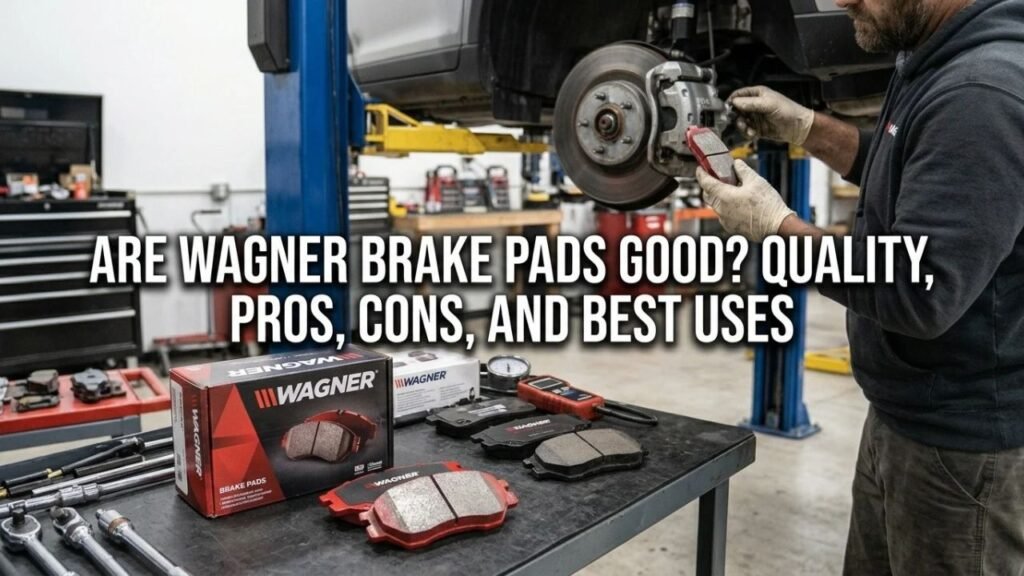
Yes. Wagner offers several pad lines made specifically for daily street use, and its current ES and QS products are positioned around OE-style fit and braking characteristics.
For a typical commuter, I would look first at Wagner QS. ES makes sense when cost matters more and the vehicle sees light-duty use.
Wagner ES for Basic Daily Driving
Wagner ES is the entry-level option in the current range.
Wagner describes ES as intended for:
- Daily commuting
- Light-duty driving
- Budget-focused brake repairs
The pads use an OE-style design, a powder-coated backing plate, and a three-layer shim aimed at reducing brake noise. The current Wagner comparison chart says hardware is not included with ES pads.
That makes ES a reasonable choice for an older commuter, second vehicle, or ordinary passenger car that does not tow or see repeated hard braking.
Wagner QS for Most Street Cars
Wagner QuickStop, commonly labeled QS, sits above ES.
The current QS line uses application-specific friction material, a four-layer noise-control shim, corrosion-resistant backing plates, and stainless hardware in most applications. Wagner positions it for everyday driving plus occasional heavier use.
For an ordinary sedan, crossover, minivan, or light-duty SUV, QS is the Wagner line I would check first unless the vehicle regularly sees higher brake temperatures.
Wagner OEX for More Demanding Street Use
OEX is Wagner’s premium line for drivers who want stronger heat management and more noise-control features.
Current OEX pads use a five-layer shim, application-specific shapes and slots, stainless hardware, and a pad design intended to move more air around the friction surface. Wagner lists OEX for high-demand driving, towing, trucks, SUVs, and performance-minded applications.
Key Takeaway: Wagner is a good daily-driving brand, but QS is usually the most logical starting point for ordinary street use, while OEX fits heavier or hotter braking conditions.
How Good Is Wagner Brake Pad Quality?
Wagner is not a no-name brake brand. It is part of DRiV, the aftermarket business created after Tenneco acquired Federal-Mogul, and Wagner’s braking history reaches back more than a century through predecessor companies.
Brand history alone does not prove that every pad is good, so construction and testing matter more.
Application-Specific Friction Formulas
Wagner states that its QS pads use friction materials selected for individual vehicle applications rather than one universal compound.
That matters because a compact sedan, pickup, SUV, and commercial vehicle may need different friction characteristics.
It also means you should not assume every Wagner QS or OEX pad is ceramic or semi-metallic just from the product-line name. Check the exact part number if friction composition matters to you.
Noise-Control Design
Noise treatment becomes more substantial as you move through Wagner’s passenger-vehicle range.
The current comparison is:
| Wagner Line | Noise-Control Design |
| ES | 3-layer shim |
| QS | Up to 4-layer application-specific shim |
| OEX | 5-layer shim plus custom pad shape |
Wagner says the shims are intended to reduce vibration that can lead to squeal.
A shim cannot correct seized hardware, poor rotor condition, contamination, or incorrect installation, so quiet braking still depends on the rest of the brake system.
Testing Standards
Wagner states that current ES, QS, and OEX pads are dynamometer-tested using SAE J2521 for noise and SAE J2522 for brake effectiveness, along with Los Angeles City Traffic test procedures.
That is a stronger quality signal than a pad sold only on vague claims about stopping power.
Key Takeaway: Wagner’s application-specific formulations, multi-layer shims, corrosion protection, and stated SAE-based testing support its reputation as a legitimate aftermarket brake-pad brand.
Which Wagner Brake Pads Are Best?
The best Wagner pad depends on how the vehicle is actually used.
Choosing the premium line every time is not automatically the smartest move.
Wagner ES
Best suited to:
- Budget repairs
- Normal commuting
- Light-duty passenger vehicles
- Older vehicles that do not see heavy brake loads
ES is the basic option. It gives up some hardware and noise-control features found farther up the range.
Wagner QS QuickStop
Best suited to:
- Daily commuters
- Family cars
- Crossovers
- Minivans
- Normal SUVs
- Occasional heavier use
QS offers a useful middle ground between price and added features. Most applications include stainless hardware, and the four-layer shim provides more noise treatment than ES.
Wagner OEX
Best suited to:
- Pickups
- SUVs
- Towing
- Frequent hills
- Higher brake temperatures
- Drivers who want the premium Wagner option
Wagner says OEX uses a custom wave shape and slot design to promote cooling and more even pad wear. Hardware is included across current OEX applications.
Wagner also claims OEX can provide longer pad life than some of its other offerings based on its own testing. I would treat that as a manufacturer test result rather than a guaranteed mileage figure for every vehicle.
Wagner SD SevereDuty
Best suited to:
- Work trucks
- Fleet vehicles
- Delivery vehicles
- Frequent stopping
- Heavy payloads
- Severe heat
- Repeated towing or hauling
Wagner SD uses a semi-metallic carbon-based friction formula and is tested for high heat, heavy loads, and frequent stops.
For a normal compact commuter, SD would usually be unnecessary.
Key Takeaway: ES fits light-duty budget use, QS suits most commuters, OEX fits higher-demand street use and towing, and SD is meant for severe service.
Are Wagner Brake Pads Quiet?
Wagner places considerable emphasis on reducing noise, but no brake pad can guarantee silence in every car.
Rotor condition, installation, hardware, pad bedding, caliper movement, corrosion, and contamination can all create squealing.
ES Noise Level
ES uses a three-layer shim.
That gives it basic vibration control, but drivers especially sensitive to brake noise may prefer QS or OEX.
QS Noise Level
QS uses up to four shim layers depending on application.
For an everyday replacement pad, that makes QS a sensible balance between price and noise treatment.
OEX Noise Level
OEX gets Wagner’s most developed passenger-vehicle noise package, including a five-layer shim and application-specific pad shape.
If quiet braking is a major concern and OEX is available for the vehicle, I would consider it ahead of ES.
Key Takeaway: Wagner pads include real noise-control features, with OEX receiving the most extensive treatment in the current passenger-vehicle lineup.
Do Wagner Brake Pads Produce a Lot of Dust?
Brake dust varies by friction formula, vehicle, driving conditions, rotor surface, and pad temperature.
It is not accurate to say every Wagner pad is low-dust or high-dust.
Friction Formula Changes by Application
Wagner uses application-specific formulas, so two pads sold under the same product family may not behave exactly the same.
A semi-metallic formula can create darker visible dust than some ceramic formulas, while pad and rotor wear also influence what collects on the wheel.
OEX Targets Lower Residue
Wagner states that its OEX design is intended to reduce residue and rotor wear compared with some other Wagner offerings.
That is useful if wheel cleanliness matters, but I would not purchase OEX solely because of a dust claim. Vehicle fit, braking load, noise, and heat requirements deserve more weight.
Key Takeaway: Wagner brake dust levels vary by exact formulation, though OEX is the line Wagner positions around reduced residue and premium street behavior.
How Long Do Wagner Brake Pads Last?
There is no single Wagner brake-pad mileage rating that applies across the range.
Pad life changes with:
- Vehicle weight
- City versus highway driving
- Towing
- Hills
- Driving style
- Rotor condition
- Caliper operation
- Front-to-rear brake balance
- Exact Wagner friction formula
A set on a lightly driven commuter can last far longer than the same general type of pad on a heavy SUV used in dense traffic.
OEX Longevity Claims
Wagner promotes OEX as its longer-life premium option and has advertised up to twice the pad life in internal comparisons against other Wagner offerings.
That does not mean every OEX installation will last twice as many miles. Real service life still depends heavily on vehicle and use.
Uneven Wear Is Not Normal Pad Life
If one Wagner pad disappears much faster than the others, inspect the brake system before blaming the pad brand.
Common causes include:
- Sticking caliper piston
- Seized slide pin
- Pad binding in the bracket
- Restricted brake hose
- Parking-brake fault
- Damaged rotor
A quality pad cannot compensate for a brake that fails to release correctly.
Key Takeaway: Wagner pad life has no universal mileage figure; driving conditions and brake-system health usually matter more than the brand name.
Do Wagner Brake Pads Wear Rotors Quickly?
There is no good basis for saying Wagner pads generally destroy rotors.
Rotor wear depends on the exact friction formula, rotor metallurgy, heat, contamination, braking load, and pad-to-rotor compatibility.
OEX Is Designed Around Rotor Wear Control
Wagner states that OEX’s friction formulation and pad geometry are intended to reduce rotor wear while maintaining braking under demanding conditions.
That claim is useful, but existing rotor condition still matters.
Installing new pads on badly grooved, undersized, overheated, or heavily rusted rotors can lead to poor contact, noise, and irregular wear no matter which pad brand you choose.
SD Pads Have a Different Mission
SD is designed for severe-duty service rather than minimizing every trace of rotor wear.
Its semi-metallic carbon-based formula is intended for heat, heavy loads, and repeated stopping. Those are different priorities from a comfort-focused commuter pad.
Key Takeaway: Wagner pads are not inherently hard on rotors, but the exact friction compound and driving application affect rotor wear.
Main Pros and Cons of Wagner Brake Pads
Wagner has enough different product lines that the strengths and drawbacks vary, but several patterns are clear.
Wagner Brake Pad Pros
Good range of applications: The lineup covers budget commuters through severe-duty fleet use.
OE-style fit: ES and QS emphasize OE-style form and vehicle-specific design.
Noise-control hardware: Multiple shim designs are used across the range.
Corrosion protection: ES, QS, and OEX use coated backing plates.
Hardware availability: QS includes hardware in most applications, while OEX includes it in current applications.
Current zero-copper formulas: Wagner identifies its major current lines as using OE25 zero-copper friction material.
Wagner Brake Pad Cons
The product name alone does not tell you the friction material: You may need to check the exact part number.
ES usually lacks new hardware: That can matter if clips are rusted or damaged.
Premium lines cost more: OEX may be unnecessary for a light-duty commuter.
Noise and dust still vary: Wagner branding cannot eliminate problems caused by rotor condition, installation, or the specific friction formulation.
Warranty details are supplier-dependent: Wagner’s current contact information directs buyers to the local Wagner supplier for warranty details rather than stating one universal warranty for every brake pad purchase.
Key Takeaway: Wagner offers strong fitment coverage and useful design features, but line selection, exact friction material, included hardware, and supplier warranty terms deserve checking before purchase.
Are Wagner Brake Pads Worth Buying?
For many drivers, yes.
I would be comfortable considering Wagner alongside other established aftermarket brake brands when the exact pad is listed for the vehicle and matches how the car or truck is used.
For a straightforward commuter repair, QS is probably the most balanced Wagner option. It gives you application-specific material, stronger noise treatment than ES, and hardware in most fitments.
For towing, heavier SUVs, trucks, or drivers who create more brake heat, OEX is more appealing.
For fleet vehicles, delivery work, repeated heavy loads, or very demanding braking, SD makes more sense than installing a normal commuter pad and expecting it to handle severe service.
I would choose the pad line from the vehicle’s job rather than automatically buying the cheapest or most expensive Wagner box.
Conclusion
Yes, are Wagner brake pads good can generally be answered positively. Wagner is an established aftermarket brake brand with application-specific friction formulas, OE-style designs, noise-control features, corrosion-resistant backing plates, and several pad lines built for different levels of brake demand.
For most daily drivers, Wagner QS is the line I would start with. ES fits budget and light-duty repairs, OEX makes more sense for towing and higher-demand road use, and SD targets work vehicles and severe braking conditions.
Check the exact part number before buying because hardware, friction material, sensors, and fitment can differ by vehicle. The condition of the rotors, calipers, slide pins, and bracket hardware is just as important as the pad brand.
My recommendation is to view Wagner as a good brand but not treat every Wagner pad as interchangeable. Match the series to the vehicle and driving conditions, and the brand offers several sensible aftermarket options.
FAQs About Wagner Brake Pads
Are Wagner Brake Pads a Good Brand?
Yes. Wagner is an established brake brand under DRiV and offers several application-specific brake-pad lines.
Its current range covers light-duty commuting, normal replacement, premium street use, towing, and severe-duty vehicles. The correct product line matters more than the Wagner name alone.
Which Wagner Brake Pads Are Best?
OEX is Wagner’s premium choice for higher-demand street driving, towing, pickups, SUVs, and drivers who want its stronger noise and heat-control package.
QS is often the better match for an ordinary daily driver because it combines OE-style fit, application-specific friction material, noise control, and hardware in most applications.
Are Wagner QuickStop Brake Pads Good?
Yes. Wagner QS QuickStop pads are a sensible choice for everyday driving and occasional heavier use.
They use vehicle-specific friction material, an application-specific noise-control shim, corrosion-resistant backing plates, and stainless hardware in most applications. They sit between the budget ES line and premium OEX line.
Are Wagner OEX Brake Pads Good?
Yes. OEX is one of Wagner’s stronger choices for trucks, SUVs, towing, and higher brake loads.
Current OEX pads use a five-layer shim, custom pad geometry, stainless hardware, and a zero-copper formulation. Wagner also tests the line for noise and braking behavior using established SAE procedures.
Are Wagner Brake Pads Ceramic?
Some Wagner applications use ceramic-type formulations, while others use different application-specific compounds. The product-family name alone should not be used to identify the friction material.
Check the exact Wagner part number and product specifications for your vehicle before purchasing.
Are Wagner Brake Pads Better Than OEM Pads?
Not in every case. OEM pads are engineered around the original vehicle’s brake feel, noise targets, rotor pairing, and other design goals.
A Wagner pad can be a good replacement and may offer different features or pricing, but the comparison changes by vehicle and Wagner series. Match the replacement pad to the use rather than assuming aftermarket or OEM is automatically superior.
Do Wagner Brake Pads Come With Hardware?
It depends on the line and application. Current Wagner QS pads include stainless hardware in most applications, while current OEX pads include hardware across listed applications.
Wagner ES normally does not include hardware. Confirm the contents of the exact part number before starting the brake job.
How Long Do Wagner Brake Pads Last?
There is no fixed mileage for Wagner pads. Traffic, towing, hills, vehicle mass, driving style, rotor condition, and caliper operation all affect wear.
Track pad thickness during inspections rather than relying on a generic mileage promise. Rapid or uneven wear should trigger a brake-system inspection instead of simply installing another set of pads.