Does Regenerative Braking Use Brake Pads? How It Really Works
Regenerative braking itself does not rely on brake pads. It slows an EV or hybrid by using the drive motor as a generator, converting some of the vehicle’s motion into electricity. The car still has conventional friction brakes, and its brake pads engage when extra stopping force is needed or operating conditions limit regeneration.
This distinction matters because regenerative braking does not eliminate normal brake maintenance. An EV or hybrid may use its pads far less than a gasoline-only vehicle, but the pads, rotors, calipers, brake fluid, and related hardware remain part of the braking system.
Using regeneration for routine deceleration reduces friction-brake wear and recovers energy that would otherwise become heat at the rotors. It also explains why an EV can slow noticeably when the accelerator is released even though the driver has not pressed the brake pedal.
The U.S. Department of Energy reported in 2024 that net regenerative braking recovers about 22% of energy on the EPA combined city/highway drive cycle for a typical EV. DOE also reports that regenerative braking contributes to substantially reduced brake wear in electric vehicles.
If you are asking does regenerative braking use brake pads, the key distinction is between regenerative braking and the complete vehicle braking system. Regen uses motor resistance to slow the wheels, while the vehicle blends in conventional hydraulic friction brakes whenever more braking force is required.
What stood out to me in the manufacturer and government information was how much the transition can vary between vehicles. Some EVs provide strong one-pedal deceleration, while others blend regeneration and friction braking through the brake pedal. The sections below explain when the pads actually work, why they last longer, what happens with a full battery, and why low pad wear can create a different maintenance problem.
How Regenerative Braking Works Without Brake Pads
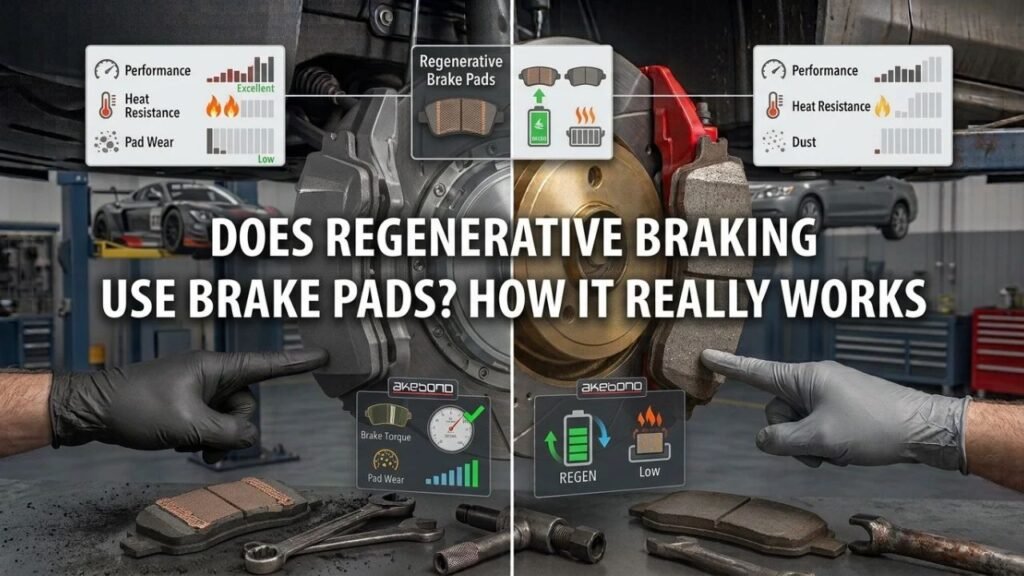
Regenerative braking uses an electric traction motor to create resistance at the driven wheels.
During acceleration, electrical energy from the battery powers the motor and the motor turns the wheels. During regeneration, that energy flow changes direction. The moving wheels drive the motor, and the motor operates as a generator.
Electrical energy produced during that process can be sent back to the high-voltage battery. The resistance created by the generator also slows the vehicle.
The Electric Motor Provides the Braking Force
During pure regenerative deceleration, no brake pad needs to press against a rotor.
The slowing force comes from electromagnetic resistance inside the electric drivetrain. This is why releasing the accelerator in an EV can feel similar to mild or strong engine braking in a conventional vehicle.
Some vehicles let the driver choose different regeneration levels. A stronger setting creates more deceleration when the accelerator is released, while a lower setting lets the vehicle coast farther.
Regenerative Braking Recovers Part of the Vehicle’s Energy
Traditional disc brakes convert motion mainly into heat through friction between the pads and rotors.
Regeneration redirects some of that motion into electrical energy instead. The process cannot recover every bit of energy because the motor, inverter, battery, tires, and drivetrain all have losses.
City driving gives regenerative braking many opportunities to work because the vehicle repeatedly slows and accelerates. Long stretches of steady-speed highway travel provide fewer deceleration events.
Regen Does Not Replace the Friction Brake System
Electric and hybrid vehicles still have conventional service brakes.
Disc-brake systems use brake pads, rotors, calipers, and hydraulic pressure much like brakes on gasoline vehicles. Some vehicles may also use drum brakes on certain axles.
The two braking methods work together rather than competing with each other. This combined operation is often called blended braking.
Key Takeaway: Pure regenerative braking slows the vehicle through the electric motor, not pad-to-rotor friction, but EVs and hybrids retain conventional brakes for situations regen cannot handle alone.
When Does Regenerative Braking Use the Regular Brakes?
The vehicle’s friction brakes engage whenever regenerative deceleration cannot provide all of the requested stopping force.
The exact transition depends on vehicle design, battery conditions, speed, traction, brake-pedal input, and software calibration.
Hard or Emergency Braking
A traction motor has a limit to how much regenerative braking torque it can produce.
If the driver demands rapid deceleration, the vehicle adds hydraulic braking so the brake pads clamp the rotors. During an emergency stop, the driver should use the brake pedal normally rather than trying to maximize regeneration.
The friction brakes are there to deliver stopping force beyond what the regenerative system can supply. U.S. Department of Energy guidance states that the brake pedal remains available for emergency braking in regenerative-braking vehicles.
Very Low-Speed and Complete Stops
Regenerative braking becomes less capable as vehicle speed approaches zero because the motor has less rotational energy available for electrical generation.
Some vehicles use friction brakes during the final part of a stop. Other systems can provide strong regeneration nearly to zero and then apply hydraulic brakes to hold the car stationary.
For example, DOE material describing EV brake modes notes that some hold functions engage the friction brakes once the vehicle is completely stopped.
When the Battery Cannot Accept Much Energy
The battery must be able to accept electricity for strong regeneration to occur.
Regenerative braking may be reduced when the traction battery is:
- Near full charge
- Very cold
- Very hot
- Limited by battery-management controls
- Experiencing another condition that restricts charging power
When regenerative capacity drops, the vehicle may rely more heavily on its friction brakes to provide the requested deceleration.
Drivers may notice reduced one-pedal slowing after charging an EV close to 100%, especially on models that clearly display limited regeneration.
Low-Traction Conditions
Snow, ice, loose gravel, or other slippery surfaces can change the amount of regenerative braking the control system permits.
Strong braking torque at the driven wheels could contribute to loss of traction, so the vehicle’s stability and anti-lock systems may reduce or modify regeneration.
The braking computer manages the available systems to maintain wheel control.
Key Takeaway: Brake pads become more active during hard stops, very low speeds, limited battery charging conditions, and situations where traction or system limits reduce available regeneration.
Does Pressing the Brake Pedal Always Use the Brake Pads?
No. Pressing the brake pedal does not necessarily mean the pads immediately clamp the rotors in an EV or hybrid.
Many electrified vehicles use brake blending. The pedal communicates the driver’s requested deceleration to the braking control system, which may provide part or most of that deceleration through regenerative braking first.
If stronger braking is needed, hydraulic pressure adds friction braking.
Light Pedal Pressure May Produce Mostly Regeneration
During gentle slowing, the vehicle may be able to meet the driver’s request almost entirely through the electric motor.
The pedal still feels like a normal brake control from the driver’s perspective. Behind the scenes, electronic controls determine how much braking should come from regeneration and how much should come from friction.
This setup recovers more energy and reduces unnecessary pad use.
Stronger Pedal Pressure Brings in More Friction Braking
As requested deceleration rises beyond the regenerative system’s capacity, brake pads contribute more stopping force.
Ideally, the transition feels smooth enough that the driver does not notice a sharp change between the two systems.
The exact blending strategy differs among hybrids, plug-in hybrids, and battery EVs.
Key Takeaway: Pressing the brake pedal can activate regeneration, friction brakes, or a blend of both; pedal movement alone does not prove the pads are being heavily used.
Does One-Pedal Driving Use Brake Pads?
One-pedal driving uses strong regenerative braking when the driver lifts off the accelerator.
In many normal deceleration events, the vehicle can slow substantially without using the friction brakes. Some systems can bring the car nearly to a stop through regeneration.
Some Vehicles Use Friction Brakes at the Final Stop
Regeneration becomes harder to maintain at very low motor speed, so some one-pedal systems blend in the friction brakes during the last part of stopping.
A vehicle may also apply the hydraulic brakes after stopping to keep the car stationary.
That means one-pedal driving does not imply that the brake pads remain untouched for the entire trip.
The Car May Apply Friction Brakes Automatically
Modern braking systems may use the friction brakes even when the driver does not explicitly request them.
Examples include:
- Stability-control intervention
- Anti-lock braking operation
- Automatic emergency braking
- Hill-hold functions
- Brake-disc cleaning or wiping
- Final vehicle hold at zero speed
Some EV manufacturers also program light brake application to remove water or surface contamination from the rotors.
Key Takeaway: One-pedal driving greatly reduces normal pad use, but vehicle software can still apply friction brakes for low-speed stopping, holding, stability functions, emergencies, or brake-disc conditioning.
Do Brake Pads Last Longer With Regenerative Braking?
Generally, yes.
Because regenerative braking handles a portion of routine deceleration, the friction material performs less work. DOE states that brake wear in EVs is substantially reduced because of regenerative braking.
That can extend brake-pad life compared with a similar vehicle that depends primarily on friction braking.
Pad Life Can Be Much Different Between Drivers
There is no single mileage number that applies to every regenerative-braking vehicle.
Brake-pad wear changes with:
- Regeneration strength
- City versus highway use
- Driving speed
- Vehicle weight
- Hills and mountain driving
- Towing
- Battery state of charge
- Climate
- Driver braking habits
- Vehicle software
- Caliper condition
A driver who anticipates traffic and regularly uses regenerative deceleration may use the pads far less than someone who frequently makes hard, late stops.
Hybrid Pads Still Wear
A hybrid may use regeneration extensively, but its friction brakes still perform real work.
Hard braking, rapid stops, low-speed operation, battery limits, and system blending all use conventional brakes to varying degrees.
Brake inspections should therefore follow the vehicle manufacturer’s maintenance guidance rather than an assumption that regenerative braking makes pad inspection unnecessary.
Key Takeaway: Regenerative braking usually extends brake-pad life because the pads perform less braking work, but actual service life still depends on driving conditions and vehicle operation.
Less Brake Pad Wear Can Create Rotor Problems
Reduced friction-brake use has one downside that surprises some EV owners: the rotors may develop corrosion even while the pads remain thick.
Normal pad-to-rotor contact removes light surface rust. When that contact occurs less often, moisture and road salt can remain on the rotor surfaces longer.
Brake Rotors Can Rust From Infrequent Use
DOE notes that EV brake wear is reduced through regeneration, but the conventional brake system still requires maintenance. Some vehicle manufacturers specifically address rotor corrosion created by limited friction-brake use.
Tesla, for example, states that brake pads are typically used less often because of regenerative braking and warns that rust or corrosion can still build on brake discs. Its vehicles also use a brake-disc wiping function under certain conditions.
Surface rust after rain may disappear once the friction brakes operate. Heavy scaling, pitting, or corrosion in areas the pad no longer cleans deserves inspection.
Calipers and Hardware Still Need Attention
Low pad wear does not stop mechanical brake parts from aging.
Caliper slide pins can corrode, rubber boots can crack, brake fluid ages, and pads can bind in rusty brackets. In salted regions, corrosion may become a larger maintenance concern than friction-material thickness.
My preference is to judge an EV brake system by the condition of the pads, rotors, calipers, hardware, and fluid together, not by pad thickness alone.
Key Takeaway: Regen reduces friction wear, but infrequent brake-pad use may give rotor corrosion and sticking hardware more time to develop.
Regenerative Braking vs Friction Braking
The two systems slow the car in different ways.
| Feature | Regenerative Braking | Friction Braking |
| Main braking component | Electric motor/generator | Brake pads and rotors |
| Energy during braking | Some returned to battery | Mostly converted into heat |
| Pad wear | Little or none during pure regen | Pads wear through friction |
| Strong emergency stops | Limited by system capability | Supplies needed extra braking |
| Near-zero-speed operation | May become limited | Works at zero and low speed |
| Battery condition affects it | Yes | Much less directly |
| Used on EVs and hybrids | Yes | Yes |
| Regular inspection needed | Electrical system managed by vehicle | Pads, rotors, fluid, calipers still need inspection |
The distinction is useful, but the driver normally does not need to manage the two systems separately.
Vehicle software coordinates them so the requested deceleration is delivered while using regeneration when conditions permit.
Can an EV Drive Without Brake Pads Because It Has Regen?
No.
Regenerative braking is not a substitute for a complete friction brake system. EVs still need physical brakes capable of stopping the vehicle when regeneration is unavailable or insufficient.
A vehicle with worn-out pads, damaged rotors, seized calipers, or a hydraulic fault should not be considered safe just because regenerative braking still slows it during accelerator lift-off.
A battery can become full. Regen can become restricted. An emergency can require more deceleration than the motor can provide. Vehicle speed can fall below the range where strong regeneration works.
Safety Tip: Treat any brake-system warning light, grinding noise, fluid leak, abnormal pedal feel, or major braking change as a reason to inspect the vehicle rather than relying more heavily on regenerative braking.
Conclusion
The answer to does regenerative braking use brake pads is no during pure regeneration. The electric motor provides the slowing force and generates electricity instead of relying on pad-to-rotor friction.
Brake pads still remain active members of an EV or hybrid braking system. They may engage during harder stops, very low speeds, limited regeneration, low-traction events, emergency braking, automated safety functions, and vehicle holding.
Because regen handles part of the daily braking workload, EV and hybrid pads often wear more slowly. The tradeoff is that rotors and caliper hardware may suffer from corrosion or limited use before the friction material itself is worn out.
I would still inspect an electrified vehicle’s brakes at the intervals specified by its manufacturer. Long-lasting pads are useful, but pad thickness alone does not tell you the condition of the entire friction brake system.
FAQs About Regenerative Braking and Brake Pads
Do electric cars still have normal brake pads?
Yes. Battery-electric vehicles normally retain a conventional hydraulic friction brake system with brake pads and rotors. Regenerative braking reduces how often those parts need to provide all the stopping force, but it does not remove them from the vehicle.
Does regenerative braking wear out brake pads?
Pure regenerative braking does not wear the pads because no pad-to-rotor friction is needed to create the regenerative slowing force. Pads still wear over time because friction braking is blended in during conditions where regeneration alone cannot provide the requested deceleration.
Why do EV brake pads last longer?
EV pads often last longer because the electric motor performs part of the vehicle’s routine braking. Every regenerative deceleration event reduces the amount of kinetic energy that the friction brakes must convert into heat, cutting the workload placed on the pads and rotors.
Does regenerative braking work when the battery is full?
Regeneration may be reduced or restricted when the battery is near its maximum state of charge because there is less capacity available to accept recovered energy. The amount of reduction varies by vehicle. Friction brakes remain available when the car needs more stopping force.
Does regenerative braking work at very low speeds?
Its ability to produce useful braking generally drops as motor speed approaches zero. Vehicle manufacturers handle this in different ways. Many systems blend in friction brakes near the end of a stop or use them to hold the vehicle once it has stopped.
Does one-pedal driving mean the brake pads are never used?
No. Strong one-pedal driving can handle a large share of ordinary deceleration without pad friction, but the car may still use its physical brakes near zero speed, for vehicle hold, emergency braking, stability control, automatic braking, or rotor-cleaning functions.
Can regenerative braking cause brake rotors to rust?
It can contribute indirectly. Regeneration reduces how frequently the pads scrub the rotor surfaces, so moisture and road salt may remain longer. EV brake rotors still need inspection for corrosion, pitting, uneven contact, and other deterioration even when the pads retain plenty of friction material.