Carbon Fiber vs Ceramic Brake Pads: Performance, Dust, and Use
For most daily-driven cars, standard ceramic pads are usually the better pick because they run quietly, create little visible dust, and are gentle on rotors. Carbon-fiber ceramic pads make more sense when you want stronger bite and better fade resistance for harder street driving, heavier vehicles, mountain routes, or towing—provided the pad is approved for your brake system.
Choosing the wrong compound can create tradeoffs you did not expect. A performance-oriented pad may make more dust, feel different when cold, or wear the rotor faster, while a comfort-focused ceramic pad may not give the firmer response you want during repeated hard stops.
Matching the pad to the vehicle and driving pattern gives you more predictable pedal feel, quieter operation, cleaner wheels, and a friction material that works within the temperature range it was designed to handle.
Modern U.S. brake-pad formulas are also changing. California’s Brake Pad Law requires Level N friction material from January 1, 2025, with less than 0.5% copper by weight for covered new and replacement brake pads. Washington uses the same Level N copper threshold for pads manufactured after January 1, 2025.
The most useful point in carbon fiber vs ceramic brake pads is that many products sold as “carbon fiber” street pads are actually carbon-fiber-reinforced ceramic compounds. What stood out to me in current manufacturer catalogs is that carbon fiber is often added to a ceramic base to strengthen the friction mix and improve high-heat street behavior, not to create a pure carbon racing pad. PowerStop describes its Z23 and Z26 products this way.
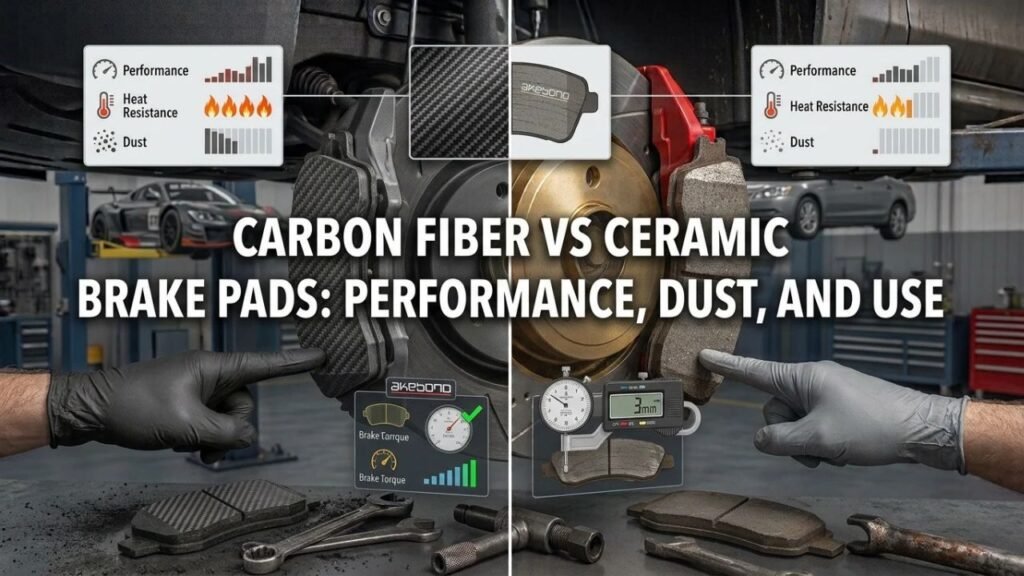
That distinction changes the comparison. The sections below cover material design, braking feel, heat and fade resistance, dust, noise, rotor wear, pad life, towing, street performance, track use, cost, and the compatibility issue between carbon-fiber ceramic pads and true carbon-ceramic brake systems.
Carbon Fiber vs Ceramic Brake Pads at a Glance
| Factor | Carbon-fiber ceramic pads | Standard ceramic pads |
| Daily commuting | Good to very good | Excellent |
| Initial bite | Often firmer | Usually smooth and progressive |
| Repeated hard stops | Usually better suited | Good for normal road braking |
| Fade resistance | Often higher | Good within normal street temperatures |
| Brake dust | Low for many formulas | Usually very low |
| Noise | Usually low with quality hardware | Usually very low |
| Rotor wear | Varies by formula | Often rotor-friendly |
| Towing/heavy use | Better options are available | Not always the first choice |
| Sporty street driving | Strong fit | Good if braking demand is moderate |
| Track use | Street versions are not automatically track pads | Usually not intended for track use |
| Cost | Often higher | Usually moderate to premium |
| Best fit | Harder street use, towing-specific or performance applications | Commuting, city driving, touring, clean-wheel priorities |
Neither category wins every row. Friction formulas vary by manufacturer, and two pads carrying the same material label can feel very different on the same vehicle.
What Are Carbon Fiber Brake Pads?
In normal aftermarket street-brake discussions, “carbon fiber brake pads” often refers to carbon-fiber ceramic brake pads rather than a pad made mainly from carbon fiber.
The friction compound starts with a ceramic-based formulation and adds carbon-fiber reinforcement. The goal is to retain low-dust, street-friendly behavior while increasing strength, heat handling, and braking response.
PowerStop’s Z23 daily-driver line uses a low-dust ceramic formula infused with carbon fiber. Its Z36 line uses the same general material concept for trucks and SUVs used for towing, hauling, off-road driving, and mountain travel.
This is different from carbon-carbon racing brakes and from pads engineered for a true carbon-ceramic rotor. Those are specialized braking systems with different friction couples, operating temperatures, and compatibility requirements.
What Are Ceramic Brake Pads?
Ceramic brake pads use a dense ceramic friction formulation combined with binders, fillers, and reinforcing materials. Exact recipes are proprietary and differ across brands and vehicle applications.
Their biggest street advantages are usually quiet operation, low visible dust, smooth pedal response, and relatively low rotor wear. Akebono’s current ProACT and EURO ceramic lines are examples of vehicle-specific ceramic formulations marketed around clean wheels, low noise, and rotor-friendly behavior.
Ceramic does not automatically mean weak braking. Many vehicles are engineered around ceramic friction materials from the factory. The limitation appears when brake temperatures and repeated stopping loads move beyond the range that a comfort-oriented ceramic formula was designed to handle.
Carbon Fiber vs Ceramic Brake Pads: Key Differences
Braking Feel and Initial Bite
Carbon-fiber ceramic pads are often aimed at drivers who want a firmer response than a basic replacement ceramic pad. The added reinforcement and performance-oriented friction formulation can produce a stronger initial bite on applications built around that goal.
Standard ceramic pads usually feel smoother and more progressive. For commuting and ordinary highway use, that character can make the car easier to modulate in traffic.
Do not treat pedal feel as a direct measure of stopping distance. Tire grip, rotor size, caliper force, brake balance, ABS calibration, pad coefficient of friction, temperature, and road conditions all contribute to how quickly a vehicle actually stops.
Heat and Brake Fade
Brake fade occurs when repeated braking raises temperatures enough that friction drops or the brake system can no longer maintain the same response.
Carbon-fiber ceramic street pads are commonly formulated to tolerate more repeated heat than basic ceramic replacements. PowerStop says its Z23 carbon-fiber ceramic pads resist fade at higher temperatures than its stock-replacement ceramic options, while the Z36 version is aimed at heavier-duty truck and SUV use.
A standard ceramic pad still handles the temperatures created by normal commuting, highway driving, and routine stops on a properly functioning brake system. Buying a hotter compound adds little benefit if the car never reaches the conditions that justify it.
Brake Dust
Both types can keep wheels cleaner than many semi-metallic formulations.
Standard ceramic pads have a strong reputation for low visible dust. Akebono promotes its ceramic lines specifically around ultra-low dust and cleaner wheels.
Carbon-fiber ceramic pads can also be low-dust because the carbon fiber is blended into a ceramic base. PowerStop markets its current Z-series carbon-fiber ceramic formulas as low-dust compounds.
The actual dust level still varies by vehicle, rotor, driving style, and formula. “Carbon fiber” does not automatically mean dusty, and “ceramic” does not mean dust-free.
Noise
Quality ceramic pads are often among the quieter street-pad choices. Their friction material, chamfers, slots, backing plates, and shims are commonly designed around low noise and vibration.
Carbon-fiber ceramic street pads can also be quiet. PowerStop uses rubberized or stainless-steel shims on several Z-series products, depending on the application.
Noise problems after pad replacement can come from rotor condition, rusted hardware, pad movement, caliper slides, contamination, poor bedding, or incorrect installation. Compound choice is only one part of the diagnosis.
Rotor Wear
Standard ceramic pads are often chosen for gentle rotor behavior during normal road use. Akebono specifically describes its ceramic formulas as rotor-friendly.
Carbon-fiber ceramic rotor wear depends on the formulation. A pad designed for stronger bite and higher heat may interact with the rotor differently from a comfort-oriented ceramic pad.
My preference is to judge pad and rotor wear as a matched system. A harder-sounding material name does not tell you enough about the actual friction couple.
Pad Life
Neither material has a universal mileage advantage.
Pad life changes with vehicle weight, rotor condition, hills, towing, traffic, driver input, caliper health, braking temperature, and the exact compound. A gentle commuter can get long life from either type, while repeated heavy braking can shorten the life of both.
Look at measured friction-material thickness during service rather than relying on a broad mileage promise.
Price
Standard ceramic pads are widely available from economy, OE-style, and premium brands. Carbon-fiber ceramic pads often sit in a performance or heavy-duty product line and may cost more.
The price gap can shrink when premium ceramic pads are compared with entry-level carbon-fiber ceramic products. Hardware, shims, wear sensors, coating, warranty, and brand also affect the final price.
Key Takeaway: Standard ceramic pads favor quiet, clean daily driving, while carbon-fiber ceramic pads usually add more heat capacity and firmer street response without giving up the low-dust character of a ceramic base.
Which Brake Pad Is Better for Daily Driving?
For an ordinary sedan, crossover, or small SUV used mainly for commuting, errands, and highway travel, standard ceramic pads are usually the simpler choice.
Their smooth engagement, low dust, low noise, and rotor-friendly character fit the way most street vehicles are driven. Akebono’s ceramic replacement lines are built around this type of use and use vehicle-specific formulations rather than one compound across every application.
Carbon-fiber ceramic pads can still work very well on a daily driver. PowerStop’s Z23 line is specifically positioned for daily-driven cars, trucks, SUVs, and crossovers.
The reason to choose the carbon-fiber ceramic option is not that a normal ceramic pad is inadequate. Choose it if you want a stronger street-oriented response, drive a heavier vehicle, regularly encounter long descents, or prefer the behavior of that specific pad line.
Which Is Better for Towing, Trucks, and Mountain Driving?
Towing and repeated downhill braking place more heat into the brakes than routine flat-road commuting.
A carbon-fiber ceramic pad formulated for severe-duty street use can make more sense here. PowerStop’s Z36 compound is specifically sold for trucks and SUVs used for towing, hauling, larger tires, off-road use, and mountain driving.
Do not assume every carbon-fiber ceramic pad is suitable for towing. The product must be rated for the vehicle and intended load. A sport pad for a light car and a towing pad for a heavy pickup may share a material label while using different friction formulas.
For a truck that tows regularly, I would prioritize the vehicle maker’s requirements, gross vehicle weight, trailer load, rotor condition, brake-fluid condition, and a pad line explicitly intended for towing over a generic material claim.
Which Is Better for Performance Street Driving?
Carbon-fiber ceramic pads have the stronger case for spirited street use.
A performance-oriented compound can maintain a more consistent response after repeated stops and may provide a firmer initial bite than a comfort-focused ceramic pad. PowerStop’s Z26 line, for example, is aimed at street-driven muscle cars, modified vehicles, and high-performance applications.
That does not turn every carbon-fiber ceramic pad into a race pad. Street compounds still have to work from cold temperatures, remain quiet enough for road use, and control dust.
A standard ceramic pad can be a better match for a performance car that spends nearly all of its time commuting. The vehicle’s factory pad specification is also a useful reference because changing friction material can alter pedal character.
Are Carbon Fiber Brake Pads Better for Track Use?
Do not choose a track pad from the words “carbon fiber” alone.
PowerStop separates its carbon-fiber ceramic street lines from dedicated Track Day pads in its current catalog. That product separation is a useful clue: a street carbon-fiber ceramic pad and a motorsport friction material are not interchangeable categories.
Track braking can place the pads and rotors at temperatures far above typical street use. A dedicated track compound may accept more noise, dust, rotor wear, and poor cold behavior in exchange for consistent hot friction.
If the car sees repeated track sessions, use a pad rated for the actual track temperature range and braking system rather than treating a street performance label as race approval.
Carbon-Fiber Ceramic Pads Are Not the Same as Carbon-Ceramic Brakes
Carbon-Fiber Ceramic Street Pads
These are conventional steel-rotor brake pads with a ceramic friction formulation reinforced with carbon fiber.
Examples include several PowerStop Z-series lines. They install on compatible iron or steel rotor systems just like other replacement pads when the part number matches the vehicle.
Carbon-Ceramic Brake Systems
A true carbon-ceramic braking system uses a carbon-ceramic composite rotor and a pad engineered to work with that rotor material.
Brembo states that its carbon-ceramic pads are specifically developed to pair with carbon-ceramic discs and the vehicle applications designed around them.
Do not fit a normal steel-rotor pad to a carbon-ceramic disc unless the brake-system manufacturer explicitly approves that combination. The friction pair is part of the design.
Key Takeaway: Carbon-fiber ceramic street pads are reinforced ceramic pads for compatible conventional rotors; true carbon-ceramic brake systems use specialized rotors and matching pads.
How to Choose Between Carbon Fiber and Ceramic Brake Pads
Start With Vehicle Compatibility
Use the exact year, make, model, engine, trim, rotor size, and brake package when selecting pads.
Some vehicles use more than one caliper or rotor option within the same model year. A pad that looks similar may have different dimensions, hardware, sensors, or friction characteristics.
The vehicle maker’s brake specification should be the first filter.
Match the Pad to the Driving Job
For quiet commuting and clean wheels, standard ceramic is usually the sensible starting point.
For repeated hard street braking, a carbon-fiber ceramic performance pad may provide the response you want.
For towing or hauling, use a compound specifically sold for that workload.
For track use, buy a track-rated pad.
Check the Environmental Marking
Modern replacement pads may carry the LeafMark environmental code.
Level N means the friction material contains less than 0.5% copper by weight and meets the related restricted-material requirements. California and Washington use this level in their current brake-friction rules.
The marking tells you about regulated material content, not which pad has stronger bite or longer life.
Compare the Whole Pad Design
Friction material is only part of a brake pad.
Look at application-specific shims, chamfers, slots, hardware, wear sensors, backing-plate coating, manufacturer fitment data, and the recommended bedding process.
Two pads labeled ceramic can behave differently because the complete design and friction recipe are different.
Key Takeaway: Choose by vehicle fitment and driving workload first, then compare compound, noise control, dust, hardware, and environmental markings.
Bedding New Carbon Fiber or Ceramic Brake Pads
Follow the Pad Manufacturer’s Procedure
New pads need proper contact with the rotor surface. Some products require a defined series of stops and cooling periods, while others use a different break-in approach.
PowerStop states that its bedding procedure is used to establish an even transfer layer of friction material on the rotor.
Do not copy a bedding routine from another brand if the pad maker gives different instructions.
Inspect the Rotors Before Installing New Pads
A new pad cannot correct a rotor that is below minimum thickness, deeply scored, cracked, badly corroded, or affected by a mechanical fault.
Measure rotor thickness using the service procedure for the vehicle. Check runout or thickness variation if the brake pedal pulsates and the manufacturer calls for those measurements.
Service the Caliper Hardware
Pads must move correctly in the bracket, and floating calipers need free slide movement.
Clean or replace hardware as required, inspect boots, and use the specified brake lubricant only at approved contact points.
Never place grease or lubricant on the pad friction surface or rotor face.
Key Takeaway: Correct bedding, sound rotors, free-moving calipers, and clean installation matter as much as the friction material printed on the pad box.
Conclusion
For carbon fiber vs ceramic brake pads, standard ceramic is usually the better fit for normal commuting because it favors quiet operation, low visible dust, smooth pedal feel, and friendly rotor behavior. Carbon-fiber ceramic pads are a stronger candidate for drivers who want a more performance-oriented street compound or need a pad line built for heavier braking loads.
The key distinction is that mainstream carbon-fiber street pads are commonly carbon-fiber-reinforced ceramic formulas, not pure carbon racing pads. Heat tolerance, bite, dust, noise, and rotor wear still vary from one product line to another.
I would choose from the vehicle’s approved fitments first and material type second. If daily comfort is the priority, start with a quality ceramic pad. If repeated heat, towing, mountain driving, or harder street use is part of the job, compare a carbon-fiber ceramic line built specifically for that use.
FAQs About Carbon Fiber and Ceramic Brake Pads
Are Carbon Fiber Brake Pads Better Than Ceramic?
They can be better for harder street use if the product is a carbon-fiber ceramic performance compound built for higher heat and repeated braking. Standard ceramic pads are often the better fit for quiet commuting, low dust, and smooth everyday braking. Compare the specific pad lines rather than assuming one material name always wins.
Do Carbon Fiber Brake Pads Make More Dust?
Not necessarily. Many current carbon-fiber street pads use a low-dust ceramic base, so they can keep wheels fairly clean. A standard ceramic pad may still produce less visible dust in some applications. Dust output varies with compound, rotor material, temperature, and driving style.
Do Carbon Fiber Ceramic Pads Stop Better?
Some are formulated for stronger bite and improved fade resistance under repeated hard braking. That does not guarantee a shorter emergency stopping distance because tires, ABS, road grip, brake hardware, and vehicle setup also limit stopping performance. The gain may be more noticeable in pedal response and consistency after repeated stops.
Are Ceramic Brake Pads Better for Daily Driving?
For many daily drivers, yes. Ceramic pads are popular for quiet operation, low dust, smooth response, and moderate rotor wear. A carbon-fiber ceramic daily-driver pad can also be a good fit if you want a firmer street response without moving to a noisier race-oriented compound.
Are Carbon Fiber Ceramic Brake Pads Good for Towing?
A towing-specific carbon-fiber ceramic pad can be a strong choice. The main issue is the product’s intended use, not the material name alone. Pick a pad rated for the truck, axle, brake package, and towing workload, and make sure the rest of the braking system is in good condition.
Can Carbon Fiber Ceramic Pads Be Used With Normal Rotors?
Many aftermarket carbon-fiber ceramic street pads are specifically designed for conventional iron or steel rotors. Confirm the part number and rotor requirements before installation. Do not confuse these pads with specialized pads made for carbon-ceramic rotors.
Are Carbon Fiber Ceramic Pads Track Pads?
Not automatically. Many are street-performance compounds. Dedicated track pads are formulated for a different operating-temperature range and may trade noise, dust, cold response, and rotor life for hot braking consistency. Use the manufacturer’s stated application rather than the phrase “carbon fiber.”
Which Brake Pads Last Longer, Carbon Fiber or Ceramic?
There is no universal winner. Wear rate changes with the friction recipe, vehicle weight, rotor surface, traffic, hills, temperature, towing, and driver input. A quality ceramic pad may last longer in gentle commuting, while a performance carbon-fiber ceramic pad may hold up better under repeated high-heat street use.