Are Carquest Brake Pads Good? Quality, Pros, Cons, and Value
Yes. Carquest brake pads are a solid aftermarket choice for many daily-driven cars, SUVs, and light trucks when the correct line and friction material are matched to the vehicle. Professional Platinum is the stronger pick for drivers who want upgraded shims, application-specific compounds, and included hardware on many fitments, while Standard pads target lower-cost replacement service.
Brake pads are not interchangeable just because they fit the same general vehicle class. Friction material, pad shape, shim design, hardware, rotor condition, vehicle weight, and driving heat all affect noise, dust, pedal feel, wear, and stopping consistency.
A good pad set should give predictable friction without creating excessive noise or abnormal rotor wear. Paying for a premium pad also makes little sense if a sticking caliper, rusty bracket, worn rotor, or wrong part number causes the new pads to bind.
U.S. brake rules offer useful context for judging any aftermarket pad. NHTSA says there is no federal motor vehicle safety standard written specifically for replacement brake pads; federal standards regulate complete brake systems instead. Under FMVSS No. 135 testing, one cold-effectiveness requirement calls for a covered light vehicle to stop within 70 meters from 100 km/h under specified test conditions.
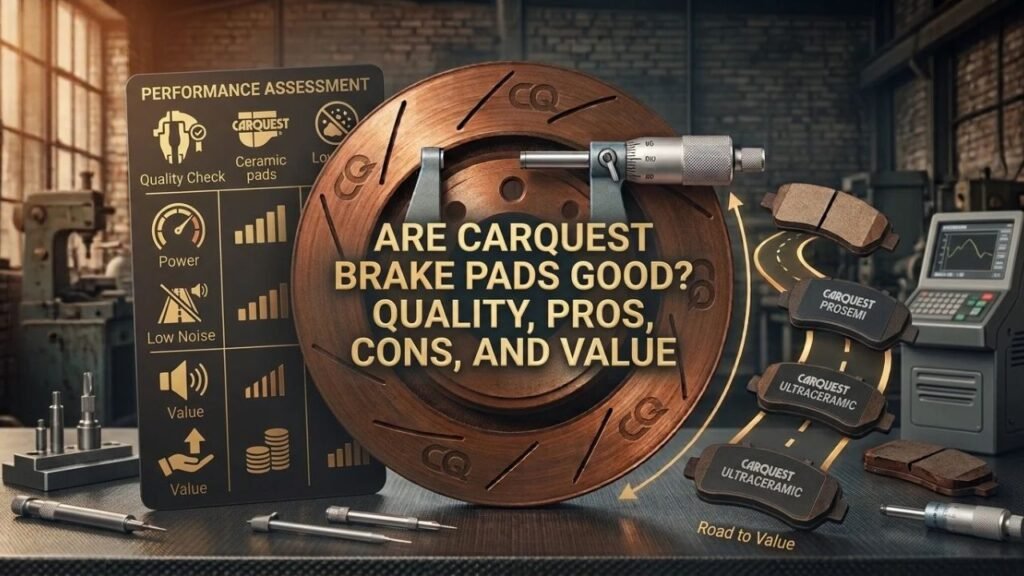
For drivers asking are Carquest brake pads good, my research points to a qualified yes. Current Carquest listings include Standard and Professional Platinum pads in ceramic and semi-metallic formulations, and the higher-tier Professional Platinum pads add features such as multi-layer HEX shims, application-specific friction formulas, corrosion-resistant backing plates, and coated hardware on many applications.
The user feedback I reviewed is mostly positive on many popular Professional Platinum part numbers, but it is not uniformly positive. Some listings show strong ratings for quiet braking and fit, while other vehicle-specific reviews report dust, hardware mismatch, or incorrect catalog fitment. That pattern is why I would judge Carquest by the exact part number and vehicle application rather than the brand name alone.
The sections below explain which Carquest line makes sense, how ceramic and semi-metallic versions differ, what current owners report, how Carquest compares with OEM-style choices, and what I would check before buying.
Are Carquest Brake Pads Good for Daily Driving?
Yes. For normal commuting, city traffic, highway use, school runs, and routine family-vehicle service, Carquest offers pad options that fit the job well.
The current Standard line is positioned as an OE-style replacement with application-based slots and chamfers, a single-layer noise-control shim, and a powder-coated backing plate. Professional Platinum moves up to application-specific formulations and a four-layer HEX shim with aramid fibers, plus coated hardware and brake lubricant on many applications.
That distinction matters because many drivers do not need a track-style friction compound. A street pad needs good cold response, smooth modulation, manageable dust, low noise, and reasonable wear over thousands of heat cycles.
Professional Platinum Is the Line I Would Check First
For a vehicle I planned to keep, I would start by pricing the Carquest Professional Platinum option against OEM and other premium aftermarket pads.
Current Professional Platinum ceramic listings describe application-specific friction formulas, four-layer HEX shims, burnishing compound for break-in, and coated hardware for many fitments. Some applications use semi-metallic material instead of ceramic, which is a reminder that Carquest does not use one friction recipe across every vehicle.
The line also carries a limited lifetime replacement warranty on current listings I checked. Read the warranty terms for the exact part rather than treating “lifetime” as a promise that friction material never wears. Brake pads are wear items.
Carquest Standard Is the Budget-Oriented Choice
Carquest Standard pads are aimed at drivers who want basic replacement performance without paying for the extra shim and hardware features of the higher line.
Current Standard listings show both ceramic and semi-metallic options, depending on application. Carquest describes them as OE-fit replacements with a single-layer shim, OE-style slots and chamfers, and powder-coated backing plates.
I would consider Standard for an older commuter or lower-mileage vehicle when price matters and the exact pad matches the factory friction type or an accepted replacement formulation.
Key Takeaway: Carquest is a reasonable daily-driver brand, with Professional Platinum making the stronger case for drivers who want more noise-control and hardware features.
How Good Is Carquest Professional Platinum?
Professional Platinum is the Carquest line that gives the brand its strongest argument against other premium parts-store pads.
It is not a single universal compound. Current part listings show ceramic pads for many passenger-vehicle applications and semi-metallic pads for others, including truck and European fitments. Carquest states that the formulations are selected by application rather than forcing the same material into every pad shape.
Noise Control Is a Strong Point on Paper
Professional Platinum uses a four-layer HEX shim with aramid fibers. Shims sit between the brake pad backing plate and caliper contact area and are intended to control vibration that can become audible squeal.
That does not guarantee silent brakes. Rotor condition, pad bedding, bracket rust, clip fit, slide-pin movement, contamination, and caliper condition can create noise even with a well-designed pad.
Still, a layered shim is a meaningful feature compared with a bare backing plate or simple economy shim.
Hardware Inclusion Can Save Time
Many Professional Platinum applications include coated abutment hardware, and Carquest states that caliper-pin grease is supplied for nearly every application. Exact box contents differ by part number, so inspect the listing before assuming every kit includes every clip or sensor.
Fresh hardware matters because corroded clips can restrict pad movement. A new pad that cannot slide freely in the bracket may wear unevenly or drag against the rotor.
Break-In Features Are Built Into the Pad Design
Carquest Professional Platinum listings mention a burnishing compound intended to speed pad-and-rotor break-in. That feature does not remove the need to follow installation instructions or any bedding procedure supplied for the specific application.
After installation, the rotor surface and pad face need clean, even contact. A badly scored, undersized, rusty, or heat-damaged rotor can make a new pad feel poor regardless of brand.
Key Takeaway: Professional Platinum offers several real hardware and noise-control upgrades, but installation quality and rotor condition still have a major effect on the result.
Are Carquest Brake Pads Quiet and Low Dust?
Many are quiet, and ceramic versions are the better Carquest choice if low dust is high on your list. Real owner reports still vary by vehicle and part number.
For example, one Professional Platinum ceramic listing for part PXD1414H shows a 4.53/5 rating from 237 reviews, with 73% of respondents saying they would recommend it. Positive comments mention quiet operation and even wear, while some negative reports mention dust, fit, or premature problems.
Another ceramic part, PXD929AH, shows a 4.59/5 rating from 99 reviews and a 92% recommendation rate on the current product page. A different application, PXD1056AH, has a much weaker 2.78/5 from nine reviews, with several complaints centered on fitment.
Those examples show why a single brand-wide star rating would be misleading.
Ceramic Carquest Pads Usually Target Cleaner Street Use
Ceramic pads tend to be chosen for quiet road behavior and lighter-looking dust. Carquest sells ceramic versions in both Standard and Professional Platinum ranges on many applications.
If keeping alloy wheels cleaner matters to you, I would first check the ceramic Professional Platinum pad listed for the exact VIN or brake package.
Semi-Metallic Versions Suit Different Applications
Some Carquest Professional Platinum pads use semi-metallic friction material. These formulas can make sense on applications that need different heat behavior, bite, or load capacity.
Do not assume ceramic is always the upgrade and semi-metallic is always the cheaper choice. The vehicle maker’s original design and the pad manufacturer’s application choice matter more than the material name by itself.
Key Takeaway: Many Carquest ceramic pads receive good noise and dust feedback, but results vary enough that checking reviews for the exact part number is more useful than reading generic brand reviews.
Do Carquest Brake Pads Stop Well?
For normal street use, current Carquest pads are built as OE-style replacements rather than racing parts, and owner feedback on many high-volume applications reports normal or strong stopping feel.
The more useful question is not “Does this brand stop a car?” It is “Does this exact pad provide the friction behavior intended for this vehicle, with the rest of the brake system in good condition?”
Tires, ABS operation, brake fluid, rotors, calipers, brake hoses, vehicle load, road grip, and temperature all affect real stopping distance. Pads are one part of that system.
Pedal Feel May Differ From OEM
Changing pad compounds can alter initial bite and pedal feel even when the brake system works correctly.
A ceramic replacement may feel smoother or less aggressive on the first touch than a semi-metallic pad. Another application-specific ceramic formula may feel very close to factory pads.
If you are satisfied with OEM braking and the OEM price is reasonable, staying with the factory pad is a simple benchmark. If OEM pricing is high, Professional Platinum becomes more attractive as a street replacement.
Heavy Towing and Track Use Need More Care
Do not pick a pad for repeated mountain towing, hauling, autocross, or track sessions from the brand name alone.
Check the specific friction composition and intended duty. Carquest lists semi-metallic Professional Platinum pads for some truck applications and describes some of those products for towing-oriented service.
A street ceramic pad that works well on a commuter is not automatically the pad I would choose for repeated high-temperature braking.
Key Takeaway: Carquest pads can provide solid street braking, but the exact friction formula and vehicle duty matter more than the logo on the box.
Common Carquest Brake Pad Complaints
No brake-pad brand gets perfect feedback across hundreds of applications. The complaints I found around Carquest cluster into a few practical categories.
Fitment and Hardware Problems
Several current product reviews report pads or supplied hardware that did not fit as expected, even when an online catalog marked the part as compatible. That issue appears on some listings far more than others.
This does not prove a brand-wide manufacturing problem. Brake packages can vary within the same model year by engine, trim, axle, wheel package, production date, or caliper option.
Before removing the old pads, compare the new parts side by side. Check backing-plate shape, ears, friction dimensions, wear indicators, clips, sensor provisions, and hardware.
Brake Dust
Some Professional Platinum owners report low dust, while others say their wheels collect more dust than expected.
Friction formulation varies by application, so this difference is plausible. Driving style, rotor surface, vehicle mass, front-to-rear brake bias, and pad temperature also change dust output.
Do not buy a ceramic pad solely because the package uses a low-dust claim. Exact-application feedback gives a better clue.
Squeal or Groan
Noise reports exist for Carquest just as they do for other pad brands.
A squeal does not automatically prove the friction material is poor. Incorrect clips, rust under abutment hardware, dry approved contact points, uneven rotor deposits, poor bedding, seized slides, or a bent dust shield can all create noise.
If fresh brakes squeal from the first drive, inspect the installation instead of assuming the sound will disappear after several thousand miles.
Key Takeaway: The most useful Carquest complaints involve application-specific fit, hardware, dust, and noise, so verify the exact kit before installation and diagnose noise rather than blaming the pad immediately.
Carquest Standard vs Professional Platinum Brake Pads
The two current lines serve different buyers.
| Feature | Carquest Standard | Carquest Professional Platinum |
| Main role | Basic OE-style replacement | Premium street replacement |
| Friction options | Ceramic or semi-metallic by application | Ceramic or semi-metallic by application |
| Shim design | Single-layer shim | Four-layer HEX shim on current listings |
| Slots/chamfers | OE-style | Application-specific |
| Hardware | Varies | Coated hardware on many applications |
| Brake grease | Check kit | Included on many applications |
| Backing plate | Powder-coated | Powder-coated on current listings |
| Warranty | Limited lifetime on listings checked | Limited lifetime replacement on listings checked |
| Best fit | Budget-minded routine service | Drivers prioritizing refinement and kit features |
For a basic commuter that sees normal traffic and modest annual mileage, Standard can be enough.
For a newer car, a vehicle you plan to keep, or a brake job where quiet operation matters, I think Professional Platinum is easier to justify if the price difference is modest.
Do not pay extra solely for the word “Platinum.” Compare the exact pad material, included hardware, warranty terms, customer feedback, and OEM option for your vehicle.
Carquest Brake Pads vs OEM Pads
OEM pads give you the friction material and noise tuning chosen for the vehicle’s original brake system. That makes them the safest baseline for factory-like pedal feel.
Carquest aims to provide replacement pads that fit OE dimensions and road use, with Professional Platinum adding aftermarket features such as upgraded shims and hardware.
Choose Carquest When
Carquest makes sense when:
- The exact application has strong owner feedback
- Professional Platinum costs less than the OEM set
- Local availability matters
- You want ceramic low-dust behavior on an application that offers it
- New clips or other supplied hardware add useful value
- The limited warranty matters to you
Choose OEM When
OEM makes more sense when:
- Factory pads gave excellent life and feel
- The price difference is small
- Your vehicle has unusual brake hardware or electronic wear sensors
- You have had aftermarket fitment problems before
- You want the closest match to the original friction behavior
My preference is to price both before deciding. A large OEM premium can make Professional Platinum appealing; a small price gap often pushes me toward the factory pad.
Key Takeaway: Carquest can be a sensible OEM alternative, but OEM remains the easiest route for matching original pedal feel, hardware, and friction behavior.
How Long Do Carquest Brake Pads Last?
There is no honest mileage number that applies to every Carquest pad.
Pad life changes with vehicle weight, driving style, city traffic, hills, towing, rotor condition, caliper movement, friction compound, and the share of braking done by each axle.
A driver who spends most miles on open highway can get far more pad life than someone making short urban trips with constant stops.
Instead of relying on a mileage promise, inspect pad thickness during tire rotations and routine service. Uneven wear between inner and outer pads can point to a sticking caliper, seized slide pin, rusty bracket, or pad fit problem.
If one pad is disappearing much faster than its mate, replacing the pads alone does not fix the cause.
Are Carquest Brake Pads Worth the Money?
For many daily drivers, yes, and Professional Platinum is the line I would favor.
The current product design gives you more than a friction block: application-specific compounds, layered noise-control shims, corrosion protection, and hardware on many fitments. Many popular part numbers also carry strong customer ratings.
Still, Carquest is not automatically the best pad for every vehicle. A weakly reviewed application, a questionable catalog match, or an OEM set priced only slightly higher can change the answer.
The smartest buying process is simple: identify the exact brake package, compare the Carquest part number with OEM, read reviews for that exact SKU, inspect what hardware comes in the box, and match ceramic or semi-metallic material to the vehicle’s duty.
Conclusion
The answer to are Carquest brake pads good is yes for many everyday vehicles, with Carquest Professional Platinum standing out as the better choice in the current range. Standard pads make more sense when the goal is a lower-cost OE-style replacement.
Professional Platinum’s multi-layer shims, application-specific friction formulas, corrosion-resistant backing plates, and included hardware on many kits give it a stronger feature set. Real owner feedback is often positive, yet several applications also show complaints about fitment, dust, or supplied clips.
I would buy Carquest Professional Platinum for a normal street vehicle if the exact part number has solid application feedback and the price is meaningfully lower than OEM. I would pause if the same SKU has repeated fit complaints, the vehicle sees severe track or towing heat, or the factory pads are available for nearly the same money.
FAQs About Carquest Brake Pads
Who makes Carquest brake pads?
Carquest is an aftermarket parts brand sold through the Advance Auto Parts network. Current Carquest Professional Platinum listings state that certain pads are engineered by an original-equipment manufacturer working within an IATF 16949-certified quality framework. Manufacturing details can differ across product lines and part numbers, so the exact package or current product listing is the better source for a specific set.
Are Carquest Professional Platinum brake pads ceramic?
Many are ceramic, but not all. Current listings show both ceramic and semi-metallic Professional Platinum pads. The material is selected by application, so check the friction-material specification for your exact part number rather than assuming every Platinum box contains ceramic pads.
Are Carquest brake pads better than OEM?
Not automatically. Carquest Professional Platinum can offer attractive features and lower pricing, but OEM pads remain the reference for the vehicle’s original brake feel and noise tuning. I would compare exact price, material, hardware, warranty, and part-number feedback before replacing a factory pad with an aftermarket option.
Do Carquest brake pads come with hardware?
Many Professional Platinum sets include coated abutment hardware, and current Carquest information says hardware and caliper-pin grease are supplied for nearly every application. Box contents vary, so verify the exact listing before starting the job. Some pads also include mechanical or electronic wear-sensor provisions depending on the vehicle.
Do Carquest brake pads have a lifetime warranty?
Many current Carquest Standard and Professional Platinum listings show a limited lifetime warranty or limited lifetime replacement coverage. The exact terms control what is covered, so do not read “lifetime” as a guarantee that normal friction wear is free forever. Check the warranty attached to the exact part number before purchase.
Are Carquest brake pads noisy?
Many owners report quiet braking, especially with Professional Platinum ceramic pads, but noise varies by application and installation. New pads can squeal if hardware binds, the rotor surface is poor, the caliper slides stick, or the bedding process leaves uneven deposits. Repeated complaints on one exact part number deserve more weight than a generic brand comment.
Are Carquest brake pads good for trucks and towing?
Some Carquest Professional Platinum semi-metallic pads are listed for truck applications and towing-oriented use. Match the pad to the exact truck, axle, brake package, and expected load. A ceramic commuter pad should not be treated as a severe-duty towing pad simply because it carries the same brand name.