Are Semi Metallic Brake Pads Good? Pros, Cons, and Who Needs Them
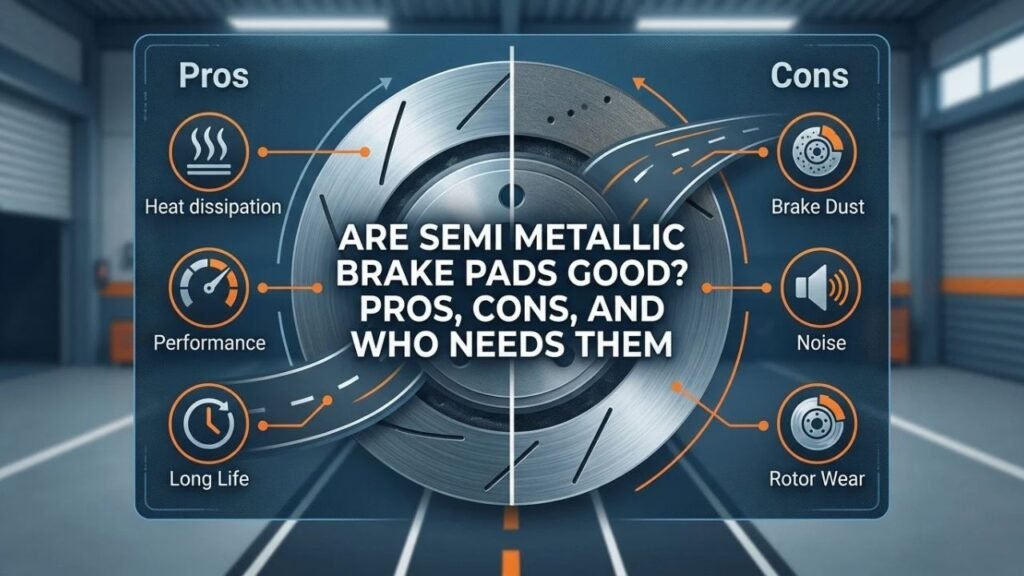
Semi-metallic pads are a strong choice for drivers who want firm pedal feel, strong initial bite, good heat handling, and dependable braking under repeated hard stops. They make the most sense for trucks, towing, mountain driving, performance-oriented cars, and drivers who place braking response above quiet operation and clean wheels.
The tradeoff is noise, dark brake dust, and potentially faster rotor wear compared with many ceramic compounds. Those drawbacks may be minor for a truck carrying heavy loads but annoying on a quiet daily commuter.
For normal street driving, both ceramic and semi-metallic pads can provide suitable braking when the pad is correctly matched to the vehicle. The material label alone does not determine pad quality. Friction formulation, rotor compatibility, hardware, vehicle weight, brake design, and operating temperature all matter.
There has also been a major change in U.S. brake-pad materials. California’s Department of Toxic Substances Control states that brake friction material sold under its 2025 requirements must contain no more than 0.5% copper by weight, so modern formulations may differ from older descriptions of metallic pads that list copper as a major ingredient.
What stood out to me during the research was how strongly application affects the answer to are semi metallic brake pads good. AAA, Bosch, Bridgestone, and other brake-industry sources consistently describe semi-metallic compounds as stronger choices for high heat, heavy loads, and aggressive braking, while ceramic pads tend to suit drivers who prioritize low noise and cleaner wheels.
A commuter in a lightweight sedan may prefer ceramic pads even if semi-metallic pads offer more initial bite. A pickup that tows, a vehicle driven through steep grades, or a performance car exposed to repeated braking may get more practical use from the heat tolerance and pedal feel of a semi-metallic compound.
The sections below cover how these pads work, their main strengths and drawbacks, how they compare with ceramic pads, expected life, rotor wear, cold and wet behavior, and which drivers are most likely to appreciate them.
Are Semi Metallic Brake Pads Good for Daily Driving?
Yes. Semi-metallic brake pads can work very well for daily driving, especially if the vehicle originally used a similar friction material or the replacement pad is approved for that application.
They tend to provide a firm pedal feel and strong initial braking response. The metal content also transfers heat away from the friction surface well, which is useful during repeated stops, heavy traffic, long descents, or higher vehicle loads.
The question is not simply whether they stop a daily-driven car well. The bigger issue is whether their tradeoffs match what you want from the vehicle.
When They Make Sense for a Commuter
A semi-metallic pad is a sensible street choice if you prefer a sharper initial response when pressing the brake pedal.
It can also be attractive in colder climates because many formulations provide good cold bite. Bosch and Bridgestone both describe semi-metallic pads as well suited to demanding temperatures and harder braking conditions.
Drivers who encounter steep roads, carry passengers or cargo frequently, or spend time in fast highway traffic may appreciate that stronger braking character.
When Ceramic Pads May Be More Pleasant
Ceramic pads often suit a commuter whose main priorities are quiet braking, low visible dust, and smooth pedal response.
If the car spends nearly all of its time on ordinary city streets and highways without towing or repeated high-heat braking, the extra heat capability of a semi-metallic pad may offer little practical advantage.
I would not choose a more aggressive pad compound simply because it sounds higher-performance. The pad should fit the actual vehicle and use pattern.
Vehicle Specification Comes First
Use a replacement pad listed for the exact year, make, model, trim, and brake package.
Changing friction material can change pedal feel, noise, dust, rotor interaction, and heat characteristics. A premium pad in the wrong application is not automatically a better brake pad.
Key Takeaway: Semi-metallic pads are good for daily driving, but ceramic pads may suit quiet commuters better, while semi-metallic compounds shine when braking loads and temperatures rise.
What Are Semi-Metallic Brake Pads?
Semi-metallic brake pads use a friction compound containing a substantial amount of metal mixed with friction modifiers, fillers, lubricants, and binding material.
Traditional descriptions commonly place metal content around 30% to 70%, though actual formulas vary. Metals may include steel, iron, and other alloys, while graphite and related materials may be added to control friction and heat behavior.
Modern formulas should not be assumed to contain the same copper levels as older pads because U.S. environmental rules have pushed manufacturers toward very low-copper and copper-free compounds.
Why Metal Is Used in the Friction Material
Metal conducts heat well. During braking, kinetic energy is converted into heat at the pad and rotor surfaces.
A metallic component can move some of that heat through the pad structure rather than allowing it to remain concentrated at the friction surface.
Metal also contributes to friction characteristics and gives many semi-metallic pads their firm, responsive pedal feel.
Semi-Metallic Does Not Mean Fully Metallic
A semi-metallic pad is not a solid block of metal.
The friction material is a blended compound engineered to create controlled friction against the rotor while surviving repeated heating and cooling cycles.
Fully metallic friction materials exist for specialized applications, but they are different from the semi-metallic pads commonly installed on passenger vehicles.
Key Takeaway: Semi-metallic pads combine metal with other friction materials to produce strong bite, heat tolerance, and a firm braking feel without using a fully metallic friction block.
Main Benefits of Semi-Metallic Brake Pads
The strongest reasons to choose semi-metallic pads relate to braking response, heat management, and demanding use.
Strong Initial Brake Bite
Semi-metallic pads often give a more immediate friction response when the driver presses the pedal.
That sharper bite can make the brakes feel more direct, especially compared with softer organic compounds or some comfort-focused ceramic pads.
AAA describes semi-metallic pads as providing stronger stopping power and more aggressive initial response than ceramic pads in demanding conditions.
Good Heat Management
Repeated braking creates large amounts of heat. Metal transfers heat well, which is one reason semi-metallic pads are common in higher-load brake applications.
This makes them a strong match for:
- Towing trailers
- Hauling cargo
- Mountain roads
- Repeated highway braking
- Performance-oriented driving
- Heavier trucks and SUVs
Heat capability matters most when the brakes are used repeatedly rather than during a single ordinary stop.
Firm Pedal Feel
Semi-metallic compounds generally compress less than softer organic materials.
Less compression can create a firmer, more direct feeling through the brake pedal. Some drivers prefer this response because pedal input feels closely connected to braking force.
Good Performance Across Broad Temperatures
Many semi-metallic formulations work well from cold starts through fairly high brake temperatures.
That characteristic can suit vehicles exposed to winter conditions followed by repeated braking later in the same trip.
Suitable for Heavy-Duty Use
Trucks, SUVs, fleet vehicles, and vehicles that tow often place more energy into their brakes during deceleration.
AAA and Goodyear Brake guidance both position semi-metallic pads as strong choices for heavier loads and demanding braking use.
Key Takeaway: Strong bite, heat control, firm pedal feel, and heavy-load capability are the main reasons drivers choose semi-metallic brake pads.
Disadvantages of Semi-Metallic Brake Pads
Semi-metallic pads are not the best match for every driver. Their strongest traits come with tradeoffs.
More Brake Dust
Semi-metallic pads generally create more visible brake dust than ceramic pads.
The dust is often dark and can collect quickly on wheels, especially vehicles with open-spoke alloy wheels. PowerStop specifically notes that semi-metallic compounds tend to produce darker, more noticeable dust than ceramic formulations.
For a driver who wants wheels to stay clean between washes, this may be the biggest drawback.
More Noise
Metallic compounds can produce more audible braking noise.
Squealing does not mean every semi-metallic pad is poorly made. Pad formulation, shims, chamfers, hardware, rotor condition, installation, bedding procedure, contamination, and temperature all influence brake noise.
A premium semi-metallic pad with good hardware can be fairly quiet, but ceramic remains the stronger choice for drivers who place low noise near the top of the list.
Greater Rotor Wear Is Possible
The harder metallic friction material can be more abrasive against the rotor than softer pad compounds.
AAA, Bridgestone, and Goodyear Brake all identify increased rotor wear as a possible semi-metallic tradeoff.
That does not mean semi-metallic pads automatically destroy rotors. A pad designed for the vehicle and paired with rotors in good condition should operate within the brake system’s intended limits.
Brake Feel May Be More Aggressive
Some drivers like a firm pedal and strong initial bite. Others prefer the smoother response associated with a comfort-focused ceramic pad.
This is partly preference and partly vehicle design. A pad that feels great on a heavy SUV may feel unnecessarily aggressive on a lightweight commuter.
Key Takeaway: The main costs of semi-metallic pads are extra dust, possible noise, stronger rotor abrasion, and a more aggressive braking character.
Semi-Metallic vs Ceramic Brake Pads
Ceramic and semi-metallic pads can both be good replacement choices. Their strengths are different.
| Feature | Semi-Metallic | Ceramic |
| Initial bite | Strong | Usually smoother |
| High-heat braking | Strong | Good for normal street use |
| Towing and heavy loads | Strong choice | Less suited to severe use |
| Brake dust | More | Less |
| Noise | More likely | Usually quieter |
| Rotor wear | Can be higher | Often lower |
| Cold response | Often strong | Formula dependent |
| Pedal feel | Firm and direct | Smooth and controlled |
| Typical use | Heavy-duty, performance, towing | Commuting, family cars, low-dust use |
Which Stops Better?
A quality semi-metallic pad often provides stronger initial bite and better behavior under repeated high-temperature braking.
That does not mean a ceramic pad makes a normal car unsafe or weak. A ceramic pad designed for the vehicle can deliver the friction level required for ordinary road use.
Pad engineering matters more than choosing solely from the material name printed on the box.
Which Is Quieter?
Ceramic usually wins on noise.
Its friction characteristics tend to create less audible sound during ordinary braking. Semi-metallic compounds are more likely to squeal, especially during cold operation or as pads and rotors age.
Which Creates Less Dust?
Ceramic generally creates less visible wheel dust.
Semi-metallic pads can leave dark residue around the wheel face and spokes. Drivers who clean polished or light-colored wheels frequently may notice the difference quickly.
Which Is Better for Towing?
I would usually favor a quality semi-metallic pad for a tow vehicle if it matches the vehicle maker’s requirements.
Towing raises vehicle mass and increases the energy the brakes must absorb. Semi-metallic compounds are commonly chosen for their heat handling and repeated-stop behavior under those conditions.
Key Takeaway: Choose semi-metallic for stronger bite and high-load braking; choose ceramic when low noise, low visible dust, and smooth street behavior matter more.
Do Semi-Metallic Brake Pads Last Long?
Semi-metallic brake-pad life varies too much to assign one mileage figure to every vehicle.
Goodyear Brakes states that some semi-metallic pads can last 40,000 miles or more under normal driving, but traffic, vehicle weight, braking habits, pad formulation, rotor condition, and caliper operation can move actual life far above or below that figure.
A highway-driven sedan may use brake material slowly. A heavy SUV used for city traffic and towing may consume pads much faster.
What Shortens Their Life?
Frequent hard stops increase friction and temperature.
Fast pad wear can also come from mechanical faults such as:
- Sticking caliper pistons
- Seized slide pins
- Uneven rotor surfaces
- Dragging brakes
- Incorrect hardware installation
- Pads that do not match the application
If one pad wears much faster than its partner, do not assume the pad compound is the cause.
Do They Last Longer Than Ceramic Pads?
Often, no.
Many ceramic street pads are chosen partly for long wear life. Semi-metallic pads trade some of that low-wear character for stronger friction and heat behavior.
Specific formulations can reverse that pattern, so material type cannot predict lifespan by itself.
Key Takeaway: Semi-metallic pads can deliver long service life, but driving load and brake condition influence mileage more than the material label alone.
Are Semi-Metallic Brake Pads Good in Cold or Wet Weather?
Semi-metallic pads are often strong performers in cold conditions because many formulations provide useful friction without needing extreme heat first.
Bosch and Bridgestone both identify demanding temperatures as an area where semi-metallic compounds can have an advantage over ceramic pads.
Wet braking involves more than pad material. Rotor condition, tire grip, ABS operation, water film, vehicle speed, and road surface all affect stopping behavior.
A properly engineered semi-metallic pad can work well in rain, but tires still determine how much braking force reaches the road before the wheels begin to lose grip.
Who Should Choose Semi-Metallic Brake Pads?
Semi-metallic pads make the most sense when braking demand is higher than ordinary light-duty commuting.
Truck and SUV Drivers
Heavier vehicles put more energy into the brakes during deceleration.
A semi-metallic pad can be a strong fit where the manufacturer or aftermarket application calls for a friction compound suited to that weight.
Drivers Who Tow
Towing increases the mass the braking system must manage.
For regular trailer use, I would put heat handling and repeatable brake response ahead of quietness or wheel cleanliness.
Mountain and Hilly-Area Drivers
Repeated downhill braking can raise pad and rotor temperatures.
Semi-metallic compounds are well suited to this kind of repeated heat exposure when matched correctly to the vehicle.
Performance-Oriented Drivers
A driver who prefers a firm pedal and stronger initial bite may like the feel of semi-metallic pads.
Street pads should still be chosen for street use. Track-oriented friction compounds can behave differently at normal road temperatures and may create substantial noise and dust.
Drivers Who Should Consider Ceramic Instead
Ceramic may make more sense for a lightly loaded commuter that spends most of its life on normal city and highway routes.
Drivers who care most about quiet brakes and clean wheels may also prefer ceramic.
Key Takeaway: Semi-metallic pads fit trucks, towing, hills, heavier vehicles, and drivers who prioritize braking response; ceramic often fits quiet daily commuting better.
What to Check Before Buying Semi-Metallic Pads
Do not buy pads based only on the friction-material category.
Start with exact vehicle fitment and then compare the characteristics of pads made for that brake system.
Check OE Fitment
Confirm the year, make, model, trim, engine, drivetrain, and brake package.
Some vehicles use different brake sizes within the same model year.
Match the Pad to Your Driving
A normal street compound makes more sense for ordinary road driving than an aggressive performance compound.
A tow vehicle may justify a higher-heat pad, while a commuter may gain little from that change.
Inspect the Rotors
Installing fresh pads against damaged rotors can create noise, poor bedding, vibration, or uneven wear.
Rotors should be checked for thickness, scoring, heat damage, corrosion, and runout according to the applicable service information.
Use Good Hardware
Worn abutment clips, seized caliper slides, damaged boots, or incorrect shims can ruin the behavior of a good set of pads.
Brake-pad quality cannot compensate for hardware that prevents the pad or caliper from moving correctly.
Follow the Bedding Procedure
Some pad makers specify a bedding or break-in procedure to establish an even transfer layer on the rotor.
Follow the instructions supplied with the pads. Do not assume every compound uses the same sequence of stops.
Key Takeaway: Buy semi-metallic pads by vehicle fitment and intended use, then pair them with sound rotors, moving caliper hardware, and the pad maker’s break-in procedure.
Conclusion
Yes, are semi metallic brake pads good has a clear answer: they are a good choice when strong initial bite, firm pedal feel, heat handling, and repeated braking performance matter more than low dust and quiet operation.
They are well suited to many trucks, SUVs, tow vehicles, mountain-driving applications, and performance-oriented street cars. Their main compromises are darker brake dust, a greater chance of noise, and potentially more rotor wear than many ceramic pads.
For a normal commuter, ceramic may be the more comfortable choice if quiet braking and clean wheels are priorities. For heavier or harder brake use, I would give semi-metallic pads serious consideration.
The final choice should still start with a pad approved for the exact vehicle. Friction material is only one part of the braking system, and a well-matched quality pad is more sensible than choosing a compound purely because one category sounds superior.
FAQs About Semi-Metallic Brake Pads
Are Semi-Metallic Brake Pads Better Than Ceramic?
Neither type is better for every vehicle. Semi-metallic pads generally offer stronger initial bite and better behavior during repeated high-heat braking.
Ceramic pads usually produce less visible dust and noise, making them attractive for everyday commuting. Vehicle fitment and driving use should decide between them.
Do Semi-Metallic Brake Pads Stop Better?
They often provide a stronger initial braking feel and perform well under demanding temperatures.
Actual stopping distance still depends on tires, road grip, brake-system condition, ABS operation, vehicle weight, speed, and the specific pad formula. The words “semi-metallic” on the box do not guarantee shorter stops.
Are Semi-Metallic Brake Pads Noisy?
They can be noisier than ceramic pads because of their friction-material composition.
Quality shims, proper lubrication at approved contact points, good rotor surfaces, sound hardware, and correct bedding can reduce unwanted noise. Persistent grinding should never be dismissed as normal metallic-pad sound.
Do Semi-Metallic Brake Pads Wear Rotors Faster?
They can. Metallic fibers may be more abrasive against the rotor than some ceramic compounds.
Rotor wear also depends on pad formula, rotor metallurgy, heat, driving habits, corrosion, and brake-system condition. A matched pad and rotor combination should be used whenever possible.
Do Semi-Metallic Brake Pads Make More Dust?
Yes, they generally create more visible brake dust than ceramic pads.
The residue is commonly darker, so it is easier to notice on alloy wheels. Drivers who care strongly about keeping wheels clean may prefer a low-dust ceramic compound.
Are Semi-Metallic Brake Pads Good for Towing?
Yes, they are commonly a strong choice for towing because they handle heat well and provide firm braking response.
Use pads listed for the tow vehicle’s exact brake system. Trailer weight, trailer brakes, rotor condition, brake fluid, tires, and vehicle load limits still matter.
Are Semi-Metallic Brake Pads Good for Winter?
Many semi-metallic compounds perform well at low temperatures and provide good cold bite.
Winter braking still depends heavily on tire traction. Even strong brake pads cannot create more road grip than the tires and surface allow.
Are Semi-Metallic Brake Pads Worth Buying?
They are worth considering if you want firm pedal feel, strong bite, good heat handling, or brake performance suited to towing and heavier use.
If quiet braking and low wheel dust matter more than high-load behavior, a quality ceramic pad may fit your priorities better.