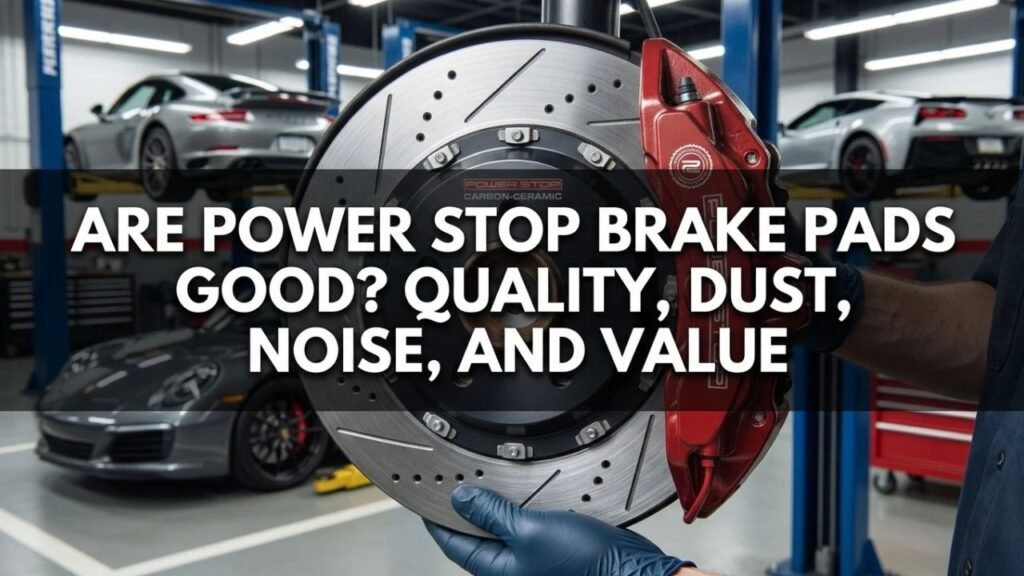
Are Power Stop Brake Pads Good? Quality, Dust, Noise, and Value
Yes, Power Stop makes solid aftermarket brake pads for many street-driven cars, SUVs, and trucks. Their main pad lines target different jobs, from ordinary replacement to towing and performance street use. Low-dust ceramic compounds, noise-control shims, included hardware on many applications, and application-specific options are the main reasons they are worth considering.
The bigger issue is choosing the correct Power Stop series. Installing a performance-oriented pad on an ordinary commuter may provide little practical advantage, while putting a basic daily-driver pad on a truck that regularly tows can leave you with the wrong friction material for the workload.
A good match can give you cleaner wheels, controlled noise, predictable street braking, and hardware suited to the application. Pad quality still cannot compensate for damaged rotors, seized caliper slides, contaminated friction surfaces, or poor installation.
There is also a large U.S. replacement-parts market behind products like these. S&P Global Mobility reported that the average U.S. light vehicle reached 12.8 years old in 2025, with roughly 289 million light vehicles in operation. An aging vehicle population means many drivers are choosing replacement friction parts long after the original pads have been changed.
So, are Power Stop brake pads good for every driver? I would say they are a strong choice when the pad line matches the vehicle and use case. Z17 targets stock-style daily driving, Z23 targets street drivers wanting an upgrade, Z26 is aimed at performance vehicles, and Z36 is built around trucks, towing, hauling, and heavier brake loads.
My research also showed that Power Stop’s biggest strength is not one universal pad compound. It is the way the company separates products by driving purpose. The rest of the page covers the main pad lines, dust and noise, stopping feel, durability, drawbacks, warranty, towing, daily use, and situations where another type of pad may make more sense.
Are Power Stop Brake Pads Good for Daily Driving?
Yes. Power Stop’s street-oriented ceramic pads make sense for drivers who want a replacement pad with restrained dust and noise without moving into a track-focused friction compound.
The two lines most relevant to ordinary street cars are Z17 Evolution and Z23 Evolution Sport.
Z17 Is the Stock-Replacement Choice
Power Stop positions the Z17 Evolution Ceramic pad as its stock-replacement option for cars, trucks, and SUVs.
The Z17 uses a ceramic friction formula, chamfered and slotted pad surfaces, rubberized shims, and a thermal-scorched surface intended to shorten the initial break-in process. Premium stainless-steel hardware is included on applicable sets.
For an ordinary commuter, this is the line I would look at first if the goal is simply to replace worn original-style pads without paying for features aimed at harder street driving.
Z17 makes the most sense for:
- Routine commuting
- Grocery and family vehicles
- Stock cars and crossovers
- Drivers focused on low dust
- Normal city and highway braking
It is not Power Stop’s towing or high-performance choice.
Z23 Adds a Street-Performance Bias
The Z23 Evolution Sport steps up to a carbon-fiber-reinforced ceramic compound. Power Stop markets it for daily-driven cars, trucks, SUVs, and crossovers that need more street-oriented braking capability than the basic replacement line.
Z23 pads also use dual-layer rubberized shims, chamfers and slots, stainless hardware, and a low-dust formula.
This is the Power Stop pad I find more interesting for someone who enjoys responsive street driving but still wants a civil pad for daily use.
It is not the same thing as a dedicated track compound. Power Stop sells separate Track Day products for sustained high-temperature circuit use.
Z17 vs. Z23 for a Commuter
For a stock commuter that rarely sees aggressive braking, Z17 is usually the simpler choice.
For a heavier vehicle, larger wheels, quicker street driving, or a driver who wants a modest brake upgrade without switching to a race-style pad, Z23 fits the intent better.
The rotor, tire, brake fluid, caliper condition, and vehicle design still set limits on the braking system. A pad swap alone cannot turn an ordinary street brake package into a full high-performance system.
Key Takeaway: Z17 is the straightforward Power Stop choice for stock daily driving, while Z23 makes more sense when you want a street-oriented upgrade with low-dust ceramic characteristics.
Are Power Stop Brake Pads Low Dust?
Low brake dust is one of the brand’s main selling points, especially across its ceramic and carbon-fiber ceramic lines.
Ceramic friction materials often produce lighter-colored dust than traditional high-metallic compounds, which can make deposits less obvious on wheels.
Power Stop Uses Ceramic Formulas Across Several Lines
Z17 uses a ceramic compound, while Z23, Z26, and Z36 use carbon-fiber-reinforced ceramic formulations aimed at different workloads.
Power Stop states that the low-dust formulation used in its performance lines has been checked through third-party on-vehicle testing. Tire Rack also lists low-dust formulation among the Z23’s product characteristics.
That does not mean the pads create zero dust.
Every friction brake wears the pad and rotor during use. Material removed from those surfaces has to go somewhere, so completely dust-free disc brakes are not realistic.
Wheel Color Changes How Dust Looks
A small amount of light-colored ceramic dust can be difficult to see on silver wheels while standing out on gloss-black wheels.
Driving conditions matter too. City traffic, mountain roads, heavy vehicles, frequent hard stops, and dirty road conditions can make wheels look dusty much sooner than steady highway use.
If clean wheels are a high priority, the Power Stop ceramic lines have a clear advantage over many dusty metallic street compounds. I would still expect some residue between washes.
Are Power Stop Brake Pads Quiet?
Power Stop puts a fair amount of attention into noise-control features, but no brake pad can be guaranteed silent in every brake system.
Pad noise depends on the friction compound, shims, rotor finish, caliper condition, hardware, temperature, humidity, pad bedding, and even the brake design of the vehicle.
Shims Are Used to Control Brake Vibration
Z17 and Z23 use rubberized shim designs intended to isolate vibration. Z26 and Z36 use stainless-steel shims, which Power Stop associates with heat dissipation and noise reduction.
Chamfers and slots are also built into many of these pads. Those features can change how the pad contacts the rotor and how vibration moves through the assembly.
New Power Stop Pads Still Need Proper Bedding
Even good pads can squeak after a poor break-in.
Power Stop states that pad bedding establishes an even friction-material layer on the rotor. Its pad instructions include a defined series of stops followed by a cooling stage.
Skipping that process can leave uneven deposits and create noise or pedal pulsation.
A squeak should not automatically be blamed on the pad brand either. Rusted abutment clips, dry or seized guide pins, badly grooved rotors, contamination, and pads binding in the bracket can create similar sounds.
Key Takeaway: Power Stop builds noise-control features into its street pads, but rotor condition, hardware, installation, and bedding have a major effect on how quiet the final brake job is.
How Good Is Power Stop Braking Performance?
Power Stop pads are designed primarily around street vehicles, with separate compounds for ordinary replacement, performance street driving, and heavier-duty truck use.
That distinction matters more than simply asking which Power Stop pad has the strongest bite.
Z23 Suits Street Performance Better Than Basic Replacement
The Z23 carbon-fiber ceramic line is positioned above Z17 for drivers seeking stronger street braking characteristics.
It is built for normal road manners rather than constant race-track heat.
A daily driver rarely needs the cold-to-hot friction behavior of a track pad. Street pads have to work during the first stop on a cold morning, in traffic, during rain, and during repeated ordinary stops without demanding race temperatures.
Z26 Targets Muscle and Performance Cars
Power Stop describes Z26 Street Performance pads as a choice for muscle cars, modified cars, higher-horsepower vehicles, and vehicles with larger wheels.
They use carbon-fiber ceramic friction material with stainless-steel shims rather than the Z23’s rubberized shim arrangement.
Z26 therefore makes more sense for a street-driven performance car than an ordinary economy sedan.
That still does not turn it into Power Stop’s dedicated circuit pad. Track Day pads are a separate product family.
Tires Still Limit Maximum Stopping Distance
Brake pads are only one piece of stopping performance.
During a hard stop, the tire must generate enough grip against the road to use the brake system’s torque. If the factory brakes can already activate ABS on dry pavement, changing pads does not automatically produce a dramatic reduction in emergency stopping distance.
Better pads may still change pedal response, fade resistance, heat behavior, dust, and repeated-stop consistency.
That distinction matters. I would buy a pad for the workload it needs to handle rather than expect a friction compound alone to rewrite the vehicle’s braking limits.
Key Takeaway: Power Stop offers sensible street braking choices, but the best-performing pad is the one matched to the vehicle, temperatures, tires, and actual driving workload.
Are Power Stop Brake Pads Good for Trucks and Towing?
Power Stop’s Z36 Truck & Tow line is the relevant option for trucks, SUVs, 4x4s, towing, hauling, lifted vehicles, and mountain driving.
It should not be confused with Z17, which is intended more as an everyday stock replacement.
Z36 Is Built Around Higher Brake Loads
Power Stop uses a carbon-fiber ceramic compound in Z36 pads and states that the formulation is intended to handle heavier loads.
The Z36 pad-and-rotor kits are marketed for towing, hauling, lifted trucks, off-road use, and mountainous driving. They also use stainless-steel shims and include applicable hardware.
A loaded trailer adds mass, and more mass means the brakes must convert more kinetic energy into heat during a stop.
Long downhill grades add another problem because the brakes may have less cooling time between applications.
Towing Capacity Still Comes From the Vehicle
Installing Z36 pads does not raise the truck’s factory tow rating.
Trailer weight limits come from the vehicle manufacturer and account for far more than brake pads, including chassis, axle ratings, cooling, drivetrain, tires, hitch structure, and vehicle stability.
Trailer brakes also matter when required for the load and jurisdiction.
For a truck that stays unloaded and spends its life commuting, Z36 may be more brake pad than the driving pattern calls for. For regular towing or hauling, it is the Power Stop line I would examine first.
Power Stop Z17 vs. Z23 vs. Z26 vs. Z36
The product names become much easier to understand once they are grouped by intended use.
| Power Stop pad | Best fit | Friction type | Main focus |
| Z17 Evolution | Stock daily driver | Ceramic | Replacement, low dust, quiet street use |
| Z23 Evolution Sport | Daily driver upgrade | Carbon-fiber ceramic | Street performance with daily manners |
| Z26 Street Performance | Muscle or performance car | Carbon-fiber ceramic | Higher-performance street use |
| Z36 Truck & Tow | Truck, SUV, towing, hauling | Carbon-fiber ceramic | Heavy loads and severe-duty street use |
These categories come directly from Power Stop’s current product positioning.
Pick Z17 for Normal Replacement
Choose Z17 when the vehicle is stock, driven normally, and the goal is a straightforward ceramic replacement.
Pick Z23 for a Daily-Driver Upgrade
Z23 is the middle ground I prefer for someone who wants a street-performance pad without moving into a truck or dedicated high-performance category.
Pick Z26 for a Performance Street Car
Z26 fits muscle cars, modified vehicles, higher horsepower, and larger-wheel performance applications.
Pick Z36 for Trucks That Work Hard
Z36 is intended for towing, hauling, lifted trucks, SUVs, and higher brake loads.
Key Takeaway: The Power Stop name alone does not tell you if a pad is right for your vehicle; the Z-series designation tells you the type of driving the pad was built around.
Main Advantages of Power Stop Brake Pads
Several characteristics make Power Stop appealing in the aftermarket.
Low-Dust Street Compounds
The ceramic-focused product range suits drivers who dislike dark brake dust collecting quickly on open-design wheels.
Application-Specific Pad Lines
Instead of selling one pad as the answer to every vehicle, Power Stop separates stock replacement, performance street, and towing applications.
That makes product selection more straightforward once the intended use of each series is clear.
Hardware Is Included on Many Applications
Power Stop includes stainless-steel hardware with many Z17, Z23, Z26, and Z36 sets where the vehicle application uses replaceable hardware.
New abutment hardware is useful during a brake job because corroded or distorted clips can interfere with pad movement.
Always confirm what comes with the exact part number before starting the job.
Pads Can Be Purchased With Matched Brake Kits
Power Stop is also well known for selling complete combinations of pads and rotors.
That can simplify parts selection for drivers replacing both at once. It does not mean drilled and slotted rotors are required just to use Power Stop pads; the correct pad can be installed with suitable compatible rotors as specified for the vehicle.
Key Takeaway: Power Stop’s strongest points are its low-dust ceramic choices, clear application categories, noise-control features, and availability with installation hardware or complete brake kits.
Drawbacks of Power Stop Brake Pads
The brand is not perfect for every application.
A few limitations deserve attention before buying.
Separately Purchased Pads Have a Shorter Warranty Than Full Kits
Power Stop’s current warranty states that pads or rotors purchased separately carry 90-day/3,000-mile coverage against defects in materials or workmanship.
Complete performance kits can receive longer coverage, with qualifying performance kits listed at three years or 36,000 miles. Normal friction wear is excluded.
That distinction is easy to miss when comparing a pad set with a full Power Stop kit.
Ceramic Feel May Differ From the Original Pads
A vehicle originally fitted with a different friction compound may feel slightly different after switching to aftermarket ceramic pads.
Initial bite, pedal response, cold behavior, and brake dust can change even when stopping capability remains suitable.
Some drivers prefer a more aggressive metallic feel and do not care about extra dust.
They Are Not All Track Pads
Z23 and Z26 names can sound very performance-oriented, but Power Stop has separate Track Day compounds.
Power Stop’s warranty information also states that its regular pads and rotors are meant for street and recreational off-road use, not competitive driving.
If the car regularly sees road-course sessions, a street ceramic pad should not be selected simply because it has a performance label.
Installation Quality Can Change the Result
Even a well-made pad can perform badly if it is installed against damaged rotors or inside a corroded caliper bracket.
Check:
- Rotor thickness and surface condition
- Caliper slide movement
- Piston operation
- Abutment hardware
- Brake hoses
- Pad fit in the bracket
- Friction-surface cleanliness
- Vehicle-specific torque specifications
Do not put lubricant on the rotor face or pad friction material.
Key Takeaway: Power Stop pads have sensible street applications, but warranty differences, compound feel, track limitations, and brake-system condition should be considered before choosing them.
Are Power Stop Brake Pads Worth Buying?
For a street-driven vehicle, they can be.
I would put Power Stop on the shortlist for a driver looking for lower-dust ceramic pads, supplied hardware, and a product line matched to commuting, performance street driving, or towing.
Public feedback also trends positively across several applications. PartReview currently reports a 4.3/5 average from 444 Power Stop brake-pad reviews, while application-specific retailer reviews also include strong ratings. User reviews should still be treated as supporting evidence rather than controlled brake testing because vehicles, installation quality, rotors, driving styles, and expectations differ.
I would not choose them from the brand name alone. The exact series, vehicle fitment, rotor condition, driving demands, and expected brake feel matter more.
For most stock commuters, Z17 is enough. Z23 is a sensible step up for street use. Z26 fits performance cars. Z36 is the line to examine for trucks that tow or haul.
Conclusion
For drivers asking are Power Stop brake pads good, my answer is yes for the street applications they are designed to serve. The brand offers credible ceramic and carbon-fiber ceramic options for stock replacement, daily-driver upgrades, performance street cars, and heavier truck use.
The main strengths are relatively low dust, noise-control features, multiple compounds for different workloads, and included hardware on many applications. The main cautions are choosing the correct series, bedding the pads properly, checking rotor and caliper condition, and recognizing that ordinary Power Stop street pads are not substitutes for dedicated track compounds.
Z17 suits normal replacement, Z23 suits a sportier daily driver, Z26 fits higher-performance street cars, and Z36 targets towing and hauling. That product split makes more sense than simply buying the most aggressive option available.
My preference would be to match the pad to the vehicle’s real use rather than buying by reputation alone. A correctly selected Power Stop pad on a healthy brake system is a reasonable aftermarket choice for many U.S. drivers.
FAQs About Power Stop Brake Pads
Are Power Stop brake pads better than OEM pads?
They can be better in specific areas, such as brake-dust appearance, included hardware, or street-performance characteristics. OEM pads are developed around the vehicle maker’s targets for pedal feel, noise, cold braking, durability, and other characteristics. A Power Stop pad should be treated as an alternative with different priorities rather than an automatic upgrade in every category.
Are Power Stop Z23 brake pads good?
Yes, Z23 pads are a good fit for daily-driven cars, trucks, SUVs, and crossovers that need more street-oriented capability than a basic replacement pad. They use a carbon-fiber ceramic compound, rubberized shims, and low-dust formulation. They are still street pads rather than dedicated circuit-racing pads.
Are Power Stop Z17 brake pads good?
Z17 pads make sense for ordinary stock replacement. They use a ceramic friction material and focus on daily driving, low dust, restrained noise, and straightforward installation. A driver who regularly tows, hauls heavy loads, or drives a modified performance vehicle should look at another Power Stop series instead.
Do Power Stop brake pads squeak?
They can. No friction pad is immune to noise. Power Stop uses shims, chamfers, slots, and ceramic compounds intended to control squeal, but poor bedding, rough rotors, corroded hardware, sticking calipers, contamination, and certain temperature conditions can still produce noise.
How long do Power Stop brake pads last?
Power Stop does not provide one universal mileage life for every pad and vehicle. Pad life changes with vehicle weight, front-to-rear brake bias, city traffic, towing, hills, driving style, rotor condition, caliper operation, and pad compound. Measure remaining friction material during service rather than relying on a fixed mileage estimate.
Are Power Stop brake pads good for towing?
The Z36 Truck & Tow line is the Power Stop pad designed for towing, hauling, trucks, SUVs, and heavier braking loads. Z17 is more appropriate for ordinary stock replacement, while Z23 and Z26 target different street-performance uses. Towing capacity itself does not increase after installing Z36 pads.
Are Power Stop brake pads good for racing?
Power Stop’s regular Z17, Z23, Z26, and Z36 street products should not be treated as race pads. The company has separate Track Day pad compounds for circuit use. Sustained track temperatures place very different demands on friction material than commuting or spirited street driving.