When to Replace Rear Brake Pads: Wear Signs and Thickness Limits
Rear brake pads should usually be replaced when the friction material reaches the vehicle maker’s service limit, when wear is uneven, or when symptoms show the pads are no longer in good condition. For many passenger vehicles, planning replacement around 3 mm of remaining material gives a practical margin before the pads reach their final wear limit.
Waiting for grinding is a poor replacement strategy. By that point, the friction layer may be nearly gone, and the steel backing plate can begin contacting the rotor. That may add rotor replacement to a job that could have required only pads and routine hardware service.
Changing worn rear pads before metal-to-metal contact protects the rotor surface and gives the brake system more margin between inspections. It also creates a chance to spot a sticking caliper, seized slide pin, damaged boot, or uneven inner-pad wear before the same fault damages a new pad set.
U.S. Subaru parts guidance recommends brake inspection every 12,000–15,000 miles or 12–15 months and classifies 0–3 mm of pad material as needing immediate attention. That is manufacturer guidance rather than a universal rule, but it shows why thickness checks matter more than guessing from mileage alone.
My research also found that manufacturers do not use one universal minimum. Ford documentation for different applications lists rear-pad limits or usable-thickness thresholds ranging from about 1.5 mm to 3 mm, while another U.S. owner document filed with NHTSA lists a 2 mm rear-pad service limit.
That variation is why when to replace rear brake pads should be decided from actual pad thickness, the specification for the exact vehicle, wear pattern, warning indicators, and rotor condition. The sections below explain practical thickness ranges, warning signs, inspection methods, uneven wear, rear-versus-front pad life, rotor decisions, and electronic parking-brake precautions.
When to Replace Rear Brake Pads Based on Thickness
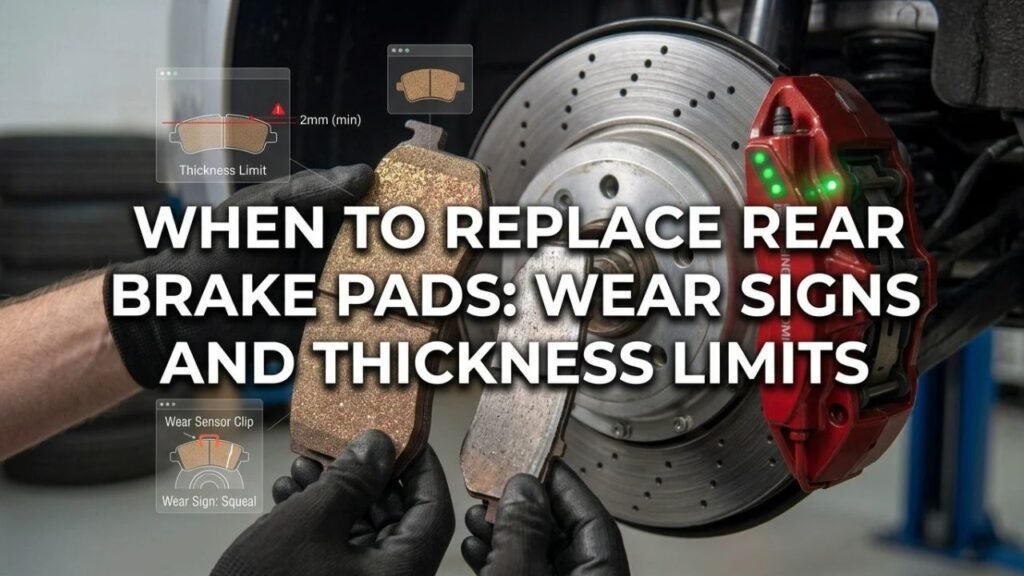
Brake-pad thickness refers to the friction material, not the steel backing plate. Some service documents state this directly; one owner document filed with NHTSA lists a new rear-pad thickness of 9 mm and a 2 mm service limit, both excluding the backing plate.
A service limit is the smallest permitted thickness for that brake design. A replacement-planning point can be thicker because waiting until the exact limit leaves little room for wear before the next inspection.
| Remaining rear-pad material | General meaning | Practical action |
| 7 mm or more | Plenty of material on many designs | Continue routine inspection |
| 5–6 mm | Moderate wear | Recheck at normal service |
| 4 mm | Getting low | Plan replacement and monitor wear rate |
| 3 mm | Common replacement-planning point | Replace soon; some makers treat this as the limit |
| 2 mm | Very thin | Replace promptly unless the exact specification says otherwise |
| At or below vehicle service limit | Worn to specification limit | Replace the rear pads |
| Friction material gone | Metal contact possible | Inspect pads and rotors immediately |
At 6–7 mm
A rear pad with 6–7 mm of friction material is commonly still serviceable if wear is even and no damage is present. There is usually no reason to replace a healthy pad solely because it is no longer close to new thickness.
Record the measurement if possible. A future reading gives a much better view of wear rate than a single estimate.
At 4–5 mm
Four to five millimeters is a planning range. The pads may still have usable life, but the next inspection interval, driving conditions, and wear balance become more relevant.
If one rear pad reads 5 mm and another on the same axle reads 3 mm, focus on the thinner pad and find the reason for the difference. Do not average the measurements.
At 3 mm
Three millimeters is a sensible point to schedule rear-pad replacement on many vehicles. Subaru’s U.S. guidance places 0–3 mm in its immediate-attention category, and some Ford specifications list 3 mm as the minimum.
I would treat a 3 mm reading as a service decision, not as a challenge to predict the maximum remaining mileage. The pad may still stop the vehicle normally, yet there is little material left before lower service limits found on some designs.
At 2 mm or Less
Two millimeters is very thin for a passenger-car disc pad. Some vehicles specify 2 mm as the service limit, while other designs call for replacement sooner. A pad below the exact vehicle specification has reached the end of its serviceable range.
Do not wait for grinding after measuring 2 mm. Wear can differ between the inner and outer pads, so the pad you cannot easily see may already be thinner.
Key Takeaway: Around 3 mm is a practical rear-pad replacement point for many cars, but the exact vehicle service limit and the thinnest pad measurement should control the final decision.
Signs Rear Brake Pads Need Replacement
Pad measurement gives the clearest answer, but symptoms often appear before the next scheduled inspection. Treat noises and changes in brake behavior as reasons to inspect the system rather than proof that one specific part has failed.
Squealing or Scraping
Many pads use a metal wear indicator that touches the rotor as the friction material becomes thin. This can create a high-pitched squeal or scraping noise.
A 2025 Ford rear-brake bulletin states that on the covered Ranger application, the rear wear indicator can rub against the rotor when the inner pad reaches about 1.5 mm or less. The bulletin also tells technicians to measure both inner and outer pads.
Squealing can also come from pad vibration, contamination, glazing, rust, or hardware, so thickness still needs to be checked.
Grinding During Braking
Grinding is more urgent than a light wear-indicator squeal. If the friction material has worn away, the backing plate can contact the rotor and cut grooves into it.
Avoid deliberately driving farther just to see if the noise changes. Have the rear brakes inspected and check the rotor faces for scoring, heat damage, and thickness.
Shaking, Pulling, or Uneven Brake Feel
A vibration, pull, or unusual pedal sensation does not automatically mean the rear pads are worn out. Rotor condition, caliper operation, front brakes, tires, suspension parts, and hydraulic faults can create similar symptoms.
Rear-pad wear still belongs on the inspection list, especially if one side shows much less friction material than the other.
Brake or Pad-Wear Warning
Some vehicles use electronic brake-pad wear sensors. A pad warning should trigger an inspection rather than a mileage estimate.
A general brake warning or ABS warning has several possible causes and should not be treated as a pad-thickness gauge. Read the owner’s manual or diagnostic information for the specific warning shown.
Key Takeaway: Squealing may be an early wear signal, while grinding calls for prompt inspection; warning lights and changes in brake feel need diagnosis rather than assumptions.
How Long Do Rear Brake Pads Last?
Rear brake pads do not have a fixed replacement mileage. Vehicle design, pad compound, road conditions, driving style, vehicle load, hills, towing, corrosion, and caliper condition all change the wear rate.
Subaru’s U.S. parts information states that brake pads and rotors have no defined replacement time because wear varies with driving habits, which is why the brand recommends routine inspection instead of one fixed mileage target.
A mileage estimate is less useful than a thickness history. If rear pads measured 7 mm at one service and 5 mm at the next, those records reveal the vehicle’s recent wear trend. That trend is still only an estimate because driving conditions and brake faults can change.
Do not assume rear pads must outlast the front pads. Many vehicles place more routine braking load on the front axle, but brake-system calibration differs, and some vehicles can consume rear pads sooner than an owner expects.
Why Rear Brake Pads May Wear Unevenly
Inner and Outer Pads Do Different Jobs in a Floating Caliper
A common floating caliper uses a piston on the inner side and slide hardware that lets the caliper clamp both pads against the rotor.
If the caliper does not slide freely, one pad can remain in heavier contact with the rotor. This creates an inner-to-outer thickness difference that may be missed during a quick inspection through the wheel.
Caliper Slides or Pistons Can Bind
Corrosion, damaged boots, dry or seized slide pins, pad binding in the bracket, or piston trouble can create rapid or uneven rear-pad wear.
A large difference is a reason to inspect the mechanism before installing new pads. New friction material will not correct a caliper that cannot release or move normally.
Ford’s Ranger bulletin uses a 3 mm or greater difference between inner and outer rear pads, together with a pad at 1.5 mm or less, as part of its diagnostic criteria for the covered condition. That figure is application-specific, but it shows why technicians measure both pads rather than looking at only the easiest one to see.
Left and Right Rear Wear Can Differ
Both rear wheels should be checked. One rear corner wearing much faster than the other can point to caliper, hardware, hose, parking-brake, or corrosion issues.
Pads should be assessed as an axle set. The thickest pad does not represent the condition of the entire rear brake assembly.
Key Takeaway: Measure inner, outer, left, and right rear pads; a large difference can expose a caliper or hardware fault that should be corrected with the pad replacement.
How to Check Rear Brake Pads Correctly
Start With a Visual Check
On some wheels, a flashlight through the spokes gives a view of the outer rear pad. This is useful for spotting a pad that is obviously very thin.
It is not a complete inspection. The inner pad can be hidden by the caliper, and that pad may be the thinner one.
Remove the Wheel for a Better Measurement
For a dependable reading, safely raise and support the vehicle at the approved lift points, remove the wheel, and inspect the inner and outer pads.
Measure the friction material only. A brake-pad gauge or suitable measuring tool can provide a clearer reading than judging thickness by eye.
Safety Tip: Never work around a raised wheel or brake assembly with the vehicle supported only by a jack. Use properly rated support equipment and the lifting points specified for the vehicle.
Check More Than One Point on the Pad
A pad can develop tapered wear, leaving one end thicker than the other. Check the thinnest real friction-material area instead of recording only the thick edge.
Also inspect for cracks, contamination, separation from the backing plate, abnormal glazing, and heat damage. Thickness alone does not prove that a pad is fit for continued service.
Compare With the Exact Vehicle Specification
After measuring, compare the lowest reading with service information for the exact year, model, brake package, and axle.
Manufacturer limits vary. The research examples above include 1.5 mm, 2 mm, 2.5 mm, and 3 mm rear-pad figures across different applications, which is enough variation to make a universal hard limit unreliable.
Key Takeaway: A wheel-off measurement of both rear pads is more dependable than a quick visual estimate, and the thinnest reading should be compared with the exact vehicle specification.
Should Rear Brake Pads Be Replaced in Pairs?
Rear disc pads should normally be replaced as a complete axle set, meaning the pads at both rear wheels are serviced together.
Replacing only one worn pad or one side can leave different friction materials, wear levels, or braking characteristics across the rear axle. If one side has unusual wear, diagnose the reason rather than fitting a single new pad and ignoring the opposite side.
This does not mean the front pads must be replaced every time the rear pads are changed. Front and rear pads are separate axle sets and can reach their limits at different times.
Do Rear Brake Rotors Need Replacement With the Pads?
Not automatically. A rotor should be inspected for thickness, scoring, cracking, heavy corrosion, heat damage, and other conditions specified by the vehicle maker.
A rotor with adequate thickness and an acceptable surface may remain in service on some vehicles. Other applications or repair procedures may call for rotor replacement with the pads, so follow the vehicle’s service information.
If a rear pad has worn to its steel backing plate and produced grinding, rotor damage becomes much more likely. Deep scoring or a rotor below its minimum thickness can change the repair from pads-only to pads and rotors.
Electronic Parking Brake Precautions During Rear Pad Service
Many newer vehicles place an electric parking-brake actuator on the rear calipers. Rear-pad replacement on these systems may require a brake service or maintenance mode before the caliper piston is retracted.
Ford service information warns that work on vehicles with electronic parking brakes can cause unexpected parking-brake application if the system is not put into service mode first. Mitsubishi technical information also specifies maintenance mode for rear-pad work on covered electronic-brake vehicles.
Do not assume the piston should be forced back with a clamp or rotated because another car used that method. The reset procedure, scan-tool requirement, piston design, and parking-brake calibration vary by vehicle.
If the correct procedure is unavailable, rear-pad replacement is a job to leave to a qualified repair shop rather than risk damaging the actuator or injuring your hands.
When Rear Brake Pads Need Replacement Before Reaching the Limit
A thickness number is not the only reason to change a pad. Replacement can be justified earlier if the friction material is damaged or contaminated.
Examples include:
- Friction material separating from the backing plate
- Oil, grease, or brake-fluid contamination
- Severe taper across the pad
- Cracks or broken friction material
- Heat damage
- Abnormal wear from a sticking caliper
- A manufacturer service bulletin calling for pad replacement for a verified condition
In these cases, simply measuring the thickest area can give a false sense of remaining service life.
When to Get the Rear Brakes Inspected Right Away
Arrange prompt inspection if you hear grinding, find a pad at or below the specified limit, see a large inner-to-outer wear difference, smell overheated brakes, notice one rear wheel becoming unusually hot, or see severe rotor scoring.
A parking brake that does not hold correctly also deserves inspection on vehicles where the parking-brake mechanism is integrated with the rear calipers.
If the brake pedal sinks, braking ability drops sharply, or the vehicle becomes hard to control under braking, do not treat the issue as routine pad wear. Those symptoms can point to a broader brake-system fault that needs diagnosis before normal driving continues.
Conclusion
The best answer to when to replace rear brake pads is to replace them when they reach the vehicle maker’s wear limit, when the thinnest pad approaches about 3 mm on many passenger vehicles, or sooner if damage, contamination, uneven wear, or warning symptoms are present.
Do not rely on mileage alone. Measure inner and outer pads on both rear wheels, compare the lowest reading with the exact service specification, and inspect the rotors and caliper hardware during the same service.
My preference is to schedule the job before the pads reach metal-to-metal contact. A planned pad replacement gives you far more control over timing and repair cost than waiting for grinding, rotor damage, or an electronic warning.
FAQs About Rear Brake Pad Replacement
Is 3 mm Too Thin for Rear Brake Pads?
Three millimeters is a common replacement-planning point. Some manufacturers place 0–3 mm in an immediate-attention range, and some vehicle specifications use 3 mm as the minimum. If your rear pads measure 3 mm, check the exact vehicle limit and arrange replacement rather than trying to stretch them to the smallest possible thickness.
Can I Drive With 2 mm Rear Brake Pads?
Two millimeters is very thin and is the service limit on some vehicles. Other models require more material. Instead of estimating a remaining mileage, compare the reading with the manufacturer specification and replace the pads promptly if they are at or below the limit.
Do Rear Brake Pads Usually Last Longer Than Front Pads?
They often can because many vehicles place more braking load on the front axle during normal stops. That pattern is not guaranteed. Vehicle calibration, stability-control activity, parking-brake design, corrosion, caliper condition, driving style, and pad compound can change rear wear.
Should I Replace Rear Brake Pads at 4 mm?
Four millimeters usually means it is time to start planning rather than assume the pads have a long service life left. Replacement may make sense sooner if an inner pad is thinner, a long trip is coming, wear is uneven, or the vehicle will not be inspected again for a long interval.
Why Are My Rear Brake Pads Wearing Faster Than the Front?
Fast rear wear can come from the vehicle’s brake calibration, a sticking rear caliper, restricted slide pins, pad binding, parking-brake issues, or operating conditions. Measure all pads before assuming the pattern is normal. A large side-to-side or inner-to-outer difference deserves mechanical inspection.
Can I Replace Rear Pads Without Replacing Front Pads?
Yes. Front and rear pads are separate axle sets and do not have to reach their wear limits together. If only the rear pads are worn, the rear set can be replaced while serviceable front pads remain in place. Inspect all four wheels so the decision is based on actual condition.
Do I Need to Replace Rear Rotors With New Pads?
Not every rear-pad replacement requires new rotors. Measure rotor thickness and inspect the surface for scoring, cracking, corrosion, and heat damage. Replace a rotor if it is below specification or its condition fails the vehicle maker’s service requirements. Grinding from a pad worn to metal raises the chance that the rotor will also need replacement.