Unstick Brake Caliper Without Removing Wheel: Safe Options
If you want to unstick brake caliper without removing wheel, there are a few basic things you can safely try, but a genuinely seized brake caliper usually cannot be properly repaired without removing the wheel.
Start by making sure the parking brake is fully released, allow overheated brakes to cool, and check whether the vehicle will roll freely afterward. If the problem is caused by a temporarily sticking parking-brake mechanism or residual heat, the brake may release.
However, if the caliper piston, slide pins, brake hose, or parking-brake mechanism is mechanically seized, the wheel normally must come off for proper inspection and repair.
Do not spray WD-40, penetrating oil, or other lubricants through the wheel onto the caliper, rotor, or brake pads. Contaminating the friction surfaces can seriously reduce braking performance.
How to Unstick Brake Caliper Without Removing Wheel
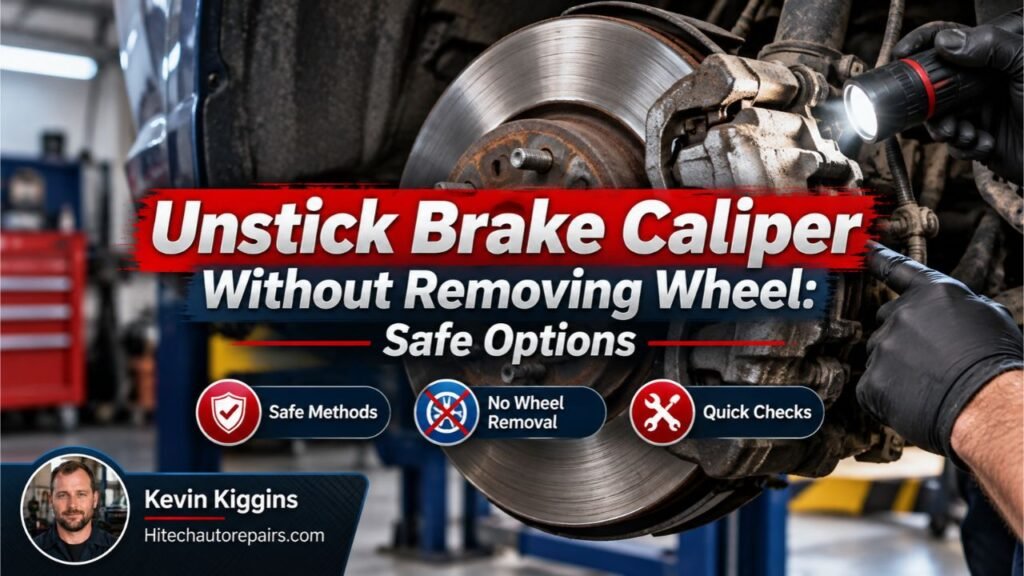
There is no reliable external trick that permanently repairs a seized caliper without accessing the brake assembly.
Before removing the wheel, you can safely try the following.
1. Make Sure the Parking Brake Is Completely Released
A stuck rear brake is not always caused by the hydraulic caliper piston.
On vehicles where the parking brake operates through the rear caliper, a sticking:
- Parking-brake cable
- Caliper lever
- Electronic parking-brake mechanism
can keep the brake applied.
Fully release the parking brake.
If your vehicle has an electronic parking brake, cycle it off normally using the manufacturer’s procedure.
Do not repeatedly activate an electronic parking brake if it is making unusual noises or displaying a warning.
2. Let the Brake Cool Completely
A dragging caliper can make the rotor, wheel, and surrounding components extremely hot.
If the brake started sticking after driving, park safely and allow everything to cool before touching the wheel or attempting any inspection.
A brake that partially releases after cooling may still have a serious underlying problem.
Heat can temporarily change clearances, but cooling does not repair:
- Corroded slide pins
- Seized piston
- Collapsed brake hose
- Damaged parking-brake mechanism
If the wheel became extremely hot, the vehicle should be inspected before normal driving continues.
3. Check Whether the Vehicle Rolls Freely
On level ground and only when it can be done safely, check whether the vehicle moves normally after the parking brake has been released.
A severely dragging wheel may feel as though the vehicle is being held back.
If the brake remains locked, do not try to overpower it by accelerating harder.
Driving against a seized brake can quickly overheat the rotor and pads.
4. Cycle the Service Brake Pedal Normally
With the vehicle stationary, press and release the brake pedal several times normally.
Occasionally, a minor temporary issue may release when hydraulic pressure is applied and removed.
Do not repeatedly pump the pedal aggressively in an attempt to force a seized piston backward.
If the caliper remains stuck, further diagnosis is needed.
5. Inspect Through the Wheel if Visibility Allows
Some wheels have enough space between the spokes to visually inspect part of the brake assembly.
Look for signs such as:
- Heavy rust
- Smoke
- Bluish rotor discoloration
- Damaged brake hardware
- Uneven pad position
- Fluid leakage
Do not place your fingers through the wheel if the vehicle could move or if the brake is hot.
Visual inspection can help identify the problem, but it normally will not allow a proper repair.
Can You Really Free a Seized Brake Caliper Without Taking the Wheel Off?
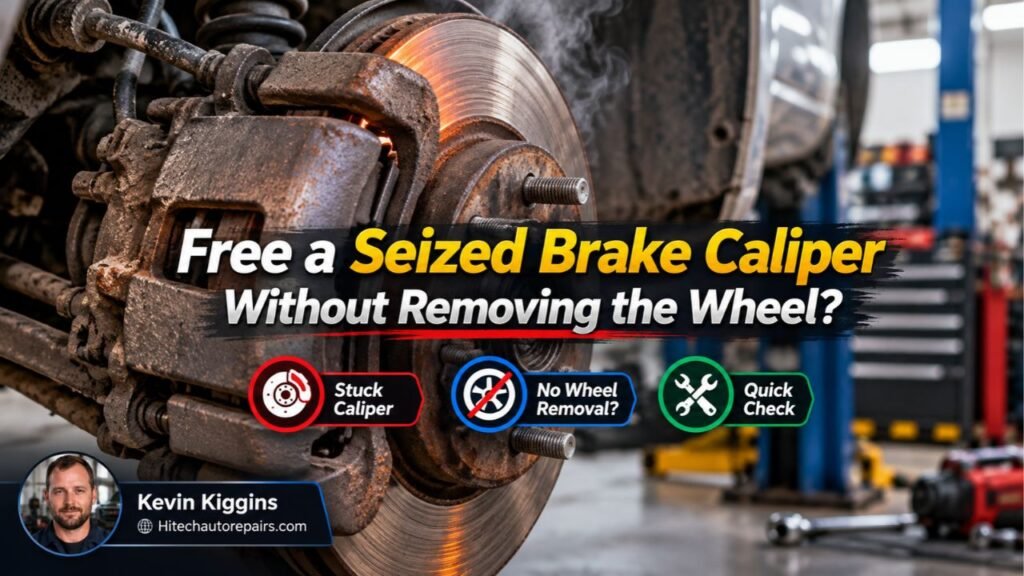
Usually not if the caliper itself is mechanically seized.
The components most likely to cause a sticking caliper are located behind the wheel and need direct access.
These include the:
- Caliper piston
- Slide pins
- Brake pads
- Caliper bracket
- Brake hose
- Parking-brake lever
- Dust boot
If one of these components has seized, removing the wheel is normally the minimum required step.
A temporary release is not the same as fixing the cause.
If the brake becomes free once and then sticks again, assume the problem is still present.
Why Does a Brake Caliper Get Stuck?
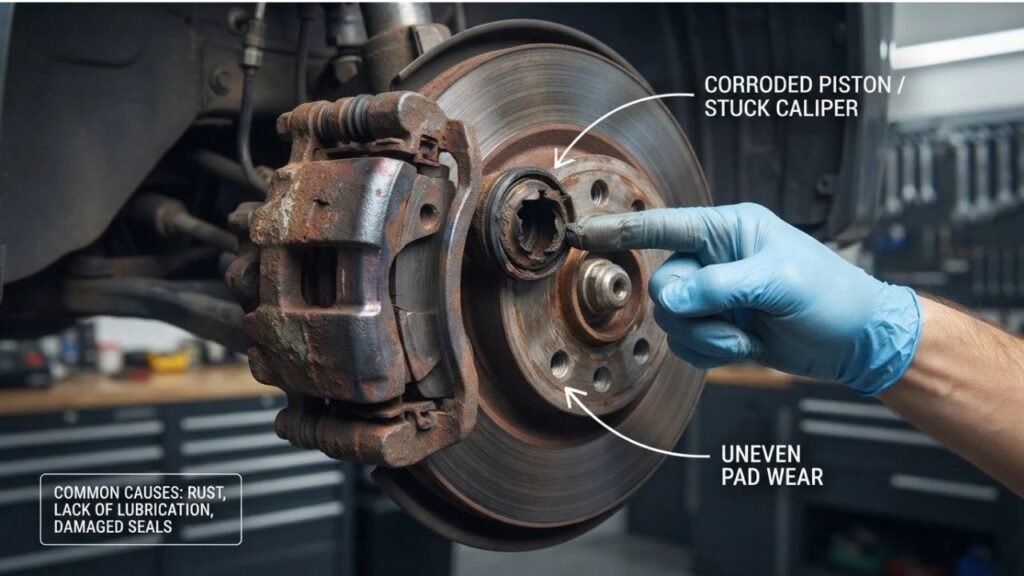
Understanding the cause helps determine whether any external fix is realistic.
Seized Caliper Piston
The caliper piston pushes the brake pad against the rotor when you press the brake pedal.
Moisture and corrosion can develop around the piston or underneath its protective boot.
Eventually, the piston may stop retracting properly.
A piston that remains extended keeps the pad pressed against the rotor.
Typical symptoms include:
- One wheel running hot
- Burning smell
- Vehicle pulling to one side
- Reduced acceleration
- Excessive brake dust
- Rapid pad wear
A genuinely seized piston normally requires caliper removal, rebuilding, or replacement.
Corroded Slide Pins
Floating brake calipers move on slide pins.
The pins allow the caliper to center itself over the rotor when braking.
If the slide pins become:
- Rusted
- Dry
- Dirty
- Bent
the caliper may remain partially applied.
Slide-pin problems cannot be properly corrected from outside the wheel.
The caliper needs to be accessed so the pins can be inspected, cleaned, lubricated with the proper brake lubricant, or replaced.
Collapsed Brake Hose
A damaged flexible brake hose can sometimes act like a one-way valve.
Hydraulic pressure reaches the caliper when the brake pedal is pressed, but pressure may not return normally when the pedal is released.
The result can feel exactly like a seized caliper.
This is important because replacing the caliper alone would not necessarily fix the problem.
A technician may compare brake release before and after carefully relieving hydraulic pressure to help distinguish between a mechanical caliper problem and trapped hydraulic pressure.
Sticking Parking Brake
Some rear calipers contain an integrated parking-brake mechanism.
Corrosion or cable problems can prevent the mechanism from returning completely.
This can leave one rear wheel dragging even after the parking brake has been released.
Rusted Brake Pads or Hardware
Brake pads need to move slightly inside the caliper bracket.
Heavy rust can cause them to bind.
Even if the piston retracts normally, a pad that cannot slide away from the rotor can continue dragging.
This requires disassembly and cleaning or replacement.
Signs You Have a Sticking Brake Caliper
A caliper does not need to be completely locked to cause problems.
Early symptoms may include:
Car Pulls While Driving
A dragging brake on one side can make the vehicle pull or feel resistant.
Pulling during braking can also have other causes, so diagnosis is important.
One Wheel Is Much Hotter Than the Others
A dragging pad creates continuous friction.
That friction becomes heat.
After driving, one wheel may become significantly hotter than the others.
Do not touch a suspected overheated rotor or caliper with your bare hand.
Burning Smell
Overheated brake pads can produce a strong burning odor.
If you smell burning brakes, stop driving as soon as it is safe.
Smoke From the Wheel
Smoke is a strong warning that the brake is overheating.
Continuing to drive can damage the:
- Pads
- Rotor
- Caliper
- Wheel bearing
- Brake fluid
Have the vehicle inspected before continuing normal operation.
Poor Fuel Economy
A brake that remains partially applied creates constant resistance.
The engine has to work harder to move the vehicle.
Uneven Brake Pad Wear
A sticking piston, slide pin, or pad can make one pad wear much faster than another.
This normally becomes apparent once the wheel and caliper are inspected.
Should You Hit a Stuck Brake Caliper With a Hammer?
This is not a good general repair method.
Light tapping is sometimes used by experienced technicians during diagnosis or disassembly, but striking a caliper through the wheel is not a reliable way to repair it.
You can damage:
- Caliper casting
- Brake hose
- Bleeder screw
- Electronic parking-brake motor
- Wheel
- Brake hardware
Even if tapping temporarily releases the brake, the original failure remains.
A caliper that seized once may seize again while you are driving.
Can You Spray WD-40 on a Stuck Brake Caliper?
Do not spray WD-40 or general penetrating lubricant onto an assembled brake through the wheel.
The biggest risk is getting lubricant onto the brake rotor or brake pads.
Brake friction surfaces need to remain clean and uncontaminated.
Oil or lubricant can dramatically reduce braking performance.
When caliper slide pins are serviced, technicians use an appropriate high-temperature brake lubricant on approved contact points after the assembly has been properly disassembled and cleaned.
That lubricant should never be applied to the rotor or pad friction material.
Can You Drive to Free a Stuck Caliper?
Do not deliberately drive a vehicle in an attempt to force a seized brake to release.
A dragging brake generates tremendous heat.
Continued driving can cause:
- Rotor overheating
- Brake-pad damage
- Brake fade
- Boiling brake fluid
- Wheel-bearing damage
- Caliper seal damage
In severe cases, an overheated brake can smoke heavily and become a fire hazard.
If the vehicle barely moves because one wheel is locked, towing is safer than trying to drive through the problem.
What if the Caliper Releases After Cooling?
This does not mean the problem is fixed.
A brake that sticks only when hot can have problems such as:
- Caliper piston binding
- Brake hose restriction
- Excessively tight pads
- Contaminated brake fluid
- Parking-brake mechanism binding
Thermal expansion can make a marginal component stick more severely.
If the wheel repeatedly becomes hot and then releases after cooling, have the brake inspected.
What if the Caliper Is Only Slightly Sticking?
Even a slight caliper drag should be taken seriously.
A mild sticking problem may gradually damage the rotor and pads before becoming obvious.
For example, a brake might release enough that the vehicle drives normally but still maintain light contact with the rotor.
Over time, this can create:
- Uneven pad wear
- Rotor discoloration
- Reduced MPG
- Heat damage
- Pulling
Early repair is usually less expensive than continuing until several brake components need replacement.
When Is Wheel Removal Necessary?
Wheel removal is normally necessary when you need to inspect or repair:
- Caliper piston
- Slide pins
- Brake pads
- Caliper bracket
- Brake hose connection
- Parking-brake mechanism
- Rotor condition
Once the wheel is removed, the technician can determine whether the problem is hydraulic or mechanical.
Simply replacing the caliper without diagnosis can miss a bad hose or seized brake pad.
Can You Push a Caliper Piston Back Without Removing the Wheel?
Generally, no practical or safe method exists to properly retract the caliper piston without accessing the caliper.
The piston sits behind the brake pad.
Proper retraction normally requires removing or repositioning the caliper and using an appropriate piston tool.
Some rear calipers must be rotated while being pushed inward because the parking-brake mechanism is built into the piston.
Vehicles with electronic parking brakes may also require a service mode before the piston can be retracted.
Trying to force the piston without knowing its design can damage the caliper.
Can You Release Brake Pressure Without Removing the Wheel?
Technically, brake hydraulic pressure can sometimes be diagnosed by opening a bleeder screw, but this should not be treated as a simple roadside method for freeing a stuck caliper.
The bleeder screw:
- May be difficult to reach
- Can be seized
- Can break
- Allows brake fluid to escape
- Can introduce air into the system
Brake fluid also damages painted surfaces.
If trapped hydraulic pressure is suspected, proper brake diagnosis is safer.
Is a Stuck Caliper Always Bad?
Not necessarily.
Sometimes the caliper itself is functional and another component is causing the drag.
Possible causes include:
- Brake hose restriction
- Stuck slide pins
- Rusted pad hardware
- Parking-brake cable
- Incorrectly installed pads
- Electronic parking-brake fault
This is why diagnosis matters before purchasing a replacement caliper.
Can a Stuck Brake Caliper Fix Itself?
No.
It may temporarily release, but the mechanical or hydraulic condition that caused it to stick remains.
A brake that works normally after cooling or after being moved does not prove the problem has disappeared.
Intermittent caliper problems frequently become progressively worse.
Temporary Fix vs Proper Repair
There is an important difference between temporarily getting a wheel to move and actually repairing the brake.
A temporary release may help move the vehicle a very short distance in a safe environment.
A proper repair requires finding and correcting the root cause.
Depending on the diagnosis, that may involve:
- Replacing the caliper
- Servicing slide pins
- Replacing brake pads
- Replacing the brake hose
- Repairing the parking-brake mechanism
- Replacing damaged hardware
- Bleeding the brake system
Brake work directly affects vehicle safety, so questionable components should not simply be forced back into operation.
FAQs About Unstick Brake Caliper Without Removing Wheel
Can you unstick a brake caliper without removing the wheel?
Sometimes a temporarily sticking brake may release after the parking brake is fully released or the brakes cool down. However, a mechanically seized caliper usually requires wheel removal for proper diagnosis and repair.
How do I temporarily free a stuck brake caliper?
Start by safely parking the vehicle, fully releasing the parking brake, and allowing an overheated brake to cool.
If the wheel remains stuck, do not use aggressive force or lubricants on the brake. The wheel should be removed and the brake inspected.
Can WD-40 free a stuck brake caliper?
Do not spray WD-40 onto an assembled brake system.
If WD-40 reaches the rotor or brake-pad friction surfaces, braking performance can be reduced.
Will a stuck caliper release when it cools?
It can, particularly when heat contributes to the binding.
However, a caliper that releases after cooling still has an underlying fault and should be inspected.
How do I know if the caliper or brake hose is stuck?
A seized piston or slide pin creates mechanical drag, while a restricted hose can trap hydraulic pressure in the caliper.
A technician can perform pressure and mechanical tests to identify the actual cause.
Can I drive with a slightly stuck brake caliper?
It is not recommended.
Even a partially dragging brake can overheat the rotor, destroy the pads, reduce fuel economy, and eventually cause brake failure or severe damage.
Can a stuck parking brake feel like a seized caliper?
Yes.
Rear parking-brake cables and mechanisms can stick and keep the brake applied even when the parking brake has been released.
Should I replace both calipers if one is stuck?
Not automatically.
Replacement depends on the age and condition of both calipers, the cause of failure, and the overall brake condition. Both sides should be inspected before deciding.
Conclusion
If you are trying to unstick brake caliper without removing wheel, the safe options are limited. You can make sure the parking brake is fully released, allow an overheated brake to cool, cycle the brake pedal normally, and visually inspect the brake through the wheel if possible.
A genuinely seized caliper piston, slide pin, brake pad, hose, or parking-brake mechanism normally requires the wheel to be removed.
Avoid spraying lubricants through the wheel, hammering aggressively on the brake, or driving the vehicle in an attempt to force the brake free. Even if the caliper temporarily releases, the underlying problem can return and cause severe overheating.
For a brake that remains locked, repeatedly overheats, produces smoke, or makes the vehicle difficult to move, proper brake inspection is the safest solution.