Symptoms of Too Much Brake Fluid: Warning Signs, Causes, Fixes
Brake fluid is one of the most important fluids in your vehicle because it transfers the force from your brake pedal to the braking components. However, having too much brake fluid can create problems inside the hydraulic braking system and may affect how safely your vehicle stops.
The most common symptoms of too much brake fluid include a stiff brake pedal, brakes that do not release properly, fluid leaks around the reservoir, overheating brakes, and unusual braking behavior. According to automotive service reports, brake system issues are among the most common reasons for vehicle inspections in the United States, and hydraulic problems can become expensive when small warning signs are ignored.
I have worked with brake systems and hydraulic repairs, and I have seen many cases where a simple mistake during brake maintenance caused unnecessary damage. Many drivers think that adding extra fluid will make their brakes work better, but the brake system is designed to operate within a specific fluid level range.
When the brake fluid reservoir is overfilled, there is less room for fluid expansion when temperatures rise. This can increase pressure inside the system and lead to problems with brake calipers, seals, and other components.
In this guide, I will explain the most common too much brake fluid symptoms, why they happen, how to identify the issue, and what steps you should take to fix it safely. Understanding these warning signs can help you prevent brake damage and keep your vehicle’s braking system working properly.
Symptoms of Too Much Brake Fluid You Should Never Ignore
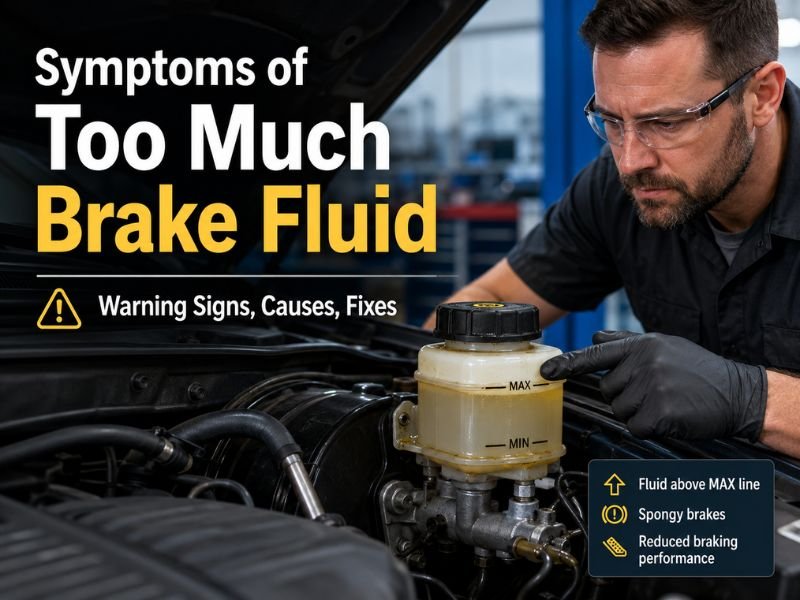
Having the correct amount of brake fluid is essential for a safe and responsive braking system. When the reservoir contains more fluid than recommended, it can disturb the pressure balance inside the hydraulic system.
The symptoms of too much brake fluid may not always appear immediately. Some drivers notice small changes in braking performance before the problem becomes serious. Paying attention to these early warning signs can help prevent expensive repairs and unsafe driving conditions.
Brake Pedal Feels Different or Harder Than Normal
One of the first signs of excess brake fluid can be a change in how the brake pedal feels. A properly working brake pedal should feel firm and consistent, but an overfilled system may create abnormal pressure inside the brake lines.
When there is not enough space for fluid expansion, the increased pressure can affect the master cylinder and the overall hydraulic brake system. As a result, the brake pedal may feel unusually stiff or harder to press compared with normal driving conditions.
However, a hard brake pedal can also happen because of other issues, such as air in the brake lines, a damaged brake booster, or a failing hydraulic component. That is why a complete inspection is important before replacing any parts.
If you notice a sudden change in brake pedal feel after adding brake fluid, check the fluid level first. Adding more fluid without checking the current level is a common mistake that can create unnecessary brake problems.
If your car feels slow after you release the brake pedal, you may be dealing with brake drag. This happens when one or more brake pads continue pressing against the rotor even though your foot is no longer on the pedal.
An overfilled reservoir by itself does not normally create enough hydraulic pressure to keep the brakes applied. The master cylinder is designed to release brake-line pressure when the pedal returns. However, if the system also has a blocked return port, sticking caliper, swollen hose, or master cylinder problem, brake drag can appear around the same time.
You may notice that the vehicle does not coast normally or requires more throttle to maintain speed. In severe cases, one wheel may become much hotter than the others after a short drive.
A burning odor near a wheel is another warning sign. Sticking brakes create constant friction, which can quickly overheat the pads and rotors.
If brake drag started immediately after brake service or adding fluid, I recommend checking both the reservoir level and the mechanical brake components rather than assuming excess fluid is the only cause.
Vehicle Pulls to One Side While Driving
A vehicle that pulls left or right while braking usually has uneven braking force between the wheels. Drivers sometimes notice this after brake maintenance and assume the fluid level is responsible.
In most cases, an overfilled reservoir alone will not make one front brake apply harder than the other. A sticking brake caliper, contaminated brake pad, restricted brake hose, or uneven rotor condition is more likely.
For example, if the right-front caliper remains partially applied, the vehicle may pull toward that side and the wheel may become unusually hot. A technician can compare brake temperatures and inspect pad movement to identify the affected wheel.
Do not confuse brake-related pulling with a basic wheel alignment problem. Alignment issues can make a vehicle drift while cruising, while brake imbalance is usually most noticeable when the brake pedal is pressed.
Brake Fluid Leakage Around the Reservoir
Visible fluid around the reservoir is one of the clearer signs that it has been filled too high. Brake fluid should normally remain between the MIN and MAX markings specified by the vehicle manufactu
Brake fluid and surrounding components become warmer as the vehicle operates. If the reservoir has little or no available space above the fluid, excess fluid may escape around the cap or reservoir area.
Look for wetness around the reservoir cap, master cylinder, or nearby surfaces. Do not automatically assume a wet reservoir means an internal leak. It may simply be fluid that spilled during filling.
Still, any unexplained loss of brake fluid deserves attention. If the level repeatedly drops after being corrected, I would inspect the brake lines, hoses, calipers, wheel cylinders, and master cylinder for leaks.
Brake fluid can also damage automotive paint, so spills should not be ignored. Vehicle manufacturers specifically warn against allowing brake fluid to remain on painted surfa
Burning Smell or Overheated Brakes
An unusual burning smell after driving should always be taken seriously. Overheated brakes can result from brake pads remaining in contact with the rotors for too long.
Again, excess fluid in the reservoir is not usually enough by itself to make the brakes overheat. If overheating happens after brake service, I would check for a sticking caliper, incorrect master-cylinder adjustment, restricted hose, or another condition preventing pressure from releasing.
You may also notice reduced acceleration, excessive brake dust, smoke near a wheel, or one wheel that feels much hotter than the others.
Avoid touching a brake rotor or caliper immediately after driving. These components can become hot enough to cause serious burns.
Some vehicle manufacturers also warn that spilled brake fluid contacting very hot engine components can become a fire hazard. That is another reason to correct an overfilled reservoir instead of leaving fluid near the
ABS Warning Light May Turn On
Your ABS warning light indicates that the anti-lock braking system has detected a problem. It does not normally come on simply because the brake fluid reservoir is slightly above the MAX line.
The ABS system uses wheel-speed sensors, an electronic control module, valves, and a hydraulic unit to prevent wheel lockup during hard braking. Problems with any of these components can trigger the warning light.
Some vehicles also monitor low brake fluid levels through a reservoir sensor. Because warning-light behavior varies by make and model, I recommend checking the owner’s manual before assuming what a specific light means.
If the ABS light appears together with strange pedal behavior, brake drag, or a red brake warning light, have the system diagnosed. Do not simply remove fluid and assume the warning has been fixed.
Too Much Brake Fluid Symptoms Compared With Normal Brake Problems
Several too much brake fluid symptoms can look similar to problems caused by other brake components. That is why I never recommend diagnosing a braking problem from one symptom alone.
| Symptom | Possible Connection to Overfill | Other Common Causes |
| Hard brake pedal | Usually not caused by mild overfill alone | Brake booster problem, vacuum issue, restricted hydraulic component |
| Brake drag | May appear after brake service but needs further diagnosis | Sticking caliper, blocked hose, master cylinder issue |
| Fluid around reservoir | Stronger indication of overfilling or spillage | Damaged cap, reservoir problem, previous spill |
| Hot wheel or burning smell | Requires immediate inspection | Sticking caliper, parking brake problem, collapsed hose |
| ABS warning light | Usually indirect or unrelated | Wheel-speed sensor, wiring, ABS module or hydraulic fault |
The key point is simple: fluid above the MAX mark is a condition you should correct, but it is not an explanation for every braking symptom.
A proper diagnosis can prevent you from replacing good parts while missing the actual problem.
Why Does Too Much Brake Fluid Happen?
Overfilling Brake Fluid During Maintenance
The most obvious cause is adding too much fluid during routine maintenance. A beginner may see empty space inside the reservoir and assume it should be filled all the way to the top.
That is not how the reservoir is designed to work. The correct level is determined by the markings on the reservoir and the instructions provided by the manufacturer.
Most passenger vehicles should have the fluid level somewhere between the MIN and MAX lines, with fluid added only as specified by the owner’s man
Adding Brake Fluid Without Checking Existing Level
Another common mistake is topping off brake fluid without understanding why the level has changed.
As disc brake pads wear, the caliper pistons gradually move farther outward. This keeps the pads close to the rotors and moves some brake fluid from the reservoir into the hydraulic system.
As a result, a gradual decrease in reservoir level can be normal as brake linings wear. Ram and Kia owner guidance both note this relationship between brake lining wear and reservoir le
If someone tops the reservoir to the maximum while the pads are worn and later installs new pads, pushing the caliper pistons back can send fluid toward the reservoir. The level may then rise too high.
Incorrect Brake Repair Procedure
An incorrect service procedure can also leave the reservoir overfilled. This may happen during brake bleeding, caliper replacement, pad replacement, or a complete brake fluid flush.
I always recommend checking the final fluid level after the brake pedal has been operated and the vehicle is in the condition specified by its service information.
Some hybrid and electronically controlled braking systems have special procedures for checking or bleeding brake fluid. For those vehicles, following the manufacturer procedure is especially important.
Wrong Brake Fluid Type or Contamination
Using the wrong fluid is more serious than simply adding too much of the correct fluid.
Vehicles may specify DOT 3, DOT 4, DOT 5, or DOT 5.1, depending on the brake system. The correct specification should be listed on the reservoir cap or in the owner’s manual.
Do not assume a higher number automatically means it is suitable for your vehicle. In particular, silicone-based DOT 5 fluid is fundamentally different from the glycol-based fluids commonly used in many passenger vehicles.
Manufacturers recommend using only the brake fluid specification approved for the vehicle because incorrect or contaminated fluid can damage brake components and reduce braking performa
What Happens If You Put Too Much Brake Fluid in Your Car?
Increased Hydraulic Pressure
This point is often misunderstood.
Simply filling the reservoir slightly above MAX does not normally increase brake-line pressure while you are driving. Hydraulic braking pressure is mainly generated when the master cylinder piston moves as you press the brake pedal.
However, an overfilled reservoir can create other problems. Fluid may have insufficient free space in the reservoir, escape around the cap, or spill when brake pistons are pushed back during service.
If the brakes remain pressurized after the pedal is released, I would look beyond fluid level and inspect the master cylinder return function, brake hoses, calipers, booster adjustment, and related components.
Brake Components Can Wear Faster
Excess reservoir fluid itself does not directly wear out brake pads or rotors faster.
The real concern appears when another problem causes the brakes to remain partially applied. Continuous contact between the pads and rotors creates friction and excessive heat, which can rapidly shorten component life.
A dragging brake can damage pads, discolor or distort rotors, overheat wheel bearings, and place additional stress on caliper seals.
That is why I treat a hot wheel or persistent brake drag as a mechanical problem requiring diagnosis rather than simply removing fluid and continuing to drive.
Reduced Driving Safety
Any unusual brake behavior deserves immediate attention because your braking system directly affects stopping distance and vehicle control.
A reservoir filled slightly above MAX may only create a spill or overflow problem. However, leaking fluid, contaminated fluid, brake drag, a warning light, or an abnormal pedal can indicate something more serious.
If the brake pedal suddenly changes, the car pulls strongly while braking, fluid is leaking, or stopping ability is reduced, do not continue driving normally. Have the vehicle inspected before the problem becomes more severe.
How to Check If Your Brake Fluid Level Is Too High
Step 1: Park the Vehicle Safely
Park on a flat, stable surface and place the transmission in Park or in gear as appropriate for the vehicle.
Allow the vehicle to cool before working around the engine compartment. Keep the vehicle secured so it cannot move while you inspect it.
Step 2: Locate the Brake Fluid Reservoir
Open the hood and find the brake fluid reservoir. On most gasoline-powered passenger vehicles, it is mounted near the brake master cylinder toward the driver’s side of the firewall.
The reservoir is commonly made from translucent plastic, which allows you to check the fluid level without removing the cap.
Before opening it, clean dirt and debris from around the cap. Brake systems must stay extremely clean because contamination can damage internal components.
Step 3: Check the MIN and MAX Lines
Look at the side of the reservoir for MIN and MAX markings.
The fluid should be within the range specified by the manufacturer. Hyundai and Kia, for example, instruct owners to keep the reservoir level between these marki
If the fluid is clearly above MAX or nearly touching the reservoir cap, it may have been overfilled.
Do not judge the level only by how full the container looks. The manufacturer’s marks are your reference.
Step 4: Inspect for Leaks or Pressure Issues
Look around the reservoir, master cylinder, brake lines, and visible connections for moisture.
Then pay attention to how the vehicle behaves. Check for a brake pedal that does not return normally, a wheel that becomes unusually hot, or a vehicle that struggles to roll freely.
If the fluid level keeps dropping, that is more concerning than a one-time overfill. Frequent brake-fluid additions can indicate a leak and should be professionally inspec
How to Fix Too Much Brake Fluid Safely
Remove Excess Brake Fluid
If the only problem is fluid slightly above the MAX line, the basic solution is to remove enough fluid to restore the correct level.
I prefer using a clean fluid syringe or dedicated brake-fluid extractor. The tool must be completely free from oil, coolant, water, or other contaminants.
A clean turkey baster is sometimes used for reservoir extraction, but I only consider it acceptable when it is new or dedicated exclusively to brake fluid. Never use a kitchen tool that may contain grease or food residue.
Remove a small amount at a time and recheck the level. Do not empty the reservoir because allowing air into the hydraulic system can turn a simple correction into a brake-bleeding job.
Bleed the Brake System if Necessary
You usually do not need to bleed the brakes simply because you removed a little excess fluid from the top of the reservoir.
Bleeding becomes necessary when air has entered the hydraulic system, brake lines or calipers have been opened, or the manufacturer’s service procedure specifically requires it.
A spongy pedal after hydraulic repair can indicate trapped air. In that situation, proper bleeding is much more important than the reservoir being a few millimeters above or below a particular point.
Modern ABS and hybrid brake systems may require a scan tool or special bleeding sequence. I recommend professional service when you are unsure of the procedure.
Get a Brake Inspection for Persistent Symptoms
Correcting the fluid level should not be treated as a cure for every brake complaint.
If the wheel still runs hot, the brake pedal remains abnormal, the vehicle pulls during braking, or warning lights stay illuminated, another component may be failing.
I would inspect the calipers, brake hoses, pads, rotors, master cylinder, brake booster, ABS system, and parking brake as appropriate.
When braking performance is questionable, professional diagnosis is safer than repeated trial-and-error repairs.
Can Too Much Brake Fluid Damage the Master Cylinder?
A small amount of extra fluid above the MAX line does not automatically destroy a master cylinder.
However, manufacturers still warn against overfilling the reservoir. Nissan states that overfilling can damage the brake system, while Ram warns about overflow onto hot components and painted surfa
The bigger threat to a master cylinder is often contamination. Petroleum-based fluids, dirty tools, moisture, or incompatible brake fluid can damage seals and interfere with normal hydraulic operation.
If the master cylinder is already malfunctioning, symptoms can include a sinking pedal, internal pressure problems, fluid leakage, or brakes that do not release correctly.
For that reason, I would not replace a master cylinder simply because the reservoir was overfilled. Diagnose its operation first.
How Much Brake Fluid Should a Vehicle Have?
There is no single universal amount that applies to every car, SUV, or pickup in the United States.
Reservoir capacity and brake-system capacity vary by vehicle. The safest reference is the owner’s manual, reservoir markings, or factory service information.
For a basic visual check, the fluid should normally remain within the marked operating range. Do not fill the reservoir to the neck simply because there is extra space available.
Also remember that fluid level may gradually drop as brake pads wear. If the level suddenly falls below MIN or requires frequent topping off, look for a leak or another brake-system problem rather than continuously adding fluid.
How to Prevent Brake Fluid Overfilling Problems
Preventing overfill is much easier than cleaning up a brake fluid spill or diagnosing a problem after service.
First, always inspect the reservoir before adding anything. Never add brake fluid automatically just because you are performing an oil change or checking other fluids.
Use only the DOT specification listed for your vehicle. Keep new fluid in its original sealed container and avoid leaving the cap open because many common brake fluids absorb moisture from the air.
Inspect brake pad condition before topping off a reservoir that has gradually dropped. Worn pads may explain part of the level change.
Keep the reservoir and cap clean. Even a small amount of engine oil, grease, or other petroleum-based contamination can damage brake-system seals.
Finally, check the level again after brake repairs. This is especially important after pushing caliper pistons back during a pad replacement because the returning fluid can raise the reservoir level.
Frequently Asked Questions About Too Much Brake Fluid Symptoms
What are the most common signs of too much brake fluid?
The clearest signs are usually fluid above the MAX line, wetness around the reservoir cap, or evidence that brake fluid has overflowed or spilled.
Hard pedals, brake drag, overheating, and warning lights may occur around the same time, but I would not assume overfilling is their direct cause without further diagnosis.
Can too much brake fluid make brakes lock up?
A slightly overfilled reservoir normally does not make properly functioning brakes lock by itself.
Locked or dragging brakes are more commonly associated with a sticking caliper, restricted brake hose, parking brake problem, blocked master-cylinder compensation port, incorrect adjustment, or another hydraulic fault.
If a wheel stays locked after you release the pedal, the vehicle should be inspected before normal driving continues.
Is it dangerous to drive with overfilled brake fluid?
A small amount above MAX may not immediately change braking performance, but I still recommend correcting it.
The excess can overflow or spill, and brake fluid may damage painted surfaces. Manufacturers also warn against overfilling the reserv
If overfilling is accompanied by brake drag, leaking fluid, smoke, warning lights, or reduced stopping ability, do not treat it as a minor fluid-level issue.
How do I remove extra brake fluid from my car?
Use a clean, dedicated syringe or fluid extractor to remove a small amount from the reservoir.
Stop when the fluid reaches the manufacturer’s recommended level. Keep dirt and petroleum products away from the reservoir, and do not remove so much fluid that air can enter the hydraulic system.
Can low brake fluid and too much brake fluid have similar symptoms?
Not usually.
Low brake fluid is more concerning because it may be related to worn brake pads or a hydraulic leak. A significant leak can reduce braking ability and may activate a brake warning light.
An overfilled reservoir is more likely to cause overflow or spillage around the reservoir. If you cannot determine why the level is changing, I recommend having the complete braking system inspected.
Conclusion
Understanding the symptoms of too much brake fluid starts with knowing what overfilling can actually do and what it usually cannot do. Fluid above the MAX mark can lead to overflow, messy leaks around the reservoir, paint damage, and problems during brake service, but it does not automatically explain every hard pedal, dragging brake, or ABS warning light.
I recommend correcting an overfilled reservoir with a clean fluid-extraction tool and then checking the brake system for any remaining symptoms. Always use the brake fluid specification listed by the vehicle manufacturer and keep the fluid within the recommended range.
Most importantly, never ignore changes in braking performance. If your brakes drag, a wheel overheats, the pedal behaves unusually, or the vehicle does not stop normally, I would have the system inspected before driving farther. A few minutes spent checking the brake system can prevent a small maintenance mistake from turning into a much more serious repair.