How Much Does Brake Fluid Replacement Cost? Shop Prices and Tips
Brake fluid replacement typically costs approximately 90–220 at a U.S. repair shop, depending on the vehicle, location, fluid specification, and service provider. Independent mechanics often charge around 110–160 for a standard brake fluid flush, while dealership prices commonly range from 140–220. Additional work, such as repairing leaks or performing specialized ABS bleeding, can increase the total.
Replacing brake fluid is an important maintenance service because most automotive brake fluids gradually absorb moisture. Excessive moisture reduces the fluid’s boiling point and can contribute to internal corrosion and reduced braking performance under demanding conditions.
However, a brake fluid replacement shouldn’t be confused with replacing brake pads, repairing brake lines, or simply adding fluid to the reservoir. Each service has a different purpose and cost.
The price of a routine fluid exchange is usually driven more by labor and the required bleeding procedure than by the cost of the fluid itself.
In this article, I explain how much brake fluid replacement costs at independent shops and dealerships, including labor, fluid, and DIY expenses. You’ll also learn what a complete brake fluid flush includes, how often replacement is needed, why some vehicles cost more, and how to avoid paying for unnecessary services.
How Much Does Brake Fluid Replacement Cost? U.S. Prices
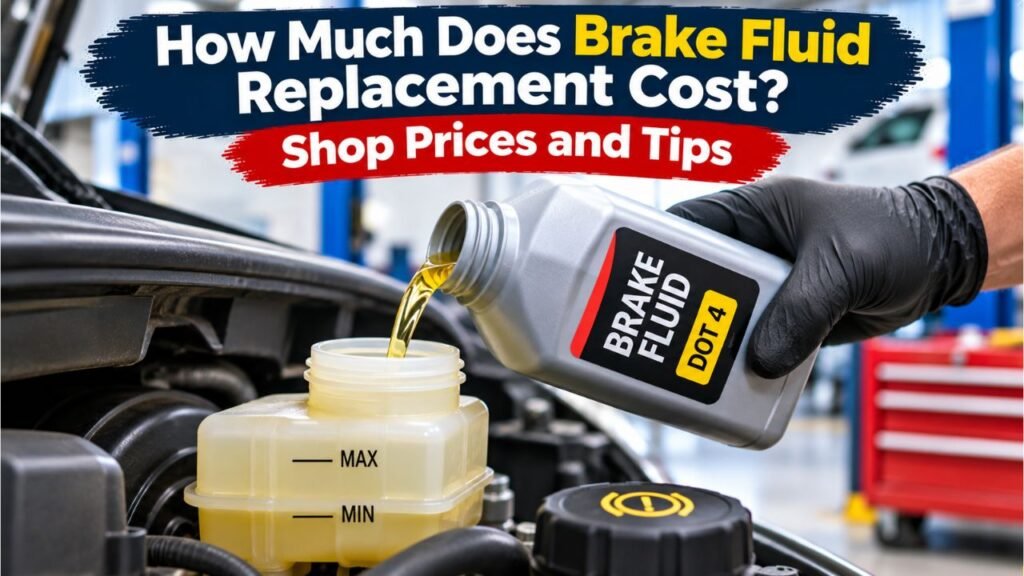
A standard brake fluid replacement generally involves removing aged fluid from the hydraulic braking system and exchanging it for fresh fluid meeting the vehicle manufacturer’s specifications.
For most ordinary passenger vehicles, the total price falls within a relatively modest range compared with major brake repairs.
Average Brake Fluid Replacement Cost
| Service provider or service | Estimated cost |
| Independent repair shop | 110–160 |
| Car dealership | 140–220 |
| Kelley Blue Book overall flush estimate | 173–205 |
| DIY brake fluid only | 10–30 |
| DIY bleeding equipment | 30–100 additional |
| Specialized ABS bleed | May involve extra labor or diagnostic charges |
| Brake fluid replacement plus leak repair | Depends on the failed components |
These are U.S. estimates, not guaranteed quotes. Taxes, shop supplies, local labor rates, and additional repairs may change the final invoice.
According to Kelley Blue Book’s brake fluid flush cost guide, the average estimated price for a brake fluid flush is 173–205.
A separate November 2026 estimate from Jerry places routine brake fluid replacement at approximately 90–175, with higher typical prices at dealerships.
The differences reflect how estimates are compiled and the types of shops and vehicles included.
Is $150 a Reasonable Price for a Brake Fluid Flush?
Yes.
For a standard passenger vehicle, a $150 quote is generally within a reasonable U.S. price range.
However, confirm that the price includes a complete hydraulic fluid exchange rather than just removing fluid from the reservoir.
Is $200 Too Much for Brake Fluid Replacement?
Not necessarily.
A $200 quote may be reasonable at a dealership or in an area with high labor costs.
It may also reflect a required specialty fluid or manufacturer-specific procedure.
However, compare the written service details with another reputable shop before authorizing the work.
Is $300 Too Much for a Brake Fluid Flush?
A $300 quote is above the common estimates for a routine flush on an ordinary passenger vehicle.
However, it isn’t automatically unreasonable.
Higher costs may be justified by specialized procedures, difficult access, seized bleeder screws, or other documented work.
Ask for an itemized explanation.
Key Takeaway: Budget approximately 100–220 for a routine brake fluid replacement, with Kelley Blue Book’s published estimate falling between $173 and $205.
Brake Fluid Replacement Cost Breakdown: Parts and Labor
Brake fluid is relatively inexpensive compared with many automotive components.
The majority of the bill often comes from the technician’s time, shop equipment, and service procedure.
Typical Cost Components
| Cost component | Illustrative amount | What it covers |
| New brake fluid | 10–30 | Correct DOT-specification fluid |
| Labor | Varies by shop | Fluid exchange and hydraulic bleeding |
| Shop supplies | Varies | Waste handling and service materials |
| Taxes and fees | Varies | Local charges |
| Additional ABS procedures | If necessary | Specialized electronic bleeding procedure |
These are examples rather than a fixed invoice structure. Some shops include fluid and supplies in a flat service price.
How Much Does Brake Fluid Cost?
Ordinary DOT 3 or DOT 4 brake fluid is usually much less expensive than the labor needed to replace it.
Specialty formulations, such as certain DOT 4 low-viscosity products, can cost more.
The amount required also varies with the vehicle and the procedure.
A mechanic may use more fluid than the system’s stated capacity to thoroughly exchange aged fluid.
How Much Is Labor for Brake Fluid Replacement?
Labor depends on the technician’s rate and time required.
A straightforward fluid replacement may take approximately 30–60 minutes in a professional shop.
However, some vehicles require additional time for preparation, wheel access, specialized bleeding, or complications.
A simple pricing example:
- Brake fluid: $20.
- Labor: $130.
- Shop supplies: $15.
Total: $165
This is an illustrative invoice, not a guaranteed shop quote.
Why Is Labor More Expensive Than the Fluid?
The technician must do more than pour fluid into a reservoir.
A proper service generally involves moving fresh fluid through the braking system while preventing air from entering.
The process may require:
- Raising the vehicle safely.
- Accessing brake bleeder fittings.
- Using pressure or vacuum equipment.
- Following the correct bleeding sequence.
- Maintaining the proper reservoir level.
- Checking for leaks.
- Verifying brake pedal operation.
These steps explain why a bottle of inexpensive fluid can be part of a service costing well over $100.
Brake Fluid Replacement Cost at Dealership vs. Independent Shop
The shop you choose can significantly affect the final bill.
Independent Mechanic
Independent repair shops often offer competitive prices for routine maintenance.
Jerry’s brake fluid replacement cost estimate, updated in November 2026, places a standard full-system flush at approximately 110–160 at independent shops.
However, actual prices depend on the vehicle and location.
An independent shop may be a good option when it has the correct equipment and follows the manufacturer’s bleeding procedure.
Dealership
Dealership service departments commonly charge more because of their labor rates and operating costs.
Jerry estimates approximately 140–220 for a standard brake fluid flush at dealerships.
Dealerships may be particularly useful when a vehicle requires specialized tools, software, or manufacturer-specific procedures.
However, a dealer isn’t automatically necessary for every brake fluid exchange.
Quick-Service Centers
Some automotive service chains offer brake fluid exchanges.
Prices vary by location and franchise.
Do not assume every branch offers the same service or charges a national fixed price.
Ask whether the quoted service includes exchanging fluid throughout the hydraulic system.
Which Is Better?
For a routine brake fluid flush, a reputable independent shop can often provide the necessary service at a competitive price.
For complex electronic brake systems, a shop familiar with the vehicle’s procedures may be especially important.
The best choice depends on technical capability, service quality, and the written estimate—not simply the lowest advertised price.
What Factors Affect Brake Fluid Replacement Cost?
Several factors determine whether the service costs closer to $100 or exceeds $200.
1. Vehicle Make and Model
Different vehicles use different brake system designs.
Some have straightforward hydraulic systems.
Others contain specialized ABS modules or require manufacturer-specific service procedures.
The exact vehicle matters more than assuming one brand always costs a particular amount.
2. Brake Fluid Type
Common automotive brake fluid specifications include:
- DOT 3.
- DOT 4.
- DOT 4 LV.
- DOT 5.
- DOT 5.1.
The required fluid can influence the price.
Certain high-performance or low-viscosity formulations are more expensive than basic DOT 3.
However, the fluid itself usually represents a smaller portion of the bill than labor.
3. ABS and Stability-Control Systems
Some vehicles require special electronic procedures to bleed particular hydraulic components.
A scan tool may be necessary to operate ABS valves or pumps during a specified service procedure.
However, not every routine flush on an ABS-equipped vehicle requires a scan-tool bleed.
Whether the procedure is needed depends on the vehicle, hydraulic system, and service conditions.
4. Local Labor Rates
Labor prices vary substantially between geographic areas.
A shop in a high-cost metropolitan area may charge more than one in a smaller town.
This is why national averages shouldn’t replace a location-specific quote.
5. Corroded Bleeder Screws
Rusty or seized bleeder fittings can make an otherwise simple service difficult.
A technician may need additional labor to loosen or repair affected components.
If a bleeder breaks or a hydraulic component is damaged, repair costs can increase significantly.
6. Additional Brake Repairs
If the mechanic finds a leaking brake hose, damaged caliper, or failing master cylinder, those repairs are separate from routine fluid maintenance.
A brake fluid replacement alone cannot fix a hydraulic leak.
7. Service Scope
Some service descriptions are unclear.
A reservoir fluid exchange is not equivalent to replacing fluid throughout the brake system.
Always confirm what the quote includes.
Brake Fluid Change vs. Brake Flush vs. Brake Bleeding
These terms are related but don’t always describe the same work.
Brake Fluid Change
A brake fluid change generally means replacing aged brake fluid with new fluid.
For scheduled maintenance, the intended service should exchange fluid throughout the relevant hydraulic circuits.
Brake Fluid Flush
A complete brake fluid flush moves fresh fluid through the braking system to replace old fluid.
In routine service discussions, brake fluid change, replacement, and flush are often used interchangeably.
However, the exact procedure should follow the vehicle manufacturer’s instructions.
Brake Bleeding
Brake bleeding removes air from the hydraulic system.
It may be necessary after:
- Replacing a brake caliper.
- Repairing a brake hose.
- Replacing a master cylinder.
- Opening a hydraulic brake line.
- Performing certain ABS service procedures.
Bleeding may also be part of a full fluid replacement.
However, a limited bleed after a repair isn’t necessarily the same as a complete fluid exchange.
Brake Fluid Top-Off
A top-off means adding a small amount of compatible fluid to the reservoir.
It doesn’t remove aged fluid from the brake lines or hydraulic components.
It also doesn’t correct a leak.
Service Comparison
| Service | Main purpose | Complete fluid exchange? |
| Reservoir top-off | Adjust fluid level when appropriate | No |
| Reservoir-only exchange | Replace fluid in the reservoir | No |
| Brake bleeding | Remove trapped air | Not necessarily |
| Full brake fluid flush | Replace aged fluid throughout the specified circuits | Yes |
| Hydraulic repair with bleeding | Repair a component and restore hydraulic operation | Depends on repair |
Key Takeaway: When paying for routine brake fluid replacement, confirm that the technician will perform the complete manufacturer-specified exchange rather than merely servicing the reservoir.
How Often Should You Replace Brake Fluid?
Many vehicles require brake fluid replacement approximately every two to three years, but the interval depends on the manufacturer.
Some vehicles specify different schedules or condition-based checks.
Why Brake Fluid Needs Replacement
Most passenger vehicles use glycol-based brake fluids that absorb moisture over time.
As moisture accumulates, the fluid’s boiling point decreases.
This can increase the risk of vapor formation during heavy braking.
Moisture can also contribute to corrosion inside hydraulic components.
Brake component manufacturer HELLA explains these effects in its technical guide on changing and testing brake fluid.
HELLA describes a general two-year replacement recommendation while emphasizing that the vehicle manufacturer’s specified interval should take priority.
Brake Fluid Replacement Interval Guide
| Situation | Recommended approach |
| Vehicle with a specified time interval | Follow the owner’s manual |
| Vehicle requiring periodic fluid testing | Follow manufacturer testing and replacement criteria |
| No known service history | Have fluid condition and maintenance history evaluated |
| Heavy braking or high-temperature use | Follow applicable severe-service guidance |
| Hydraulic system opened for repairs | Bleed as required by the repair procedure |
| Signs of contamination or moisture problems | Have the braking system inspected |
Does Brake Fluid Need Changing Every 30,000 Miles?
Not universally.
Brake fluid deterioration is related to time, moisture exposure, temperature, and system conditions—not just mileage.
A low-mileage vehicle may still need a fluid change after several years.
Conversely, a mileage threshold should not be applied to every vehicle without checking its maintenance schedule.
Can Brake Fluid Last Five Years?
Possibly, depending on the vehicle and manufacturer requirements.
However, don’t assume that five years is acceptable for every braking system.
Follow the specified service interval or testing method.
What if You Don’t Know When It Was Last Changed?
Check the maintenance records.
If the service history is unknown, ask a qualified mechanic to inspect the fluid and review the manufacturer’s maintenance recommendations.
A fluid condition test can provide useful evidence, but it doesn’t automatically override a time-based replacement requirement.
How Do You Know When Brake Fluid Needs Replacing?
Brake fluid may need service even if the brakes appear to operate normally.
However, some symptoms indicate a more serious problem requiring immediate inspection.
Signs Worth Investigating
- The manufacturer-specified interval has passed.
- A brake fluid test indicates excessive moisture or reduced boiling point.
- The fluid appears heavily contaminated.
- A hydraulic component has been repaired or replaced.
- The brake pedal feels unusual.
- There is visible fluid leakage.
- A brake warning light is illuminated.
Can Dark Brake Fluid Mean It Needs Replacing?
Dark or cloudy fluid can indicate aging or contamination.
However, color alone isn’t a reliable measure of moisture content or boiling point.
A qualified technician can evaluate the fluid using suitable testing methods.
What Moisture Level Is Too High?
HELLA’s brake fluid maintenance guidance identifies moisture content exceeding approximately 3% as a condition requiring replacement.
However, test results and replacement decisions must be interpreted according to the vehicle manufacturer’s requirements and the measurement method.
An inexpensive handheld tester should not be treated as definitive proof that the fluid is safe indefinitely.
Does a Spongy Brake Pedal Mean Old Fluid?
Not necessarily.
A spongy pedal may indicate air in the hydraulic system, a leak, or other brake problems.
Moisture-related vapor formation under high heat can also affect pedal feel.
However, a flush isn’t guaranteed to fix the problem.
If the pedal sinks excessively, braking performance is reduced, or a hydraulic leak is suspected, do not drive the vehicle. Arrange professional inspection or towing.
What Is Included in a Professional Brake Fluid Replacement?
A proper brake fluid replacement involves more than opening the reservoir and adding new fluid.
Step 1: Identify the Required Fluid
The technician checks the manufacturer’s brake fluid specification.
The correct fluid is important for seal compatibility, boiling-point performance, and hydraulic system operation.
Step 2: Inspect the Brake System
Before servicing, the technician may check for:
- Low fluid level.
- Visible leaks.
- Damaged hoses.
- Corroded brake lines.
- Problems with bleeder fittings.
- Abnormal pedal feel.
If the system has a hydraulic leak, repairing it is more urgent than performing routine fluid maintenance alone.
Step 3: Prepare the Fluid Exchange Equipment
The technician may use pressure, vacuum, or manual bleeding equipment, depending on the vehicle and procedure.
Clean, compatible brake fluid is required.
The reservoir must be managed correctly so that air is not introduced into the system.
Step 4: Exchange the Old Fluid
Fresh fluid is moved through the prescribed hydraulic circuits.
The correct bleeding sequence varies by vehicle.
The goal is to remove old fluid and prevent air from remaining inside the system.
Step 5: Perform Any Required ABS Procedure
Some systems require electronic activation of ABS hydraulic components during specific bleeding procedures.
If required, the technician follows the manufacturer-specified process.
Step 6: Verify Brake Operation
After the service, the technician should verify:
- Correct fluid level.
- Secure fittings.
- No hydraulic leaks.
- Proper brake pedal feel.
- No relevant warning conditions.
- Normal brake operation according to the repair procedure.
A vehicle should not be returned to service with an unsafe brake pedal or unresolved hydraulic problem.
How Much Does DIY Brake Fluid Replacement Cost?
Doing the job yourself may reduce labor expenses, but brake fluid replacement requires appropriate tools and knowledge.
For a basic vehicle, the fluid itself may cost approximately 10–30.
Additional tools can increase the initial expense.
DIY Brake Fluid Replacement Cost Chart
| Item | Estimated DIY expense |
| Correct brake fluid | 10–30 |
| Basic bleeding or pressure equipment | 30–100 |
| Catch container and other supplies | Varies |
| Specialty diagnostic equipment | Additional cost if required |
| Professional repair of a mistake | Potentially substantial |
For a first-time DIY job, budgeting approximately 40–130 or more for basic fluid and bleeding equipment is reasonable based on these illustrative component ranges.
If you already own the tools, future fluid changes may be less expensive.
Is Replacing Brake Fluid Yourself Difficult?
The difficulty depends on the vehicle and your experience.
A straightforward brake fluid exchange may be manageable for an experienced home mechanic.
However, the process requires preventing air from entering the hydraulic system and correctly verifying braking performance afterward.
Some vehicles have special bleeding requirements.
Can You Replace Brake Fluid Without Bleeding the Brakes?
A proper full fluid exchange requires moving fluid through the hydraulic system and ensuring that air is not trapped.
Simply removing fluid from the reservoir and refilling it doesn’t replace the old fluid in the brake lines and calipers.
Is DIY Brake Fluid Replacement Worth It?
The potential savings should be weighed against the risks.
Incorrect bleeding can leave air in the hydraulic system and reduce braking performance.
Using an incompatible fluid or damaging a bleeder screw can also create expensive problems.
For drivers without suitable tools or brake-system experience, professional service is the safer choice.
Key Takeaway: DIY replacement can save labor costs, but a professional fluid flush is often worth paying for because braking-system reliability is safety-critical.
Does Brake Fluid Type Affect Replacement Cost?
Yes, although labor usually remains a major part of the total price.
DOT 3 Brake Fluid
DOT 3 is a common glycol-based brake fluid.
It is used in many passenger vehicles, particularly models with specifications calling for DOT 3.
DOT 4 Brake Fluid
DOT 4 is another widely used glycol-based specification.
It generally has higher minimum boiling-point requirements than DOT 3.
Some vehicles require particular DOT 4 formulations.
DOT 4 Low-Viscosity Fluid
Certain modern brake systems require low-viscosity fluid designed for specific hydraulic and electronic control characteristics.
Use the manufacturer’s specified product.
Do not assume that every bottle labeled DOT 4 meets the required low-viscosity specification.
DOT 5 Brake Fluid
DOT 5 is silicone-based.
It is fundamentally different from the glycol-based DOT 3, DOT 4, and DOT 5.1 families.
DOT 5 should not be substituted for glycol-based brake fluid unless the vehicle is specifically designed for it.
DOT 5.1 Brake Fluid
Despite its similar name, DOT 5.1 is generally glycol-based, unlike silicone DOT 5.
It has different performance requirements.
However, fluid substitution should always follow the vehicle manufacturer’s specifications.
Can You Mix Different Brake Fluid Types?
Do not mix brake fluids arbitrarily.
Some glycol-based fluids have chemical compatibility, but that doesn’t mean every formulation provides the required vehicle performance.
Use the exact fluid specification listed in the owner’s manual or on the brake reservoir.
The wrong fluid can damage the braking system or compromise safety.
Is Brake Fluid Replacement Worth the Cost?
When the replacement is due, yes.
Brake fluid replacement is generally inexpensive compared with repairing major hydraulic brake components.
Why the Service Matters
As glycol-based brake fluid absorbs moisture, its boiling point can decline.
During sustained or heavy braking, the hydraulic system may become hot.
If moisture-contaminated fluid vaporizes, the resulting gas can compress under pedal pressure.
This may reduce the effectiveness of hydraulic force transmission.
Moisture also contributes to internal corrosion.
Can Skipping Brake Fluid Changes Damage ABS Components?
Contaminated brake fluid can contribute to corrosion and deterioration within brake hydraulic components, including ABS units.
However, it isn’t possible to predict exactly when damage will occur.
Following the specified maintenance schedule helps manage that risk.
Will New Brake Fluid Improve Braking?
If the old fluid is degraded or contaminated, replacing it helps restore the system’s intended fluid condition.
However, fresh fluid will not repair:
- Worn brake pads.
- Damaged rotors.
- A leaking master cylinder.
- Faulty calipers.
- A damaged brake hose.
- Electronic brake system faults.
Do not expect a fluid replacement to solve unrelated brake problems.
Should You Replace Brake Fluid Just Because a Shop Recommends It?
Not automatically.
Ask why the service is due.
Reasonable explanations include:
- The manufacturer’s replacement interval has elapsed.
- Service records show it is overdue.
- Testing indicates unacceptable fluid condition.
- A required repair includes fluid replacement or bleeding.
A written recommendation should explain the reason for the service.
How to Save Money on Brake Fluid Replacement
You can reduce unnecessary costs without compromising the repair.
Check the Maintenance Schedule
Review the owner’s manual and service history.
If the fluid was recently replaced and there is no other reason for service, another full replacement may not be necessary.
Compare Written Estimates
Ask reputable shops to quote the same service.
Make sure each estimate covers a complete fluid exchange using the correct specification.
Ask for an Itemized Price
The estimate should identify:
- Brake fluid.
- Labor.
- Special procedures, if required.
- Shop supplies.
- Taxes and fees.
- Additional recommended repairs.
Ask Whether ABS Procedures Are Included
If the vehicle requires a specialized bleeding procedure, confirm whether that work is included in the original quote.
Do not assume an additional ABS fee is automatically necessary for every vehicle equipped with ABS.
Combine Services When Appropriate
If the hydraulic brake system is being opened for another repair, fluid bleeding may already be required.
Ask whether combining the work can avoid duplicated labor.
However, replacing brake pads alone doesn’t necessarily require opening the hydraulic system or performing a full fluid flush.
Avoid Unnecessary Add-Ons
Do not approve extra services without understanding what they address.
For example, replacing brake fluid won’t repair worn pads or a leaking caliper.
Each recommended repair should have a clear explanation.
Choose a Shop With Proper Equipment
The lowest quote isn’t always the best value.
Make sure the technician can follow the required procedure and verify safe brake operation.
Questions to Ask Before Paying for a Brake Fluid Flush
Before authorizing service, ask the mechanic:
- Is the brake fluid replacement due according to the vehicle’s maintenance schedule?
- Does the quote include a complete hydraulic fluid exchange?
- What brake fluid specification will be used?
- Will the fluid be replaced through all required hydraulic circuits?
- Does my vehicle require a specialized ABS bleeding procedure?
- Are labor, fluid, supplies, taxes, and fees included?
- Have you found any leaks or other brake problems?
- Will the pedal feel and braking system be checked after the service?
These questions help distinguish routine maintenance from additional repairs.
A qualified mechanic should be able to explain the scope and cost before starting the work.
Common Mistakes When Paying for Brake Fluid Replacement
Paying for Only a Reservoir Top-Off
A top-off isn’t a full fluid change.
If you’re paying for a replacement, confirm that the hydraulic system will receive the appropriate fluid exchange.
Assuming Every Soft Pedal Needs a Flush
A soft pedal can indicate air, hydraulic leakage, or other mechanical problems.
A flush isn’t a substitute for diagnosis.
Choosing the Wrong Fluid to Save Money
Using an incompatible brake fluid can cause expensive damage and create a safety risk.
Always follow the vehicle specification.
Assuming a Higher Quote Is Always Unfair
Some vehicles need additional labor or special procedures.
Compare the written work rather than judging by price alone.
Ignoring Brake Fluid Leaks
Low fluid may indicate pad wear or a hydraulic leak.
A leak must be diagnosed and repaired.
Adding fluid isn’t a permanent solution.
Relying Only on Fluid Color
Dark fluid may justify further inspection, but appearance alone cannot establish its complete chemical condition.
Use maintenance records, manufacturer recommendations, and appropriate testing.
Attempting DIY Service Without the Required Equipment
Incorrect bleeding can compromise braking.
If you cannot safely complete and verify the procedure, use a professional technician.
Conclusion
Brake fluid replacement usually costs approximately 90–220 at a U.S. repair shop, depending on the vehicle, location, and service provider. Kelley Blue Book places the average estimated brake fluid flush cost at 173–205.
Independent mechanics often provide lower prices than dealerships, but the best value depends on the technician’s ability to perform the correct procedure.
The brake fluid itself is relatively inexpensive. Labor and any specialized bleeding requirements account for much of the expense.
I recommend checking the manufacturer’s service interval, confirming that the quoted service includes a complete fluid exchange, and comparing itemized estimates from reputable shops. If the brake pedal is unusually soft or the system has a leak, have the problem diagnosed rather than assuming routine fluid replacement will fix it.
A properly performed brake fluid replacement is generally a modest maintenance expense that helps protect the braking system from moisture-related deterioration.
FAQs About Brake Fluid Replacement Cost
How Much Does Brake Fluid Replacement Cost on Average?
Kelley Blue Book estimates approximately 173–205 for a brake fluid flush.
Other U.S. estimates place routine replacement around 90–220, depending on the shop, vehicle, and location.
Actual prices vary.
How Much Does a Brake Fluid Flush Cost at a Dealership?
A typical dealership estimate is approximately 140–220 for a standard brake fluid flush.
Some vehicles or specialized procedures cost more.
Request a written estimate for your exact model.
Is $150 a Good Price for Brake Fluid Replacement?
Yes.
A $150 quote falls within common U.S. pricing for a routine brake fluid exchange.
Confirm that it includes the correct fluid and complete manufacturer-specified service.
Is $250 Too Much for a Brake Fluid Flush?
A $250 quote is higher than many routine passenger-car estimates.
However, it may be reasonable when specialized procedures, high labor rates, or additional documented work are involved.
Ask for an itemized breakdown.
How Much Does It Cost to Replace Brake Fluid Yourself?
Brake fluid may cost approximately 10–30, while basic bleeding equipment can add 30–100.
A first-time DIY project may therefore cost about 40–130 or more.
Additional specialty tools may be required.
How Long Does Brake Fluid Replacement Take?
A straightforward professional fluid exchange often takes approximately 30–60 minutes.
Some vehicles require more time for access, inspections, specialized ABS procedures, or unexpected repairs.
How Often Should Brake Fluid Be Replaced?
Many manufacturers recommend replacement every two to three years, but requirements vary.
Follow the specific maintenance schedule for your vehicle.
Some systems use fluid condition tests or different service intervals.
Can You Replace Brake Fluid Without Replacing Brake Pads?
Yes.
Brake fluid replacement and brake pad replacement are different maintenance tasks.
A vehicle may require fresh brake fluid even when its brake pads remain in good condition.
Is a Brake Fluid Flush the Same as Brake Bleeding?
Not exactly.
A flush replaces aged hydraulic fluid.
Bleeding removes trapped air and may be part of a flush or a separate brake repair.
A limited bleed doesn’t necessarily replace all the old fluid.
Can You Just Add Brake Fluid Instead of Replacing It?
Adding fluid doesn’t remove moisture or contamination already present in the hydraulic system.
A low fluid level can also indicate worn pads or a leak.
Identify the cause before topping off.
Does ABS Make Brake Fluid Replacement More Expensive?
Sometimes.
Certain vehicles require specialized electronic bleeding procedures, which may increase labor costs.
However, not every ABS-equipped vehicle needs that procedure during a routine fluid exchange.
Is Brake Fluid Replacement Necessary if the Car Has Low Mileage?
It may be.
Brake fluid can absorb moisture over time even when the vehicle is driven very little.
Follow the manufacturer’s time-based or condition-based maintenance requirements.
Can Old Brake Fluid Cause Brake Failure?
Severely moisture-contaminated brake fluid can have a reduced boiling point.
Under high temperatures, vapor formation may compromise hydraulic braking performance.
Hydraulic leaks or other brake faults can also cause serious braking problems.
Is It Safe to Drive With a Brake Fluid Leak?
No.
A suspected hydraulic brake fluid leak can lead to loss of braking ability.
Do not continue driving. Arrange professional inspection or towing.
Can Brake Fluid Replacement Fix a Spongy Brake Pedal?
Sometimes, if trapped air or degraded fluid is contributing to the problem.
However, a spongy pedal may also result from leaks or faulty hydraulic components.
The cause should be diagnosed rather than assuming a flush is sufficient.