How to Tell What Brake Pads I Need: Fitment and Buying Guide
The correct brake pads must match your vehicle’s exact brake system, not just its make and model. Start with the year, make, model, trim, engine, and front or rear axle, then verify rotor size, caliper type, VIN notes, and OE or catalog part numbers before ordering.
Brake pads are highly application-specific. Two vehicles with the same model name and model year can use different pads because one has a larger brake package, towing package, performance trim, different engine, or a mid-year production change.
That is why how to tell what brake pads I need cannot always be answered by entering only “2018 Ford F-150” or “2020 Honda Accord” into a parts search. The brake configuration installed on the vehicle also matters.
Brake manufacturers’ catalogs show this clearly. Akebono application data identifies pad sets by make, model, model year, and axle position, while Brembo listings can narrow fitment further by rotor diameter, brake system, VIN range, and brake size.
The good news is that identifying the right pad is usually straightforward once you know what to check. In many cases, the vehicle VIN and a reputable application catalog get you most of the way there. A quick visual comparison with the old pads can provide the final confirmation before installation.
Brake pad fitment is a safety issue, not just a parts-counter inconvenience. NHTSA notes that brake pads are motor-vehicle equipment subject to federal defect and recall provisions, even though there is no separate Federal Motor Vehicle Safety Standard written specifically for brake pads themselves.
How to Tell What Brake Pads I Need for My Vehicle
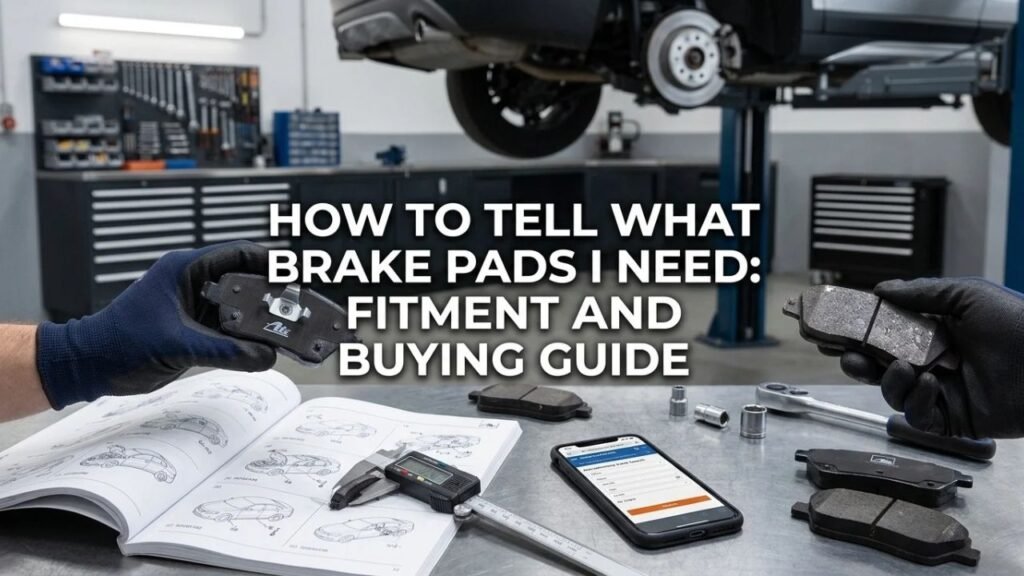
The most reliable process is to identify the vehicle first, then narrow the brake system.
Start With the Full Vehicle Information
Record:
- Model year
- Make
- Model
- Trim level
- Engine
- Drivetrain
- Body style if relevant
- Front or rear axle
Do not assume the front and rear pads use the same part number.
Brake manufacturers normally list them separately. Akebono’s application guide, for example, labels each part by vehicle application and position such as front or rear.
Use the VIN When Available
The 17-character VIN can identify vehicle details that a simple year/make/model search may miss.
Parts catalogs sometimes use VIN breakpoints because a manufacturer changed brake hardware during the model year.
Brembo’s catalog provides examples where one pad applies only up to a specific VIN sequence and where fitment also depends on rotor diameter or brake size.
If a catalog asks for your VIN, use it.
Confirm Front or Rear Position
Brake pads are sold by axle position.
A front set normally services both front wheels, while a rear set services both rear wheels.
The front and rear sets can differ in:
- Shape
- Thickness
- Width
- Wear sensor arrangement
- Hardware
- Friction formulation
Ordering “a set of brake pads” without checking axle position is an easy way to receive the wrong parts.
Check for Multiple Brake Packages
Some vehicles offer more than one brake system within the same year and trim range.
Differences can include:
- Standard vs. heavy-duty brakes
- Base vs. performance brakes
- Different rotor diameters
- Different caliper manufacturers
- Tow-package brakes
- Sport-package brakes
This is where rotor size, wheel size, or caliper identification becomes useful.
Key Takeaway: Use full vehicle information, VIN, axle position, and brake-package details instead of choosing pads based only on make and model.
Why the Same Vehicle Can Use Different Brake Pads
Manufacturers often change brake components without changing the vehicle’s basic name.
Rotor Diameter Can Change Pad Fitment
Larger brake packages may use:
- Larger rotors
- Larger calipers
- Different pads
Brembo’s application catalog shows vehicle listings where brake pad fitment is tied to a specific rotor diameter, such as a 349 mm front disc.
That means two versions of the same vehicle may need different pads even though both appear under the same year and model.
Caliper Manufacturer Can Matter
A vehicle manufacturer may source calipers from different suppliers.
A parts listing may identify systems such as:
- ATE
- Brembo
- TRW
- Akebono
- Bosch
Brembo’s catalog, for example, identifies pad applications by braking system and lists different pad dimensions for different caliper systems.
Performance Packages Often Use Unique Pads
Sport trims may have larger brakes for increased heat capacity.
Examples can include factory:
- Brembo packages
- Track packages
- Performance packages
- Heavy-duty towing packages
Do not assume a base-model pad fits the performance version.
Production Changes Can Occur Mid-Year
Manufacturers sometimes revise:
- Calipers
- Rotor sizes
- Pad shape
- Wear sensors
during a model year.
A catalog may describe this as:
- VIN from
- VIN to
- Before production date
- After production date
That note matters.
Key Takeaway: Rotor size, caliper supplier, performance package, and production date can all create multiple brake-pad options for one apparent vehicle application.
How to Identify Brake Pads by the Old Pad
If the old pads are already removed, they are useful references.
Do not rely on shape alone, but compare them before opening or installing the new set.
Compare Overall Shape
Place the old and new pads side by side.
Check:
- Overall length
- Overall height
- Backing-plate shape
- Mounting ears
- Spring locations
- Sensor tabs
- Chamfers
- Slots
The new pad should match the application-specific design.
Compare Thickness Carefully
New friction material should normally be thicker than worn material, so total thickness will not match.
Focus more on:
- Backing plate
- Pad outline
- Clip locations
- Sensor provisions
Look for Stamped Numbers
Some pads have:
- OE numbers
- FMSI numbers
- Manufacturer part numbers
- WVA numbers
stamped or printed on the backing plate.
These can be searched in a manufacturer catalog.
Brembo product listings commonly include FMSI and WVA references alongside pad dimensions and fitment data.
Do Not Copy an Incorrect Previous Pad
A previous owner may have installed:
- Wrong pads
- Cheap substitutes
- Pads missing required hardware
- Pads intended for a different brake package
Use the old pads as a visual check, not the sole source of truth.
Key Takeaway: Compare pad shape, mounting ears, sensor locations, and stamped identifiers with the old part, but confirm fitment through vehicle and catalog data.
How to Measure Brake Pads for Identification
Measurement can help when a catalog lists multiple near-identical options.
Measure Pad Width
Measure across the longest section of the backing plate.
Brake catalogs may list width in millimeters.
Measure Pad Height
Measure from the lower edge to the highest point of the pad or backing plate according to the catalog drawing.
Measure the Backing-Plate Shape
Two pads may have similar width and height but different:
- Tabs
- Hooks
- Curves
- Clip arrangements
Visual catalog diagrams matter.
Measure Rotor Diameter
Rotor diameter can separate two brake packages.
You may need to measure across the rotor from outside edge to outside edge.
If the rotor cannot be measured accurately while installed, check the OE build information or brake catalog.
Brembo’s listings demonstrate how rotor diameter can be part of pad selection for a specific vehicle.
Do Not Guess From Wheel Diameter
Wheel size can sometimes correlate with a brake package, but it is not a dependable universal rule.
A 19-inch wheel does not automatically mean the car has one specific rotor.
Use brake-system data whenever possible.
Key Takeaway: Pad dimensions and rotor diameter are useful confirmation tools when a vehicle has multiple brake options, but they should support rather than replace catalog fitment data.
How to Know if You Need Front or Rear Brake Pads
First determine which axle has worn pads.
Listen and Inspect the Source
Symptoms can include:
- Wear indicator squeal
- Grinding
- Brake warning message
- Uneven braking
- Visible thin friction material
Inspect both front and rear brakes before ordering.
A noise that sounds like it comes from the front can sometimes travel through the vehicle.
Measure Remaining Pad Material
Pad thickness should be checked at:
- Inner pad
- Outer pad
- Left side
- Right side
Uneven wear can signal a caliper or slide-pin problem rather than normal pad wear alone.
A recent manufacturer service bulletin hosted by NHTSA uses a remaining-pad threshold of 5 mm as part of its specific diagnostic procedure, showing why actual lining thickness can matter during inspection. That number is specific to that procedure rather than a universal replacement limit.
Replace Pads by Axle
Do not replace only one front pad or one wheel’s pads under normal service.
Pads should normally be replaced as an axle set so braking characteristics remain balanced left to right.
NHTSA-hosted service information also describes replacing brake linings across the same axle to maintain brake balance.
Key Takeaway: Inspect all four corners, identify the worn axle, and replace pads as a matched axle set rather than replacing only one wheel.
What Type of Brake Pads Should I Buy?
Once you know the correct shape, you still need to choose a friction material.
The main aftermarket categories are ceramic, semi-metallic, and organic/non-asbestos organic.
Ceramic Brake Pads
Ceramic pads are popular on many passenger vehicles.
Common characteristics include:
- Low visible dust
- Quiet operation
- Smooth braking feel
- Long service life in normal driving
They are often a good match for daily commuters when the manufacturer lists them for the vehicle.
Semi-Metallic Brake Pads
Semi-metallic formulations use a higher metal content.
They are commonly chosen for:
- Trucks
- Performance driving
- Heavy loads
- Higher heat conditions
They can offer strong bite and heat tolerance, though dust and noise characteristics vary.
Organic Brake Pads
Organic or NAO formulations use fibers and binders rather than a high metallic content.
They can provide smooth, quiet operation but may wear faster in demanding conditions.
Match the Vehicle’s Intended Use
For a normal daily driver, an OE-style replacement pad is often the safest starting point.
For towing or repeated high-temperature use, a heavy-duty or performance formulation may make more sense if the manufacturer lists it for the exact brake system.
Akebono, for example, separates its product lines into ProACT, EURO, Performance, and Severe Duty applications rather than treating one pad compound as suitable for every vehicle.
Key Takeaway: After confirming fitment, choose a pad compound suited to the vehicle and driving conditions rather than selecting material before fitment.
Do Brake Pad Brands Have to Match the Car Brand?
No.
You do not need Ford-branded pads for a Ford or Honda-branded pads for a Honda.
Aftermarket pads can fit correctly when they are cataloged for the vehicle’s exact brake system.
OEM Pads
OEM pads come through the vehicle manufacturer’s parts network.
Advantages can include:
- Factory friction characteristics
- Known noise behavior
- Vehicle-specific hardware
Aftermarket Pads
Reputable aftermarket manufacturers offer replacements designed for specific OE applications.
Fitment information may include:
- Compatible vehicles
- OE cross-reference
- FMSI number
- Pad dimensions
- Brake system
- Included hardware
Brembo and Akebono both publish application-specific information rather than offering brake pads as universal components.
Avoid Shopping by Brand Reputation Alone
A highly rated pad from a good brand is still the wrong pad if its part number does not match your vehicle.
Fitment comes first.
What Brake Pad Information Should I Give the Parts Store?
Provide more than “I need pads for my car.”
Bring the VIN
The VIN is especially useful when multiple brake options exist.
It can help identify:
- Production period
- Engine
- Trim
- Factory equipment
State Front or Rear
Tell the counterperson exactly which axle you are servicing.
Mention Performance or Towing Packages
If the vehicle has:
- Factory Brembo brakes
- Sport package
- Heavy-duty package
- Tow package
mention it.
Know the Rotor Size if There Are Multiple Options
If the catalog gives two pad choices based on brake diameter, confirm the rotor.
Bring the Old Pad if Needed
When the catalog remains ambiguous, bringing one old pad to a local parts store can make comparison easier.
Do not drive the vehicle with brakes disassembled to do this.
Should I Replace Rotors When I Replace Brake Pads?
Not always, but the rotors need inspection.
Check Rotor Thickness
Every rotor has a minimum allowable thickness.
Do not continue using a rotor below its specified minimum.
Manufacturer service procedures commonly require checking the rotor before fitting new pads. One NHTSA-hosted brake service procedure, for example, instructs technicians to inspect the rotor and replace or resurface it as needed during pad service.
Check the Surface
Look for:
- Deep grooves
- Heavy corrosion
- Heat spots
- Cracks
- Severe lip
- Uneven wear
Check Runout and Thickness Variation if Needed
Brake pulsation can come from rotor runout or disc thickness variation.
Installing new pads on a rotor with unresolved issues may leave you with poor braking feel.
Never Install the Wrong Pad to Match a Worn Rotor
Pad fitment is based on the brake system, not on how the old rotor has worn.
Key Takeaway: Rotors do not automatically need replacement with every pad change, but they should be checked for thickness, damage, and surface condition first.
Signs You Ordered the Wrong Brake Pads
Do not force a new pad into the bracket.
The Pad Is Too Long or Too Short
If the ears do not align with the bracket, stop.
The Pad Will Not Slide in the Hardware
Verify:
- Correct part number
- Correct hardware
- Correct bracket
- Rust buildup
A properly fitted pad should not need grinding of its backing plate to make an incorrect application fit.
Wear Sensor Is in the Wrong Location
Some vehicles use:
- Mechanical squealer tabs
- Electronic wear sensors
- Directional pads
A NHTSA-hosted service bulletin shows a vehicle-specific example where the inner pad and wear indicator have a defined orientation.
New Pad Shape Differs Significantly
Small changes in chamfer or friction-material shape can be normal across brands.
Major differences in:
- Mounting ears
- Backing plate
- Width
- Height
- Sensor provision
deserve rechecking.
The Catalog Lists Two Possible Sets
Do not pick one at random.
Resolve the difference through:
- VIN
- Rotor measurement
- Brake code
- Caliper identification
- OE part number
Key Takeaway: If mounting points, dimensions, sensors, or catalog notes do not match, stop and verify the brake application instead of modifying the new pads.
Brake Pad Fitment Checklist Before Installation
Before opening lubricant or retracting the caliper piston, confirm:
- Correct year, make, and model
- Correct trim and engine
- Correct front or rear position
- Correct rotor or brake-package size
- Correct caliper system
- VIN range if listed
- Matching pad outline
- Correct sensor provision
- Correct included hardware
- Suitable friction material
- Rotor is serviceable
Also check the brake system for:
- Sticking slide pins
- Torn caliper boots
- Fluid leaks
- Damaged hoses
- Uneven pad wear
- Rotor damage
A pad replacement will not correct a seized caliper or hydraulic problem.
Conclusion
How to tell what brake pads I need starts with identifying the exact vehicle and brake configuration. Use the year, make, model, trim, engine, axle position, and VIN, then check any catalog notes about rotor diameter, caliper type, brake package, or production date.
Do not rely only on the visual shape of the old pads or on a generic online listing. Brake catalogs from manufacturers such as Akebono and Brembo show that one model can have several pad applications based on position, brake system, rotor size, or VIN range.
Once fitment is confirmed, choose the friction material that matches your driving. An OE-style ceramic or semi-metallic pad is usually more sensible for a daily driver than choosing a pad based only on marketing claims.
Before installation, compare the new and old backing plates, inspect the rotors and calipers, and resolve any fitment difference before driving. If the application remains uncertain, use the VIN with an OEM dealer or reputable brake-parts catalog rather than guessing.
FAQs About How to Tell What Brake Pads I Need
Can I Find My Brake Pads by VIN Number?
Yes. A VIN can help narrow brake-pad fitment, especially when a vehicle had mid-year production changes or more than one brake package.
Some catalogs specifically list brake pads by VIN range.
Are Front and Rear Brake Pads the Same?
Usually not.
Front and rear brakes commonly use different calipers, rotors, pad shapes, and hardware. Brake-pad catalogs identify the axle position separately, so order the set listed specifically for the front or rear of your vehicle.
How Do I Know if I Have Large or Small Brakes?
Check the parts catalog for the rotor-diameter options, then identify your vehicle through VIN, option code, OE parts data, or direct rotor measurement.
Do not guess from wheel diameter alone.
Can Two Cars of the Same Year and Model Use Different Brake Pads?
Yes.
Differences in engine, trim, brake package, caliper supplier, rotor diameter, or production date can result in different pad sets within the same model year.
Can I Use Ceramic Pads if My Car Came With Semi-Metallic Pads?
Sometimes, if a reputable brake manufacturer specifically catalogs the ceramic pad for your vehicle.
Fitment and braking characteristics matter more than material name alone. For towing, performance use, or heavy vehicles, choose a formulation suited to the intended service.
How Many Brake Pads Do I Need for One Axle?
A typical disc-brake axle uses four individual pads: an inner and outer pad at each wheel.
Brake pads are normally sold as an axle set, so one front set usually covers both front wheels and one rear set covers both rear wheels.
Should I Replace Brake Pads on Both Sides?
Yes, brake pads should normally be replaced in axle sets so the left and right sides have matching friction material and wear condition.
If one side is much more worn than the other, inspect the caliper, slides, hose, and hardware for a fault before installing the new set.
What Is the Easiest Way to Make Sure I Buy the Right Pads?
Use a reputable parts catalog with your VIN, confirm front or rear position, read every fitment note, and compare the new pads with the old pads before installation.
If the catalog lists more than one option, identify the rotor size, caliper system, or factory brake package before ordering.