How Thick Should Brake Pads Be? New Thickness and Wear Limits
Most new passenger-car brake pads have roughly 10–12 mm of friction material. Around 4–5 mm usually means the pads are getting low, while about 3 mm is a common replacement point. The exact minimum is vehicle-specific, so factory service information takes priority over a general thickness chart.
Pad thickness matters because the friction material gradually disappears every time the brakes are applied. Waiting until almost none remains increases the chance of the steel backing plate contacting the rotor, which can turn a routine pad replacement into a more expensive pad-and-rotor repair.
A measured thickness also gives you time to schedule service before warning noises or grinding start. A driver at 7 mm is in a very different position from one at 3 mm, even if both vehicles still stop normally during everyday driving.
U.S. vehicles also remain in service for a long time. S&P Global Mobility reported that the average age of U.S. light vehicles reached 12.8 years in 2025, with about 289 million vehicles in operation. Older vehicles may go through several sets of pads during their lives, making accurate pad inspection a routine maintenance issue.
The answer to how thick should brake pads be is best viewed as a range rather than one universal number. Brembo lists new pads at roughly 10–12 mm and recommends replacement below 3 mm, while Akebono has published guidance calling for replacement around 4 mm or less. Vehicle manufacturers may specify still different service limits.
What stood out to me in the service information is how much the actual minimum can vary. Ford service specifications, for example, show a 1.5 mm minimum on some applications and 3 mm on others. That is why I would use a 3–4 mm range for planning, then verify the exact specification before treating any number as the final limit.
The sections below explain normal new thickness, what 8 mm through 2 mm readings mean, how to measure only the friction material, why inner and outer pads may differ, and when thickness should no longer be the only reason for replacement.
How Thick Should Brake Pads Be at Each Wear Stage?
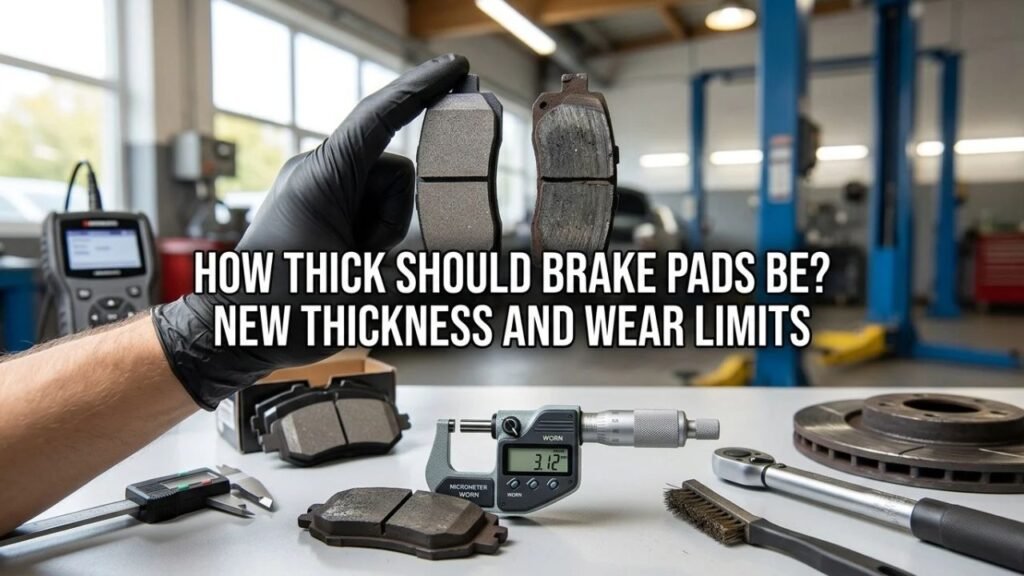
For many passenger vehicles, 10–12 mm is a common new-pad range. As that material wears away, the measurement becomes a useful service-planning tool.
The chart below is a general reference rather than a factory specification for every vehicle.
| Pad Friction Material | General Condition | Practical Action |
| 10–12 mm | New or nearly new | No pad service based on thickness alone |
| 8–9 mm | Lightly worn | Normal monitoring |
| 6–7 mm | Moderately worn | Check at routine service |
| 4–5 mm | Getting low | Start planning replacement |
| 3 mm | Common replacement point | Schedule replacement soon |
| 2 mm or less | Very thin | Prompt inspection and replacement |
| Backing plate exposed | Friction material gone | Stop normal driving and inspect rotor damage |
10–12mm: Typical New Brake Pad Thickness
Brembo and AutoZone both describe about 10–12 mm of friction material as common for new passenger-car brake pads. Akebono has also published approximately 10 mm as a typical new friction-material thickness.
That figure refers to the friction material, not the total thickness of the complete pad.
A brake pad also includes a steel backing plate and may have a shim attached to the rear. Measuring the complete assembly produces a much larger number that does not show how much usable friction material remains.
Some applications start outside the 10–12 mm range. Large trucks, performance brakes, compact rear pads, and specialty calipers can use different dimensions.
8–9mm: Plenty of Material Remains
A pad in the 8–9 mm range is usually far from a normal replacement threshold.
At this stage, the more useful inspection is checking that all pads are wearing at a similar rate. One outer pad at 9 mm does not prove that the hidden inner pad is also 9 mm.
If the pads are even and the brake system has no symptoms, thickness alone normally gives no reason to replace them.
6–7mm: Partly Worn but Commonly Serviceable
Pads measuring 6–7 mm have used a meaningful portion of their original friction material but are commonly still serviceable.
A 6 mm measurement is not automatically “half the pad life remaining.” If the pad started at 10 mm and replacement is planned at 3 mm, only 7 mm of the original material represents the usable range before that planning point.
That leaves 3 mm of usable material at a 6 mm reading, or roughly 43% of that particular 10-to-3 mm wear range.
Actual mileage remaining cannot be calculated from thickness percentage alone because wear rate changes with traffic, hills, vehicle weight, driving style, pad compound, and brake condition.
4–5mm: Start Planning Brake Service
A 4–5 mm reading is a good point to start planning the next brake job.
The pads may still have usable material left, but the margin before a common 3 mm replacement point is becoming small.
Akebono has published guidance recommending replacement at about 4 mm or less, while Brembo uses below 3 mm as its general recommendation. Those differences show why a shop may reasonably recommend pads at 4 mm even though another shop might monitor them a little longer.
I would pay more attention at 4–5 mm if the vehicle sees heavy city traffic, towing, mountain driving, or high monthly mileage.
3mm: Common Brake Pad Replacement Point
Three millimeters is one of the most commonly cited replacement measurements for passenger-car pads.
Brembo states that pads should be replaced once friction material drops below 3 mm, and AutoZone gives 3 mm as a common replacement point for most applications.
That does not mean a pad instantly stops working at 2.9 mm.
The reason for replacing before the absolute mechanical limit is to preserve some margin before the friction material disappears and metal components begin contacting the rotor.
2mm or Less: Very Little Margin Remains
At 2 mm, the pad is very thin.
Some vehicle manufacturers publish minimums around this range or lower. Ford service information demonstrates that real factory limits can vary from 1.5 mm to 3 mm among different applications.
A factory minimum should not be confused with the ideal time to begin planning maintenance. Waiting for every pad to touch the absolute service limit leaves less margin for uneven wear between inspections.
Key Takeaway: About 10–12 mm is common when new, 4–5 mm is a sensible planning range, and around 3 mm is a common replacement point, but your vehicle’s factory specification controls the final limit.
Why Brake Pad Minimum Thickness Is Not Universal
It would be convenient if every car used the same replacement number, but brake systems differ too much for one figure to cover every vehicle.
Pad Design Varies by Vehicle
Brake pads differ in:
- Friction-material thickness
- Backing-plate shape
- Pad surface area
- Caliper design
- Rotor diameter
- Vehicle weight
- Axle position
- Heat load
A small rear pad on one vehicle may start thinner than a large front pad on another.
That means comparing your measurement with a random car’s service limit can produce the wrong answer.
Factory Service Limits Can Differ
Ford’s published brake specifications provide a clear example.
One application lists 1.5 mm as minimum front and rear pad thickness, while another lists 3 mm. A separate Ford specification calls for at least 2 mm on front and rear pads.
These are manufacturer specifications, not contradictions. The vehicles use different brake designs.
This is why a general 3 mm rule works well as a maintenance benchmark but should not replace factory data.
Wear Sensors May Trigger Before the Absolute Minimum
Many brake pads have either a mechanical wear indicator or an electronic sensor.
A mechanical indicator is often a small metal tab positioned to touch the rotor once the friction material becomes thin. Contact produces a high-pitched squeal.
An electronic sensor completes or breaks a circuit as the pad wears to a designed point, producing a dashboard warning.
If the vehicle displays a brake-pad wear warning, I would inspect the brakes rather than assume there is extra mileage available because another visible pad still measures above a generic minimum.
Key Takeaway: Pad dimensions, caliper design, vehicle weight, and manufacturer limits differ, so use general thickness ranges for planning and factory specifications for the final service decision.
How to Measure Brake Pad Thickness Correctly
A thickness number only means something when the correct part of the pad is measured.
The target is the friction material between the rotor and the steel backing plate.
Measure the Friction Material Only
Do not include:
- Steel backing plate
- Anti-noise shim
- Piston clip
- Other hardware
AutoZone describes most new friction layers as roughly 10–12 mm thick. That measurement is separate from the pad’s steel support structure.
If a shop says your pads measure 4 mm, that number should normally refer to the remaining friction material.
Check Both Inner and Outer Pads
Disc-brake calipers normally place one pad on each side of the rotor.
The outer pad may be easy to see through the wheel while the inner pad is hidden behind the caliper. Measuring only the visible pad can miss uneven wear.
A sticking caliper piston, seized slide pin, rusty pad contact point, or other movement problem can make one pad wear much faster than the other.
The thinnest pad should guide the service decision.
Measure More Than One Area of the Pad
A pad can wear unevenly from top to bottom or from one end to the other.
If one edge is 5 mm and another is 3 mm, calling the pad “5 mm” hides the actual condition.
Measure the thinnest usable section and look for taper.
Uneven thickness is also a reason to inspect the caliper, bracket, guide pins, and rotor rather than replacing pads alone.
Use a Brake Pad Gauge When Access Is Limited
Color-coded brake gauges are common because they quickly show approximate remaining friction thickness.
One current OEMTOOLS gauge set uses:
- Red: 2 and 3 mm
- Yellow: 4, 5, and 6 mm
- Green: 8, 10, and 12 mm
That color scheme is a service tool reference, not a universal manufacturer standard, but it shows how technicians commonly separate low, intermediate, and higher pad thickness ranges.
For a more exact reading, the wheel may need to come off so the inner and outer pads can be inspected directly.
Key Takeaway: Measure friction material only, inspect both pads on each caliper, and use the thinnest measured point when deciding how much pad remains.
Is 8mm Brake Pad Thickness Good?
Yes. An 8 mm pad is generally in good condition if it is wearing evenly and the brake system has no fault.
For a pad that started at 10–12 mm, an 8 mm measurement represents moderate use with substantial friction material remaining.
No replacement is normally needed based on thickness alone.
The inspection still needs to account for the other pad on that wheel and the pads on the opposite side of the axle.
Is 6mm Brake Pad Thickness Good?
Six millimeters is commonly still a serviceable reading.
At 6 mm, I would record the number and compare it with the next inspection rather than schedule replacement solely because of thickness.
The recent wear rate matters. A pad that moved from 8 mm to 6 mm over a short mileage deserves closer monitoring than one that took a long time to lose the same 2 mm.
Driving conditions may also change the rate from this point forward.
Is 5mm Brake Pad Thickness OK?
Yes, 5 mm is generally still above common replacement thresholds.
It is also close enough to the low range that future service should be considered.
If the vehicle receives routine inspections at short intervals, monitoring may be reasonable. If the next inspection is far away, planning a brake appointment earlier reduces the chance of reaching the wear limit unnoticed.
A 5 mm outer pad paired with a 3 mm inner pad is a different situation. Always use the thinner reading.
Is 4mm Brake Pad Thickness OK?
Four millimeters is commonly still usable, but it is near the replacement-planning zone.
Akebono has recommended replacement at about 4 mm or less, while Brembo recommends replacement below 3 mm.
For that reason, a 4 mm recommendation from a shop is not automatically premature.
The decision also changes with the driver’s upcoming use. A low-mileage highway driver and a driver preparing to tow through mountain roads may reasonably make different service plans at the same thickness.
Is 3mm Brake Pad Thickness Safe?
Three millimeters is generally treated as a replace-soon measurement, not a thickness I would plan to use for a long interval.
Brembo and AutoZone both identify about 3 mm as a common replacement threshold.
The brakes may still function normally at that point. The concern is the small amount of friction material left before reaching much thinner territory.
Schedule replacement rather than waiting for grinding.
How Much Brake Pad Thickness Is Too Thin?
A pad is too thin once it reaches or passes the service limit specified for that brake system.
For general passenger-car maintenance, 3 mm or less deserves prompt attention.
Some factory specifications permit thinner material. Ford publishes 1.5 mm on some systems, while others use 2 mm or 3 mm.
I would not use those lower examples as permission to run every car down to 1.5 mm.
A service limit is specific to the vehicle that specification belongs to.
Does Brake Pad Thickness Include the Backing Plate?
No. When technicians discuss remaining brake-pad thickness for wear evaluation, they normally mean the friction lining only.
The steel backing plate stays behind the friction material and does not count as usable brake lining.
This distinction explains why a worn pad may look physically thicker than its stated 3 mm friction measurement.
A complete aftermarket pad specification may list total pad thickness for fitment purposes. That number serves a different purpose from a wear inspection.
Why Inner and Outer Brake Pads May Have Different Thickness
A small difference can occur as the brake system ages, but a large difference can point to a mechanical problem.
Sticking Slide Pins
Floating calipers move on guide or slide pins.
If a pin becomes rusty or seized, the caliper may not apply and release both pads evenly.
One pad can then lose friction material faster than the other.
Sticking Caliper Piston
A piston that does not retract correctly may leave the inner pad dragging against the rotor.
That creates extra heat and accelerated wear.
If an inner pad is nearly gone while the outer pad still looks thick, I would inspect piston and caliper movement before fitting new pads.
Pads Binding in the Bracket
Rust buildup at the pad contact points can prevent a pad from sliding freely.
The pad may remain partially applied or wear at an angle.
Cleaning or repairing the contact areas during pad replacement is part of correcting the cause rather than treating only the worn friction material.
Key Takeaway: A large inner-to-outer thickness difference can point to a caliper, slide-pin, or pad-movement problem that should be repaired before the new pad set is installed.
Should Front and Rear Brake Pads Have the Same Thickness?
No. Front and rear pads do not need to start at the same thickness or wear at the same rate.
Front brakes often handle a large share of deceleration because vehicle weight transfers forward under braking.
Rear brake design, electronic stability control, parking-brake integration, regenerative braking, and vehicle tuning can change the wear balance.
A vehicle may therefore have 5 mm front pads and 8 mm rear pads without anything being wrong.
Compare each axle with its own specifications and wear history.
Thickness Is Not the Only Reason to Replace Brake Pads
A pad may need replacement before reaching a low thickness measurement.
Cracked or Broken Friction Material
A pad with major cracks, chunks missing, or friction material separating from its backing plate should be replaced even if the remaining material measures well above 3 mm.
Thickness does not compensate for structural damage.
Oil or Brake Fluid Contamination
Friction material contaminated by brake fluid, grease, or oil may not provide normal friction.
Cleaning the surface does not always restore the pad.
The leak or contamination source also needs repair.
Severe Overheating
Repeated overheating can damage the pad surface or alter its friction behavior.
Blue rotor discoloration, burnt odor, severe glazing, or crumbling friction material deserves a full brake inspection.
Uneven Wear
A pad measuring 6 mm on one end and 2 mm on the other is not a healthy “6 mm pad.”
The thin point and the reason for the taper matter more than the thick edge.
Key Takeaway: Cracks, contamination, heat damage, separation, and severe uneven wear can require replacement before the pads reach a normal numerical wear limit.
How Often Should Brake Pad Thickness Be Checked?
There is no single mileage interval that fits every vehicle.
The owner’s manual or maintenance schedule should set the baseline.
Brake inspection is also sensible during tire rotations, wheel service, or other work that gives clear access to the pads.
More frequent checks make sense after the pads enter the 4–5 mm range because less material remains between the current reading and the replacement point.
High-mileage driving, frequent city stops, towing, mountain roads, and a history of uneven pad wear also justify closer monitoring.
If a warning light appears or the brakes begin grinding, squealing abnormally, pulling, or changing pedal feel, do not wait for the next scheduled thickness check.
Conclusion
For anyone asking how thick should brake pads be, a useful general benchmark is about 10–12 mm when new, 4–5 mm when replacement planning should begin, and around 3 mm as a common replacement point.
Those numbers are general service references rather than a universal rule. Published Ford specifications show minimum pad thickness values from 1.5 mm to 3 mm across different applications, which makes vehicle-specific service information the final authority.
Measure only the friction material, check inner and outer pads, and use the thinnest part of the pad as the meaningful reading. A single easy-to-see outer pad can hide a much thinner inner pad.
My approach would be to start planning at 4–5 mm rather than trying to use every last millimeter. Once the pads reach about 3 mm, schedule replacement unless the vehicle’s service information gives a different procedure.
FAQs About Brake Pad Thickness
What Is Normal Brake Pad Thickness?
New passenger-car pads commonly have about 10–12 mm of friction material. Pads with 6–8 mm remaining are generally still well above common replacement ranges. Exact new thickness varies by brake design, so a pad does not need to start at precisely 10 or 12 mm to be normal.
Is 8mm Good for Brake Pads?
Yes. Eight millimeters usually means substantial friction material remains. Check that the inner and outer pads are wearing evenly and that no brake symptoms are present. Thickness alone would not normally justify replacement at 8 mm.
Is 6mm Brake Pad Thickness OK?
Yes. Six millimeters is usually still serviceable. Record the measurement and inspect it again at a later service. Recent wear rate, inner-versus-outer pad condition, driving conditions, and the factory minimum provide more context than the 6 mm number alone.
Should Brake Pads Be Replaced at 5mm?
Not automatically. Five millimeters is commonly above the usual replacement range, but it is a sensible time to begin planning. Earlier replacement may make sense if wear is fast, another pad is thinner, or demanding driving is coming up.
Should I Replace Brake Pads at 4mm?
Four millimeters is a common planning point. Akebono has published guidance recommending replacement around 4 mm or less, while Brembo states that pads below about 3 mm should be replaced. Check the specification for your exact vehicle before treating either figure as universal.
Is 3mm Too Thin for Brake Pads?
Three millimeters is near the point where replacement is commonly recommended. The brakes may still operate normally, but very little wear margin remains. Brembo and AutoZone both use about 3 mm as a common replacement threshold.
Is 2mm Brake Pad Thickness Safe?
Two millimeters is very thin and calls for prompt service. Some vehicle-specific minimums are near this range, but other vehicles use higher limits. Do not apply a 2 mm specification from one model to another. Check the correct service information for your brake system.
Do I Measure Brake Pads With the Metal Backing Included?
No. Measure the friction material that contacts the rotor, not the steel backing plate or shim. The total assembled pad thickness is useful for part dimensions, while friction-material thickness is the measurement used to judge wear.