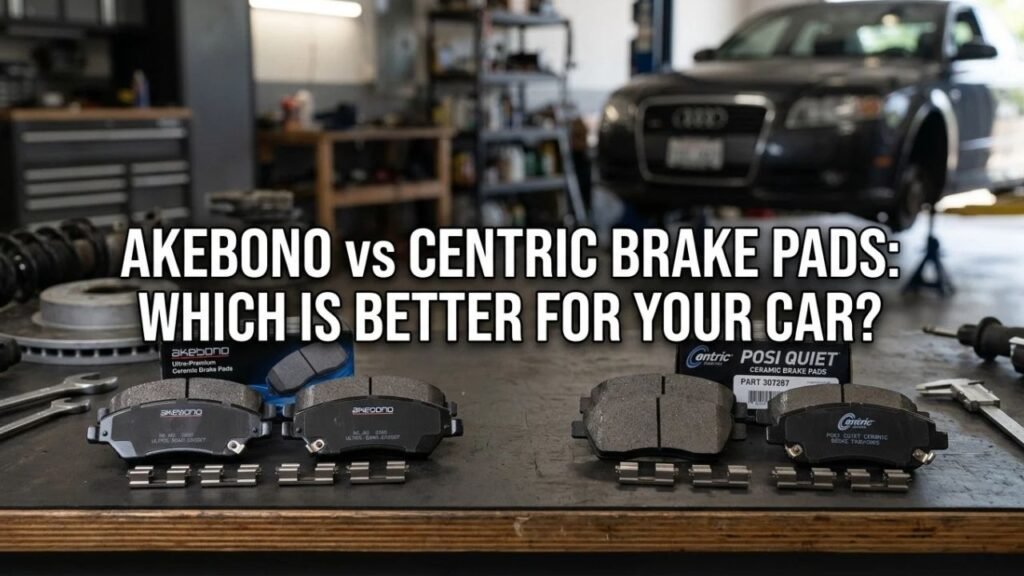
Akebono vs Centric Brake Pads: Which Is Better for Your Car?
For most daily-driven cars, I would choose Akebono if quiet braking, low dust, smooth pedal feel, and rotor-friendly ceramic friction are the main priorities. Centric is also a solid street-brake brand and often makes more sense for a price-focused repair, especially when a suitable Posi Quiet or Premium pad is available for the vehicle.
The comparison needs one qualification: neither company sells just one type of pad. Akebono offers lines such as ProACT, EURO, Performance, and Severe Duty, while Centric sells several friction families that include C-Tek, Posi Quiet, Premium, and PQ Pro products. Comparing the wrong tiers can make either brand look better than it really is.
For the typical passenger car, Akebono ProACT versus Centric Posi Quiet ceramic is the most useful street-pad comparison. Both target drivers who want OE-like braking with little noise and dust rather than a race-oriented friction compound. Tire Rack has placed both products in its premium street category for low noise and low dust.
A relevant U.S. manufacturing detail separates the brands as well. Akebono currently states that all of its aftermarket brake pads are manufactured in the United States. Its ProACT line uses vehicle-specific ceramic formulas and is sold for many domestic and Asian applications.
For Akebono vs Centric brake pads, my overall pick is Akebono for a normal commuter if both brands fit the car and the price difference is reasonable. Centric gets the edge when the Centric pad is much cheaper, when a semi-metallic formula better matches the original brake system, or when you want to pair the pads with Centric rotors in a budget-conscious brake job.
The sections below compare the brands by friction material, noise, dust, pedal feel, heat behavior, rotor wear, service life, price, warranty, hardware, vehicle type, and driving style.
Akebono vs Centric Brake Pads: Quick Verdict
For ordinary street driving, these brands are closer than their reputations sometimes suggest.
| Category | Akebono | Centric |
| Best-known street line | ProACT | Posi Quiet / Posi Quiet Advanced |
| Main street-pad focus | Ceramic | Ceramic and semi-metallic |
| Noise control | Excellent | Excellent |
| Brake dust | Very low with ProACT | Very low with Posi Quiet ceramic |
| Pedal feel | Smooth, OE-like | OE-style, formula varies |
| Rotor friendliness | Strong ProACT focus | Good with correct friction formula |
| Product tiers | More focused lineup | More price and formula tiers |
| Hardware | Included on applications that require it | Included on many Posi Quiet applications |
| Best for | Quiet daily drivers | Daily drivers and value-focused repairs |
| My overall street pick | Akebono | Strong alternative |
The winner can change once the exact vehicle and product lines are identified. A low-cost Centric C-Tek pad should not be judged against an Akebono ultra-premium pad as if they were direct equivalents.
Main Differences Between Akebono and Centric Brake Pads
Akebono Focuses Heavily on Ceramic Friction
Akebono is strongly associated with ceramic friction technology. ProACT is its main ultra-premium ceramic replacement line for domestic and Asian vehicles, while EURO targets European applications. Akebono also offers Performance and Severe Duty lines for different use cases.
ProACT uses vehicle-optimized ceramic formulas rather than one compound across every part number. Akebono promotes low dust, low noise, consistent pedal feel, high fade resistance, and reduced rotor wear as major characteristics of the line.
That makes Akebono easy to understand for a buyer who wants a premium street pad: find the correct Akebono line and part number for the vehicle, then install a friction formula engineered around that application.
Centric Offers More Friction Tiers
Centric takes a broader product-tier approach.
Its catalog includes C-Tek metallic and ceramic pads, Posi Quiet semi-metallic and ceramic pads, extended-wear versions, Centric Premium pads, and PQ Pro. Recent Centric part announcements also use the Posi Quiet Advanced name for new applications.
This gives Centric more room at different price points.
The downside is that saying “Centric pads” alone does not tell you enough. A C-Tek pad, Posi Quiet ceramic pad, and premium semi-metallic pad may produce different dust, noise, bite, and wear characteristics.
For a fair Akebono ProACT comparison, I would look first at Centric Posi Quiet ceramic or the current equivalent Posi Quiet Advanced application.
Key Takeaway: Akebono has a more focused premium-ceramic identity, while Centric offers more friction families and price levels.
Which Brake Pads Are Quieter?
Both brands perform well in this category when premium street products are compared.
Akebono ProACT Noise Control
Akebono puts a lot of emphasis on noise, vibration, and harshness control, commonly shortened to NVH.
ProACT pads use application-specific designs and harmonically damped construction. Akebono says its ceramic technology is intended to reduce squealing, grinding, vibration, and harsh braking feel.
For a daily driver where squealing is the complaint I most want to avoid, Akebono would be my first pick.
That does not mean an Akebono pad can never make noise. Rusted hardware, poor rotor finish, seized slides, contaminated friction material, incorrect installation, or a brake system fault can make any pad noisy.
Centric Posi Quiet Noise Control
Noise reduction is also one of the main goals of Posi Quiet.
Centric Posi Quiet ceramic pads use mechanically attached, application-specific shims, precision-cut backing plates, and scorched friction surfaces. Tire Rack describes these features as methods for controlling vibration, pad glazing, and brake noise.
Centric also uses positive molding, a process associated with OE friction-material production, to produce consistent material density.
In normal street use, the difference in noise between a properly installed ProACT set and a properly installed Posi Quiet ceramic set may be small.
I still give Akebono a slight advantage because NVH control is such a central part of the company’s ceramic-pad design and OE background.
Key Takeaway: Both brands can be very quiet, but Akebono gets a small advantage for drivers who place brake-noise control above other factors.
Akebono vs Centric for Brake Dust
Akebono Is Very Strong for Clean Wheels
Low dust is one of the clearest reasons people buy Akebono ProACT.
Akebono describes ProACT as an ultra-low-dust ceramic pad, and its low-copper ceramic formulas are designed around quiet street use and clean wheel appearance.
This is especially attractive on vehicles with light-colored or complex alloy wheels where dark friction dust becomes visible quickly.
European cars can be an interesting case. Factory European friction compounds are sometimes associated with heavier visible dust, and Akebono EURO is commonly chosen by owners who want to reduce that dust while retaining street-oriented braking.
Centric Ceramic Pads Also Produce Little Dust
Centric Posi Quiet ceramic pads are also marketed for ultra-low dust output. Tire Rack lists low dust among their main features and places them in the same premium low-dust category as Akebono ProACT.
The friction type matters, though.
A Centric semi-metallic pad may produce more visible wheel dust than a Centric ceramic pad, even though both carry the Centric name.
For clean wheels, compare ceramic with ceramic.
My dust-control pick between ProACT and Posi Quiet ceramic is Akebono by a small margin, but either is a reasonable low-dust street option.
Key Takeaway: Akebono ProACT gets my slight preference for low-dust street driving, while Centric Posi Quiet ceramic is close behind.
Which Has Better Stopping Power and Pedal Feel?
A brake-pad brand should not be judged by the idea that a harder initial bite always means better brakes.
Tires, rotor condition, brake temperature, ABS calibration, hydraulic condition, vehicle weight, and road grip all affect stopping behavior.
Akebono for Smooth OE-Style Braking
ProACT is designed around smooth and consistent braking rather than an aggressive race-pad feel.
Akebono states that ProACT provides consistent pedal feel across a broad set of driving conditions and strong fade resistance. Tire Rack also describes the pads as smooth, quiet, and consistent from the start.
This character works well for commuter cars, family vehicles, crossovers, and highway driving.
Some drivers coming from a more aggressive semi-metallic compound may interpret the smooth ceramic response as less initial bite. That does not automatically mean the pad has poor braking capability.
Centric Gives More Choice in Friction Feel
Centric has an advantage if you want to choose between ceramic and semi-metallic friction families.
Posi Quiet ceramic targets clean, quiet street braking. Posi Quiet semi-metallic uses the same general OE-style production approach while providing a different friction composition.
A semi-metallic option may feel more immediate on some vehicles and may suit brake systems originally designed around metallic friction.
That is why I would not automatically replace an OE semi-metallic pad with ceramic solely because ceramic sounds like the higher-grade material.
For Spirited Street Driving
Standard ProACT and Posi Quiet ceramic are primarily premium street pads.
Tire Rack has historically separated Akebono Performance from ProACT, placing Performance in a more aggressive street category while ProACT and Posi Quiet sit in the premium low-noise, low-dust group.
If the car sees repeated mountain runs, very hard street braking, autocross, or track sessions, choose a friction product specifically rated for that use instead of treating a quiet commuter pad as a competition pad.
Key Takeaway: Akebono favors smooth, predictable street feel; Centric gives more friction-material choices if you want ceramic or semi-metallic behavior.
Which Is Better for Rotor Life and Pad Wear?
Akebono Has a Strong Rotor-Friendly Focus
Akebono specifically promotes ProACT as a rotor-friendly formula.
Its current ProACT data highlights low rotor wear alongside low pad wear and smooth braking. Tire Rack also describes ProACT ceramic pads as producing minimal rotor wear.
For a daily driver where I want rotors to remain smooth through a long pad service cycle, this is another reason I lean toward Akebono.
Rotor life still depends on far more than pad brand. Corrosion, overheating, caliper drag, rotor quality, driving conditions, and installation can shorten rotor life.
Centric Uses Positive-Molded Friction Material
Posi Quiet ceramic pads use positive molding to create consistent friction-material density.
Centric also scorches the friction surface during manufacturing. Tire Rack states that the process stabilizes friction characteristics and is intended to promote even wear during the service life of the pad.
Centric therefore has a solid wear-control design of its own.
I would not claim that one brand will always last a fixed number of miles longer. Pad life changes too much from one vehicle and driver to another.
A sticking caliper can wear out either brand in a fraction of the service life expected from a healthy brake system.
Key Takeaway: Akebono gets a small edge for its rotor-friendly ceramic focus, but both premium lines are built around controlled street wear.
Akebono vs Centric Price and Warranty
Centric Can Be the Better Value
Prices change by vehicle and retailer, so there is no fixed dollar difference between the brands.
Centric’s broad lineup gives buyers more choices at lower and middle price levels. C-Tek can cover budget-oriented work, while Posi Quiet and Premium products move higher in the range.
Akebono concentrates more heavily on ultra-premium friction products. That can make ProACT more expensive than a basic Centric option on some vehicles.
Price should be compared at the same tier. Comparing Akebono ProACT with the cheapest Centric pad available tells you more about product level than brand quality.
If Posi Quiet ceramic costs much less than ProACT for the same car, I would be comfortable choosing Centric for a normal commuter.
Manufacturer Warranty Terms Differ
The current manufacturer warranty terms deserve attention.
Akebono’s published aftermarket disc-pad warranty covers defects in material and workmanship and requires a nonconforming product to be returned to the seller or installer within 30 days of purchase. Normal wear is excluded.
Centric’s current limited product warranty covers defects for 90 days or 3,000 miles, whichever occurs first, and also excludes normal wear and misuse.
Retailer warranty policies may be different from the manufacturer’s written warranty, so check the seller’s terms before purchase.
Based only on the current published manufacturer time limits, Centric offers the longer defect-claim period.
Key Takeaway: Centric often presents more lower-cost choices and currently has the longer published manufacturer defect-warranty period; Akebono’s strength is the product itself rather than warranty length.
Hardware, Fitment, and Installation Differences
Akebono Hardware
Many Akebono kits include premium stainless-steel abutment hardware where the application calls for it.
Akebono’s recent product releases specifically state that hardware and electronic wear sensors are supplied in kits that require them. The company also maintains a listing of applications supplied with hardware.
Do not assume every Akebono box contains clips. Check the exact part number.
Centric Hardware
Centric’s catalog lists Posi Quiet ceramic and semi-metallic lines with shims and hardware, though individual applications still need to be checked.
For example, current Posi Quiet listings show application-specific shims, and some part records include a full mounting hardware kit and wear sensor.
Fitment matters more than brand preference.
A correctly fitted Centric pad is a better choice than an Akebono part intended for a different caliper or brake package.
Always match year, make, model, trim, axle position, rotor size, caliper option, and brake package before ordering.
Key Takeaway: Both brands offer application-specific hardware on many kits, but box contents must be checked by exact part number.
Which Brand Is Better for Different Vehicles?
Honda, Toyota, Lexus, Acura, Nissan, and Other Asian Cars
Akebono is especially attractive for Asian vehicles.
The company supplies original-equipment brake components for many Asian applications and positions ProACT as a way to restore OE-style ceramic braking characteristics.
For a Honda, Toyota, Lexus, Acura, Nissan, Subaru, or similar daily driver, Akebono ProACT would usually be my first brand to check.
Centric Posi Quiet remains a good alternative if the application is listed and the price is much better.
Domestic Cars, Crossovers, and Light Trucks
Both brands work well here.
Akebono ProACT covers many domestic applications and can replace original semi-metallic pads with an application-approved ceramic formulation in listed vehicles.
Centric has broad domestic coverage across several price levels, which makes it attractive for older vehicles or repairs where budget matters.
For an everyday domestic sedan or crossover, I would choose Akebono for refinement and Centric for price-to-quality balance.
European Cars
Akebono EURO is the more relevant Akebono product than ProACT for supported European applications.
EURO is designed to retain street braking characteristics while cutting visible wheel dust. Akebono continued expanding EURO coverage in 2026 for BMW, MINI, Jaguar, and Land Rover applications.
Centric also supports European vehicles through Posi Quiet and Premium applications.
If the owner is trying specifically to reduce black wheel dust on a European daily driver, Akebono EURO would be my first option to research.
Trucks and Heavy Use
Do not assume ProACT or Posi Quiet ceramic is automatically the best pad for a truck that spends its life towing.
Akebono has a Severe Duty line for commercial vans, trucks, fleet vehicles, and demanding use. Centric also lists extended-wear and fleet-oriented friction products.
Match the friction line to the load and brake system rather than buying the same commuter pad used on a compact sedan.
Key Takeaway: Akebono has a strong case for Asian cars and low-dust European applications, while Centric’s broad catalog gives it strong coverage across budget and OE-style repairs.
Akebono or Centric: Which Brake Pads Should You Buy?
For a normal daily driver, Akebono is my overall winner.
Choose Akebono if your priorities are:
- Very low brake dust
- Quiet operation
- Smooth OE-style pedal response
- Ceramic friction
- Low rotor wear
- A premium street pad
- U.S.-made aftermarket Akebono products
Choose Centric if your priorities are:
- Lower purchase cost on the exact application
- More friction-material choices
- A choice between several product tiers
- A Posi Quiet pad already matched with Centric rotors
- Semi-metallic friction where the vehicle calls for it
- Strong street performance without paying extra for Akebono
For many drivers, Akebono ProACT and Centric Posi Quiet ceramic are both good purchases. The difference is not large enough to replace a perfectly suitable Centric pad solely to get the Akebono name.
My decision would come down to fitment first, friction line second, and price third. If both are direct premium ceramic matches and cost is close, I would buy Akebono.
Conclusion
For Akebono vs Centric brake pads, Akebono is my preferred brand for most street-driven cars. ProACT’s low dust, quiet operation, smooth response, vehicle-specific ceramic formulas, and rotor-friendly design give it a slight advantage as an all-around commuter pad.
Centric remains a strong choice. Posi Quiet ceramic uses positive-molded friction material, application-specific shims, scorched surfaces, and low-dust compounds, while Centric’s larger range of product tiers gives shoppers more ways to control repair cost.
I would choose Akebono when the price gap is small and refinement is the goal. I would choose Centric when the matching Posi Quiet product costs much less, a semi-metallic formula suits the vehicle better, or the brake job is being built around compatible Centric components.
FAQs About Akebono and Centric Brake Pads
Are Akebono brake pads better than Centric?
For most daily drivers, I give Akebono a small advantage because ProACT combines very low dust, strong noise control, smooth street response, and rotor-friendly ceramic friction. Centric Posi Quiet ceramic is still a strong premium alternative and may offer better value on vehicles where it costs much less.
Are Centric Posi Quiet brake pads good?
Yes. Posi Quiet ceramic pads use positive-molded friction material, application-specific shims, scorched surfaces, and low-dust formulas. They are aimed at OE-style street braking rather than track use and are a good match for many commuter cars, SUVs, and light trucks.
Are Akebono brake pads OEM?
Akebono is an original-equipment brake supplier for many vehicle manufacturers, but an aftermarket Akebono ProACT pad should not automatically be called the exact factory pad that came on every vehicle. ProACT uses application-specific Akebono ceramic technology designed to reproduce or upgrade OE-style street braking on supported applications.
Which is quieter, Akebono or Centric?
Both can be very quiet when the brake system is healthy and installation is correct. I give Akebono a slight edge because NVH reduction is a central part of ProACT’s design. Centric Posi Quiet also uses application-specific shims and manufacturing methods aimed at controlling vibration and brake squeal.
Which makes less brake dust, Akebono or Centric?
Akebono ProACT and Centric Posi Quiet ceramic are both low-dust products. I would give ProACT a small advantage based on Akebono’s strong focus on ultra-low-dust ceramic friction. A Centric semi-metallic pad should not be compared directly with either ceramic option for wheel cleanliness.
Can I use Akebono pads with Centric rotors?
Yes, if both parts are the correct fit for the vehicle and axle. Brake pads and rotors do not need to carry the same brand name. An Akebono pad can be paired with a suitable Centric rotor as long as the rotor specifications, pad fitment, brake system condition, and installation procedure are correct.
Which is better for daily driving, Akebono ProACT or Centric Posi Quiet?
I would choose Akebono ProACT if the prices are close. Its ceramic formulation, low dust, quiet operation, and rotor-friendly character make it a strong daily-driver pad. Centric Posi Quiet is the better buy when it offers the same correct fitment at a much lower price or when its friction formulation better matches the original brake system.