Do Brake Pads Have Asbestos? Risks, Rules, and Safe Handling
Most modern brake pads sold through normal U.S. channels should be asbestos-free. The main concern is older brake components, legacy replacement parts, and pads with an unknown history. If you cannot verify what an old pad contains, treat its dust cautiously instead of assuming it is harmless.
Asbestos was once common in automotive friction material because its fibers tolerated heat and reinforced the brake lining. The problem appears when wear or servicing releases microscopic fibers that can become airborne and enter the lungs.
Modern friction materials use other ingredients to provide braking force and heat resistance. Common pad categories include ceramic, semi-metallic, and non-asbestos organic, each using different combinations of fibers, fillers, binders, metals, graphite, and friction modifiers.
A major U.S. regulatory change took effect in 2024. The Environmental Protection Agency prohibited the remaining use of chrysotile asbestos in aftermarket automotive brakes and linings, with the prohibition for that product category taking effect on November 25, 2024.
The direct answer to do brake pads have asbestos therefore changes with the age and origin of the part. Newly sold legal replacement pads in the United States should not contain chrysotile asbestos, but older pads already installed before the restriction may still be encountered during repair work.
What stood out to me while reviewing EPA material was that appearance cannot reliably identify asbestos. An old pad may look no different from a non-asbestos pad, so vehicle age, repair records, packaging, manufacturer documentation, and safe dust-control practices matter more than visual guesses.
The sections below explain where asbestos may still be found, why it was once used, how modern pad types differ, how to handle old brake dust, and what to do when the composition of a pad cannot be confirmed.
Do Brake Pads Have Asbestos in the U.S.?
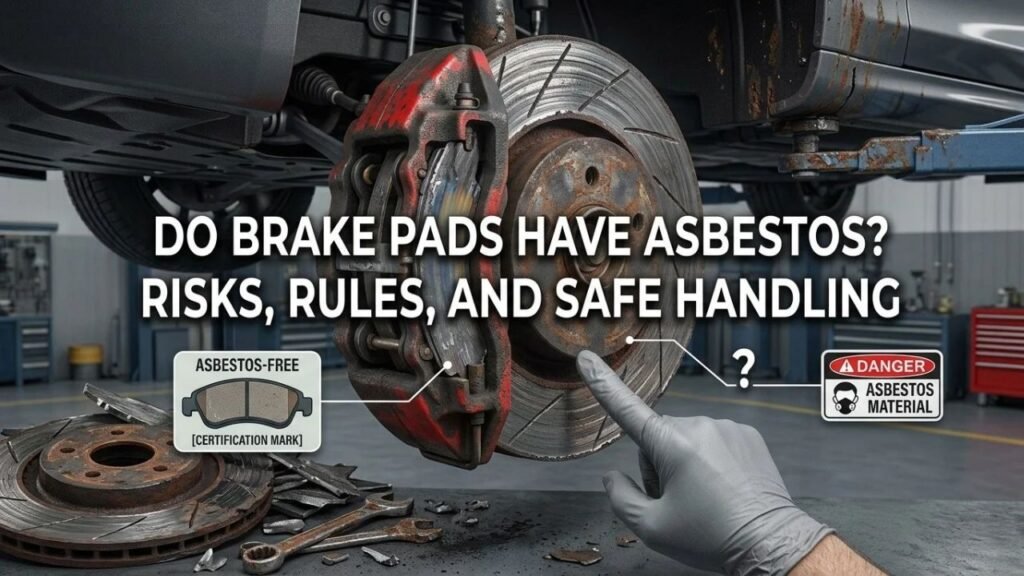
Modern replacement pads sold legally in the United States should no longer contain chrysotile asbestos. Older installed brake components are a different situation because many vehicles remain on the road for decades.
Modern Replacement Pads Should Be Asbestos-Free
The EPA’s 2024 chrysotile asbestos rule covered manufacture, import, processing, distribution, and commercial use of affected aftermarket automotive brakes and linings.
For this product category, the applicable prohibition date was November 25, 2024.
The automotive industry had already moved away from asbestos long before that federal deadline. EPA research found that asbestos had disappeared from virtually all brake assemblies in domestically sold new automobiles by around 2000.
Current branded replacement pads normally rely on ceramic compounds, metals, synthetic fibers, resins, graphite, fillers, and other non-asbestos friction materials.
Older Installed Brake Pads May Still Contain Asbestos
The 2024 rule did not require every brake component already installed on an older vehicle to be removed immediately.
That means an older car, classic vehicle, stored truck, restoration project, or vehicle with a poorly documented repair history may still contain a legacy asbestos friction part.
A pad installed years ago may continue to remain on the vehicle until normal replacement. This is one reason older brake work deserves more dust control than simply assuming every pad is asbestos-free.
Old Stock and Unknown Parts Need More Caution
Loose pads found in an old garage, shop inventory, parts collection, or vehicle trunk may not have enough documentation to identify their composition.
Packaging can provide clues, but an old box does not automatically prove the product is safe. Labels can be missing, faded, inaccurate, or separated from the original parts.
I would treat undocumented old friction components as uncertain rather than trying to identify them from color or texture.
Key Takeaway: Current U.S. replacement pads should be asbestos-free, but old installed parts and undocumented legacy stock may still contain asbestos.
Why Was Asbestos Used in Brake Pads?
Brake pads operate under repeated heat, pressure, vibration, and friction. Older friction-material designers needed ingredients that could tolerate those conditions without quickly breaking apart.
Asbestos Resists High Temperatures
Braking converts the vehicle’s motion into heat at the rotor and pad surface. Repeated braking can raise component temperatures substantially, especially on heavy vehicles, steep grades, or during frequent stops.
Asbestos fibers tolerate heat well. That made them attractive for older brake linings, clutch materials, and other friction products.
The fibers could remain structurally stable under temperatures that damaged many other materials available at the time.
Asbestos Reinforced the Friction Material
A brake pad is not made from one solid substance. Friction materials combine several ingredients that must remain bonded together while the pad repeatedly presses against the rotor.
Asbestos fibers provided reinforcement inside the compound. They helped the friction material resist cracking and mechanical breakdown while also contributing useful heat resistance.
This combination made asbestos common in older organic brake formulations.
Health Risks Drove the Move Away From Asbestos
The performance benefits did not remove the health hazard.
Brake wear and service work can release dust. If the friction material contains asbestos, that dust may include fibers small enough to become airborne and inhaled.
OSHA identifies brake and clutch repair as work where asbestos exposure can occur. Long-term asbestos exposure is associated with diseases such as mesothelioma, lung cancer, and asbestosis.
Manufacturers gradually moved to non-asbestos formulas as alternative friction materials became practical.
Key Takeaway: Asbestos was used because it handled heat and reinforced brake friction material, but inhalation risks drove the shift to safer substitutes.
How Can You Tell If Brake Pads Contain Asbestos?
You usually cannot confirm asbestos content by looking at a pad.
Two pads can have similar color, surface texture, dust, and backing plates while using very different friction-material recipes.
Check the Packaging and Manufacturer Information
For a replacement pad, start with the box, label, part number, manufacturer specifications, or safety data supplied with the product.
Terms such as asbestos-free, non-asbestos organic, or NAO directly indicate that asbestos is not part of the intended friction formulation.
A current branded product from a traceable U.S. seller presents far less uncertainty than an unmarked part found in old inventory.
Check the Vehicle’s Brake Service Records
Repair invoices can show when the pads were installed, which brand was used, and where the work was completed.
A vehicle documented as receiving modern branded pads recently is much easier to assess than a classic car with no brake-service records.
Vehicle model year by itself is not enough. A 1970s vehicle may have brand-new asbestos-free pads, while an old stored vehicle could still contain brake parts installed decades ago.
Do Not Rely on Color or Texture
Asbestos fibers cannot be reliably identified from the normal appearance of a brake pad.
Gray friction material does not prove asbestos content. A smooth pad does not prove it is asbestos-free. Dust color is not a dependable indicator either.
EPA guidance makes the same basic point: worn asbestos and non-asbestos brake components cannot be reliably distinguished by simple visual inspection.
Treat Unknown Older Parts as Suspect
If records, packaging, and manufacturer information cannot establish what an old pad contains, cautious handling is the safer choice.
That does not mean declaring every old pad asbestos-containing. It means avoiding actions that could spread dust until the material is identified or safely removed.
Key Takeaway: Documentation can identify many modern pads, but visual inspection cannot reliably prove that an unknown older brake pad contains no asbestos.
Is Brake Dust From Old Pads Dangerous?
Brake dust is produced as the pad and rotor wear. Modern asbestos-free systems still produce particulate matter, so brake dust should never be treated as clean household dust.
The added concern with an older asbestos-containing pad is the possibility of microscopic asbestos fibers being mixed into that dust.
Inhalation Is the Main Asbestos Concern
An asbestos-containing pad sitting untouched inside a brake assembly presents a different exposure situation from dust being blown, brushed, ground, or swept into the air.
The main concern is breathing airborne fibers.
Particles small enough to enter the lungs may not be visible. A lack of a visible dust cloud does not prove that the air contains no fine particles.
Compressed Air Can Spread Brake Dust
Using compressed air to blow dust from a caliper, rotor, drum, or backing plate can send settled material throughout the workspace.
EPA brake-service guidance specifically warns against using compressed air to clean brakes or clutches where asbestos may be present.
The same concern applies to aggressive dry brushing and sweeping.
Grinding or Sanding Old Pads Can Release More Particles
Grinding, drilling, sanding, cutting, or machining an unidentified friction material can disturb more of the pad than simple removal.
There is rarely a good reason for a home mechanic to grind an old pad to determine what it contains.
If an old part requires machining or specialized restoration, professional handling is the safer route.
Key Takeaway: The main risk from asbestos-containing brake pads comes from airborne fibers, so avoid any cleaning or machining method that throws old brake dust into the air.
How to Handle Old Brake Pads Safely
A brake job on a newer vehicle with traceable asbestos-free parts is different from opening the brakes on a decades-old vehicle with no repair history.
For uncertain older brakes, the main goal is to control dust.
Do Not Use Compressed Air
Do not blow the caliper, drum, backing plate, pads, or shoes clean with an air gun.
Compressed air can spread settled brake dust around the garage, onto clothing, and into the breathing zone.
This is one of the clearest precautions in EPA brake and clutch guidance.
Avoid Dry Brushing and Sweeping
A stiff dry brush can lift fine particles from brake components.
Dry sweeping can then move those particles across the floor and back into the air.
If suspected asbestos-containing dust has already spread through a work area, ordinary cleanup methods may make the problem worse.
Do Not Use an Ordinary Shop Vacuum
A normal wet/dry shop vacuum is not intended to control asbestos fibers unless it is specifically equipped and approved for that type of hazardous particulate collection.
EPA guidance refers to HEPA-filtered equipment and controlled cleaning practices for brake and clutch work where asbestos exposure may be possible.
A household vacuum or basic shop vacuum may exhaust fine dust back into the room.
Use Controlled Wet Cleaning Methods
EPA describes low-pressure wet cleaning and wet wiping as ways to reduce airborne brake dust.
The point is to keep particles damp and contained rather than blast them around the work area.
Do not create high-pressure spray that sends contaminated liquid or dust over surrounding surfaces.
Keep Work Dust Out of Living Areas
Clothing, shoes, rags, and tools used around old brake dust should not carry contamination into living spaces.
Wash hands and exposed skin after the work. Keep dirty work clothing separate from normal household laundry if asbestos exposure is suspected.
For an old vehicle with a completely unknown brake history, I would consider having a repair facility familiar with asbestos precautions do the work.
Key Takeaway: Avoid compressed air, dry brushing, sweeping, and ordinary shop vacuums around uncertain old brake dust; use controlled dust-suppression practices instead.
Do Ceramic, Semi-Metallic, and Organic Pads Have Asbestos?
Modern pad categories use different friction formulas, but current products sold legally in the United States should not rely on chrysotile asbestos.
Do Ceramic Brake Pads Have Asbestos?
Modern ceramic brake pads should be asbestos-free.
Ceramic formulations can include ceramic fibers or compounds, binders, friction modifiers, fillers, graphite, and small amounts of metallic material.
The exact recipe differs between manufacturers.
The word ceramic describes a broad friction-material category rather than one standardized mixture, so manufacturer specifications remain the best source for the exact composition of a given pad.
Do Semi-Metallic Brake Pads Have Asbestos?
Modern semi-metallic pads are normally asbestos-free.
Their friction material contains a substantial metallic component combined with binders, graphite, fillers, and other ingredients.
Metals may include steel, iron, and other metallic friction components chosen for heat transfer and braking characteristics.
An old unidentified pad that appears metallic should still not be declared asbestos-free based on appearance alone.
Do Organic Brake Pads Have Asbestos?
Modern non-asbestos organic pads, or NAO pads, are specifically formulated without asbestos.
They may use synthetic fibers, aramid-type fibers, carbon materials, rubber compounds, resins, fillers, and friction modifiers.
The term organic can create confusion because older organic-style brake friction materials once used asbestos. A current NAO label is far more informative than simply calling a pad “organic.”
Key Takeaway: Current ceramic, semi-metallic, and NAO pads should be asbestos-free, though old unidentified friction materials still deserve cautious handling.
Can Imported Brake Pads Contain Asbestos?
The EPA rule covers prohibited chrysotile asbestos uses in aftermarket automotive brakes and linings entering U.S. commerce.
That means legally imported current brake pads sold for the covered U.S. aftermarket use should comply with the federal restriction.
Normal U.S. Imports Must Follow EPA Rules
Importing a product does not create an exemption from U.S. chemical restrictions.
A reputable manufacturer or distributor selling pads into the U.S. market is expected to supply compliant products.
Buying from established suppliers also improves traceability if a material or labeling question appears later.
Unknown Online Parts Can Be Harder to Verify
A poorly documented product may create uncertainty even if the listing claims to be new.
Counterfeit packaging, old inventory, mislabeled parts, or products intended for another market can make composition harder to confirm.
For brakes, I prefer a traceable manufacturer and seller rather than an unknown bargain listing with little technical information.
Old Imported Stock May Predate Current Rules
Unused parts can sit on shelves for years.
A sealed package does not necessarily mean the product was recently manufactured. If the box is clearly old and the friction composition is not stated, check the manufacturer’s archived information or avoid disturbing the material unnecessarily.
Key Takeaway: Current legal U.S. imports must follow applicable asbestos restrictions, but old or poorly documented parts may require extra verification.
What About Asbestos Brake Pads on Classic Cars?
Classic vehicles create the greatest uncertainty because their repair histories can stretch across several decades.
The vehicle’s production year tells only part of the story.
Original Components May Still Be Present
A stored or low-mileage classic may retain very old friction components.
Even if a vehicle has been driven regularly, one axle may have received brake work at a different time from the other.
Restoration projects can also include boxes of spare parts accumulated by previous owners.
Period-Correct Replacement Parts May Be Old
Some restorers collect new-old-stock parts to maintain originality.
A part can be unused yet still come from an era when asbestos friction materials were available.
For brake components, unused does not automatically mean modern.
Restoration Work Can Disturb More Dust
Classic-car brake work may involve cleaning, stripping, rebuilding, or restoring components rather than simple pad replacement.
Those tasks create more chances to disturb old friction dust.
If the brake history is uncertain, dust control should begin before cleaning starts.
Key Takeaway: Classic cars and new-old-stock friction parts deserve extra caution because age, storage history, and previous repairs can make asbestos content difficult to verify.
Conclusion
For anyone asking do brake pads have asbestos, most current replacement pads in the United States should not. The remaining concern is older installed brake components, classic vehicles, old inventory, and undocumented friction parts that may predate current restrictions.
The EPA’s 2024 chrysotile asbestos rule prohibited the affected use in aftermarket automotive brakes and linings as of November 25, 2024. Previously installed brake components were not all forced off vehicles immediately, so old asbestos-containing parts can still appear during repair work.
The safest approach is simple: verify modern parts through packaging and manufacturer information, and do not judge old friction material by appearance. I would treat unknown older brake dust cautiously and avoid compressed air, dry brushing, unnecessary grinding, and other practices that can put fine particles into the air.
FAQs About Asbestos in Brake Pads
When Did Brake Pads Stop Using Asbestos in the United States?
There was no single industry-wide date when every manufacturer stopped. The shift happened over many years as automakers adopted other friction materials. EPA research reported that asbestos was absent from virtually all brake assemblies in domestically sold new automobiles by around 2000. The federal prohibition covering chrysotile asbestos in aftermarket automotive brakes and linings later took effect on November 25, 2024.
Can a Newer Car Still Have Asbestos Brake Pads?
A normal newer U.S. vehicle using current legal replacement pads should not have chrysotile asbestos pads. An unusual repair history can complicate the answer, such as an old stock part or an undocumented component installed years earlier. Recent branded replacement parts are far less likely to create this uncertainty.
Can I Identify Asbestos Brake Pads by Looking at Them?
No. Color, texture, dust level, backing-plate design, and surface appearance cannot reliably prove asbestos content. EPA guidance states that asbestos and non-asbestos brake components cannot be reliably separated by visual inspection alone. Manufacturer records or product documentation provide stronger evidence.
Is All Brake Dust Asbestos?
No. Modern asbestos-free pads still produce brake dust as friction material and rotor surfaces wear. Asbestos becomes a specific concern when an older or unidentified brake component may contain asbestos fibers. Brake dust still deserves careful handling even when asbestos is not present.
Should I Use Compressed Air to Clean Old Brakes?
No. EPA guidance advises against using compressed air on brake and clutch assemblies where asbestos may be present. Compressed air can spread settled particles through the work area and into the breathing zone. Controlled wet cleaning or other approved dust-control methods are safer.
Are Ceramic Brake Pads Asbestos-Free?
Modern ceramic pads sold legally in the United States should be asbestos-free. Their formulas generally use ceramic compounds, binders, fillers, graphite, friction modifiers, and other non-asbestos materials. Check the product manufacturer’s specifications if you need confirmation for a specific pad.
Are NAO Brake Pads Asbestos-Free?
Yes. NAO stands for non-asbestos organic, so asbestos is excluded from that friction-material category by definition. NAO pads may use synthetic fibers, resins, rubber compounds, carbon materials, fillers, and other ingredients to produce the required friction characteristics.
Are Old Brake Pads Dangerous to Remove?
They can present an exposure concern if their composition is unknown and dust is disturbed. Avoid compressed air, dry brushing, sanding, grinding, and ordinary vacuuming of suspected asbestos brake dust. If the brake system is very old or the work involves heavy contamination, professional service with proper dust-control equipment is the safer option.