How Long Will 5mm Brake Pads Last? Miles Left and When to Replace
At 5 mm of friction material, most passenger-car brake pads are worn but usually have some usable material left. A reasonable planning range is roughly 5,000 to 20,000 miles before reaching a common 3 mm replacement point, though city traffic, hills, towing, vehicle weight, and uneven wear can shorten that distance sharply.
The main mistake is treating pad thickness like a fuel gauge. Brake pads do not lose one millimeter after a fixed number of miles. One driver may take years to wear away the next 2 mm, while another can do it much sooner through frequent stop-and-go braking or mountain driving.
At 5 mm, replacing the pads immediately is not automatically required on every vehicle. The safer goal is to measure the pads periodically, compare them with the vehicle manufacturer’s service limit, and watch for uneven wear, noises, heat, or braking changes.
AAA Automotive reports that brake pads generally last around 30,000 to 80,000 miles, with driving habits playing a large part in lifespan. AAA guidance also states that pads around 3 mm thick are commonly at the point where replacement should be planned.
The question how long will 5mm brake pads last has no exact mileage answer because the 5 mm measurement tells you thickness, not the rate at which your vehicle consumes friction material. What matters more is how quickly those same pads dropped from their previous measured thickness.
What stood out to me during the research was the huge spread in mileage estimates published online. Some pages claim only a few thousand miles, while others claim tens of thousands. A calculation based on your vehicle’s actual wear history is far more useful than choosing one universal number.
The sections below explain what 5 mm means, a realistic mileage range, how to calculate remaining life from past measurements, when 5 mm pads should be replaced early, and how often to check them.
How Long Will 5mm Brake Pads Last in Miles?
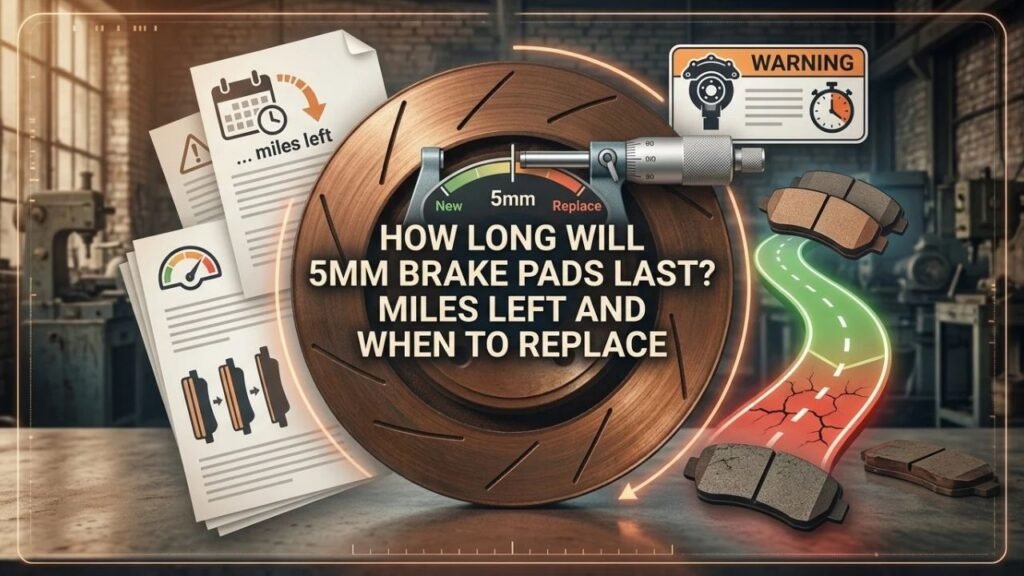
There is no manufacturer-approved mileage number that applies to every 5 mm brake pad. For many everyday passenger vehicles, about 5,000 to 20,000 miles is a practical planning range before the pads approach roughly 3 mm.
That range should be treated as an estimate, not a service interval. Some pads can cover more distance. Pads on a heavy SUV used in traffic or on steep roads may cover far less.
Why 5,000 to 20,000 Miles Is a Reasonable Estimate
Many new passenger-car pads start with roughly 10 to 12 mm of friction material, though the original thickness varies by vehicle and pad design.
If replacement is planned around 3 mm, a pad that measures 5 mm has around 2 mm of commonly usable material remaining before that point.
AAA gives a broad full-pad lifespan of about 30,000 to 80,000 miles. A 5 mm pad is already well through that usable thickness, so expecting another entire 30,000 to 80,000 miles would usually be unrealistic.
The remaining 2 mm might represent roughly a quarter of the pad’s original usable wear range on some applications. That produces a rough remaining-life estimate measured in thousands or tens of thousands of miles rather than another complete pad lifespan.
5 mm Does Not Mean 50% Life Remaining
A common assumption is that a pad that started near 10 mm and now measures 5 mm has exactly half its life left.
That calculation ignores the minimum usable thickness.
For example, suppose a new pad has 11 mm of friction material and you plan replacement at 3 mm:
- New thickness: 11 mm
- Replacement point: 3 mm
- Total usable wear: 8 mm
- Current thickness: 5 mm
- Remaining usable wear: 2 mm
Only 2 of the original 8 usable millimeters remain. By thickness alone, that is about 25% of the original usable wear range, not 50%.
Mileage still may not track that percentage perfectly because wear rate changes with driving conditions.
Your Previous Measurement Gives a Better Answer
If you have an older brake inspection report, use it.
Suppose your pads measured 7 mm at 50,000 miles and now measure 5 mm at 60,000 miles. They lost 2 mm over 10,000 miles.
That works out to approximately:
1 mm per 5,000 miles
If you plan replacement at 3 mm, another 2 mm remains.
At the same wear rate:
2 mm × 5,000 miles = about 10,000 miles remaining
That estimate is much more specific to your car than a generic mileage chart.
Key Takeaway: A 5 mm pad may have roughly 5,000 to 20,000 miles left in many situations, but measuring your vehicle’s past wear rate produces a far better estimate.
Is 5mm Brake Pad Thickness Safe?
In many passenger vehicles, 5 mm is still above the usual replacement zone. AAA guidance places roughly 3 mm at a common replacement point.
That does not make 5 mm a thickness you should ignore. The pads are already worn enough that inspection frequency should increase, especially before long trips or demanding driving.
What 5 mm Means Compared With Other Thicknesses
A simple thickness chart gives useful context:
| Friction Material | General Condition | Practical Action |
| 8 mm or more | Plenty of material on many pads | Continue normal inspections |
| 6–7 mm | Moderate wear | Monitor during routine service |
| 5 mm | Worn, usable on many vehicles | Start tracking wear more closely |
| 4 mm | Getting close to replacement | Plan service soon |
| 3 mm | Common replacement point | Replace based on vehicle specification |
| 2 mm or less | Very low material | Prompt replacement is usually needed |
These figures are general references. Your vehicle manufacturer’s service specification comes first.
Some brake systems use wear sensors or service limits that call for replacement at a different measurement.
Measure Friction Material, Not the Backing Plate
A brake pad includes a steel backing plate plus the friction material that presses against the rotor.
When discussing a 5 mm brake pad measurement, the useful number is normally the remaining friction material.
If someone measured the entire pad, including the backing plate, 5 mm would mean something very different and could indicate extremely low friction material.
Ask the shop or technician what exactly was measured if the inspection report is unclear.
Check the Thinnest Pad
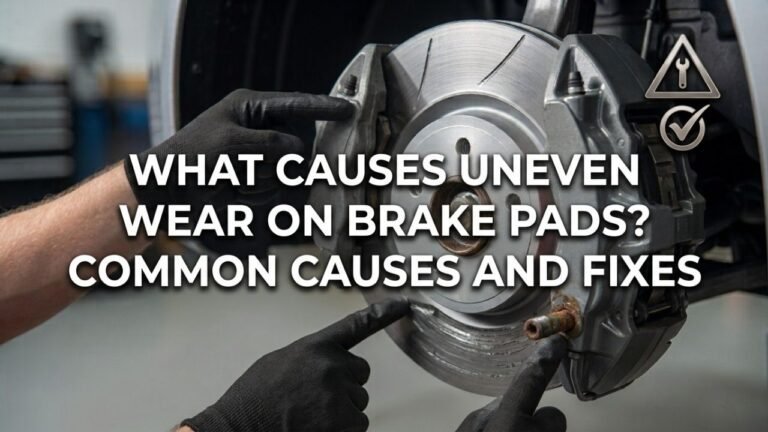
Disc brakes commonly have an inner and outer pad at each rotor. Those pads do not always wear at the same rate.
A caliper problem, sticking guide pin, rusted hardware, or binding pad can cause one pad to become much thinner than the one visible through the wheel.
AAA recommends inspecting both inner and outer pads because wear can differ across the brake assembly.
If one pad measures 5 mm but its partner measures 2 or 3 mm, the thinner measurement should drive the service decision.
Key Takeaway: Five millimeters is usually usable, but the vehicle’s service limit and the thinnest pad matter more than one isolated measurement.
What Determines How Long 5mm Brake Pads Last?
Brake-pad wear comes from friction and heat every time the vehicle slows. The amount of remaining mileage changes with how often the brakes work and how much energy they must absorb.
City Driving vs. Highway Driving
Stop-and-go traffic consumes pads faster because the brakes are applied repeatedly.
A highway vehicle may travel many miles while using the brakes only a few times. A city vehicle can make dozens of stops over a short distance.
AAA states that drivers who apply the brakes frequently wear pads faster than drivers whose driving involves fewer brake applications.
This means two cars with identical 5 mm pads can have very different remaining mileage.
Hills, Mountain Roads, and Towing
Descending long grades requires brakes to convert a large amount of vehicle energy into heat.
Towing adds mass, so the brakes have more weight to slow. The same principle applies to a vehicle regularly carrying heavy cargo.
Frequent downhill braking, towing, or heavy loading can eat through the remaining 2 mm much faster than relaxed driving on flat roads.
Hard Braking and Following Distance
Drivers who brake late and hard create more heat at the pad and rotor than drivers who anticipate stops and slow gradually.
Hard braking is sometimes unavoidable. Repeated aggressive braking as a normal driving habit raises pad wear.
Leaving enough following distance also reduces the need for repeated sharp brake applications.
Vehicle Weight and Brake Design
A compact sedan and a three-row SUV do not place the same demands on their braking systems.
Manufacturers size brakes around vehicle weight and performance, so larger vehicles may also use larger pads and rotors. Even so, vehicle mass remains part of the wear equation.
Performance cars can also consume pads quickly because their brakes may be used at higher speeds and temperatures.
Front vs. Rear Brake Pads
Front brakes often perform a larger share of braking because vehicle weight shifts toward the front axle during deceleration.
That is why front pads commonly wear faster on many cars.
Modern stability-control systems, electronic brake distribution, regenerative braking, rear brake designs, and driving conditions can change that pattern. Do not assume the front pads will always wear first.
Caliper and Rotor Condition
Mechanical problems can destroy a mileage estimate.
A sticking caliper piston or guide pin may keep one pad touching the rotor after the pedal is released. That pad can wear rapidly and create excess heat.
AAA notes that uneven pad wear can point to sticking or binding calipers.
A 5 mm measurement should therefore be considered alongside pad wear pattern, rotor condition, and free caliper movement.
Pad Material
Ceramic, semi-metallic, and organic pads have different wear characteristics.
Pad compound is only one part of the equation. A long-life compound used in harsh traffic may still wear faster than another compound used primarily on open highways.
I would not estimate remaining mileage from pad material alone.
Key Takeaway: Traffic, hills, towing, driver behavior, vehicle weight, pad position, and brake condition can change the remaining life of a 5 mm pad by thousands of miles.
How to Estimate the Remaining Life of 5mm Brake Pads
The best estimate comes from comparing two thickness measurements taken a known number of miles apart.
This creates a wear rate for your vehicle, driving style, and brake setup.
Step 1: Find an Earlier Pad Measurement
Look through recent service invoices or inspection reports.
You need:
- Previous pad thickness
- Current pad thickness
- Mileage at both inspections
- The same axle measured both times
Try to confirm that both measurements refer to friction material rather than total pad thickness.
Step 2: Calculate Millimeters Worn
Subtract the current measurement from the older one.
Example:
Previous measurement: 8 mm
Current measurement: 5 mm
Material used: 3 mm
Step 3: Calculate Miles Per Millimeter
Suppose the vehicle traveled 18,000 miles while the pads dropped from 8 mm to 5 mm.
Divide mileage by the material worn:
18,000 ÷ 3 = 6,000 miles per mm
Your recent wear rate is approximately 6,000 miles for each millimeter.
Step 4: Choose the Correct Replacement Point
Check the service information for the vehicle.
If the manufacturer’s limit or your chosen service point is 3 mm, a 5 mm pad has 2 mm left before reaching that measurement.
AAA commonly points to about 3 mm as replacement territory.
Step 5: Estimate Remaining Mileage
Using the example above:
2 mm remaining × 6,000 miles per mm = about 12,000 miles
That does not guarantee another 12,000 miles. Your future driving may involve different roads, loads, weather, or braking frequency.
I would use the figure as a planning estimate and inspect the pads again well before reaching it.
Example Wear Estimates
| Previous Wear History | Estimated Miles per 1 mm | Approx. Miles From 5 mm to 3 mm |
| 2 mm worn in 6,000 miles | 3,000 | 6,000 |
| 2 mm worn in 10,000 miles | 5,000 | 10,000 |
| 2 mm worn in 16,000 miles | 8,000 | 16,000 |
| 2 mm worn in 20,000 miles | 10,000 | 20,000 |
This method assumes future wear resembles recent wear. Mechanical faults can make the estimate inaccurate very quickly.
Key Takeaway: Divide the miles driven between two inspections by the millimeters lost, then multiply that wear rate by the usable thickness remaining.
When Should You Replace 5mm Brake Pads Early?
Thickness is only one reason to replace a brake pad. A pad can still measure 5 mm and need service because of damage, contamination, abnormal wear, or another brake-system problem.
One Pad Is Much Thinner Than the Others
Uneven wear deserves attention even if one visible pad still measures 5 mm.
For example, an outside pad may have 5 mm while the hidden inside pad has 2 mm. The brake assembly is then near or beyond the normal service point despite the reassuring outer-pad measurement.
Uneven wear can point to caliper, guide-pin, bracket, or hardware trouble.
The Wear Indicator Is Active
Many pads have a metal wear tab that produces a squealing sound as the pad approaches its service point. Other vehicles use an electronic sensor and dashboard warning.
Do not ignore a wear warning simply because a previous inspection showed 5 mm. Measurements can be old, taken from another pad, or affected by uneven wear.
Firestone describes wear indicators as a warning that pad replacement is approaching and advises against delaying service until the friction material is exhausted.
You Hear Grinding
Grinding during braking is different from a normal wear-indicator squeal.
It can mean the friction material has worn through and metal is contacting the rotor.
A pad that truly has 5 mm of good friction material should not normally produce metal-on-metal grinding. If you hear grinding, get the brakes inspected rather than assuming the old thickness measurement is still accurate.
The Vehicle Pulls or One Wheel Runs Hot
Pulling during braking, a burning smell, or one wheel becoming much hotter than the others may indicate a dragging or sticking brake.
A dragging pad can lose material much faster than your previous wear history predicts.
A Long Trip Is Coming Soon
Five millimeters does not automatically require replacement before every road trip.
A pre-trip inspection makes sense if the pads are already at 5 mm, especially before mountain travel, towing, or a trip that will add several thousand miles.
The goal is to confirm the thinnest pad measurement and make sure the calipers, rotors, and hardware are in good condition.
Key Takeaway: Replace or inspect 5 mm pads sooner if wear is uneven, a warning activates, grinding starts, the brakes drag, or demanding travel is coming up.
How Often Should 5mm Brake Pads Be Rechecked?
Once the pads reach 5 mm, I would stop treating them as a part that can be ignored until the next distant service.
A good approach is to inspect them during upcoming tire rotations, oil-service visits, or other maintenance where brake access is practical.
AAA recommends brake-pad checks every 12,000 to 15,000 miles or during tire rotations as a general maintenance practice. Pads already at 5 mm may justify checking sooner if your driving produces rapid wear.
If you know that your pads lose about 1 mm every 4,000 miles, waiting another 12,000 miles would make little sense. Your personal wear rate should set the recheck interval.
Measure all pads on the axle when possible. One easy-to-see outer pad does not tell you how much material remains on the inner pad.
Should You Replace Brake Pads at 5mm?
Not automatically.
If all pads on the axle are wearing evenly, braking feels normal, no wear warning is active, and the manufacturer permits further use, 5 mm commonly leaves some service life.
Replacement at 5 mm can still make practical sense in certain situations. You may be preparing for a long trip, paying labor to access the brakes for another repair, or driving in conditions that produce fast wear.
Some brake manufacturers and service providers also use more conservative replacement recommendations than others. This is why the factory service information for the specific vehicle should settle the minimum thickness question.
I would treat 5 mm as a planning point, not a reason to panic and not a reason to forget about the brakes.
Conclusion
How long will 5mm brake pads last depends far more on the wear rate than the thickness measurement alone. For many passenger vehicles, roughly 5,000 to 20,000 additional miles is a reasonable planning estimate before reaching around 3 mm, but that range is not a guaranteed service life.
The better method is to compare the current 5 mm reading with an earlier inspection. Calculate how many miles it took to lose each millimeter, then estimate how long the remaining usable material may last.
Check the manufacturer’s service limit and inspect all pads on the axle. If wear is uneven, the brakes grind, a wear warning appears, a wheel runs hot, or braking behavior changes, do not wait for the thickness to reach a particular number.
My preference is to start planning brake service at 5 mm and use actual measurements to decide the timing. That approach gives you a clearer answer than trying to assign one fixed mileage figure to every car.
FAQs About 5mm Brake Pad Life
Are 5mm brake pads still good?
In many passenger vehicles, yes. Five millimeters of friction material is commonly above the usual replacement range of roughly 3 mm. The pads are still worn enough that they should be monitored. Check the manufacturer’s specification and make sure every pad on the axle is wearing evenly.
How long will 5mm front brake pads last?
A rough estimate is around 5,000 to 20,000 miles, but front pads can wear faster than rear pads because the front axle commonly handles more braking load. City traffic, heavy vehicles, hard stops, hills, and a sticking caliper may cut that estimate substantially. Previous thickness measurements give a better prediction.
How long will 5mm rear brake pads last?
Rear pads may last longer than front pads on many vehicles, so 5 mm could remain usable for many thousands of miles. Modern brake-balance and stability systems can produce different rear-pad wear patterns. Calculate the rear pads’ own wear rate instead of estimating from the front brakes.
Should I replace brake pads at 5mm or 3mm?
Five millimeters is usually a point to monitor and plan service, while roughly 3 mm is a common replacement point. The exact limit is vehicle-specific. Replace sooner if a pad is damaged, contaminated, wearing unevenly, or causing braking symptoms.
Can 5mm brake pads last another 10,000 miles?
Yes, they may. Ten thousand miles is plausible if your pads have historically worn at about 1 mm per 5,000 miles and you plan replacement at 3 mm. That does not guarantee the result. Driving conditions and mechanical problems can change the wear rate.
Is 4mm of brake pad thickness still safe?
Four millimeters is commonly close to the replacement zone. It may still be above the manufacturer’s minimum, but there is less material left than at 5 mm. Plan replacement and monitor thickness rather than assuming a fixed amount of mileage remains.
How many miles does 1mm of brake pad last?
There is no universal mileage per millimeter. On one vehicle, 1 mm may disappear in a few thousand miles; another vehicle may take much longer. Calculate your rate by dividing the miles driven between two inspections by the amount of pad material lost.
Should both sides be replaced if only one pad is at 5mm?
Brake pads are generally replaced as an axle set rather than changing a single pad. If one side or one pad is wearing much faster, inspect the caliper, guide pins, hardware, and rotor for the cause before installing new pads.